











 Secure payments
Standard refund policy
Trade Assurance
Secure payments
Standard refund policy
Trade Assurance
| Product Type | Memory Module |
|---|---|
| Compliance Standards | RoHS |
| Memory Capacity | 8 GB |
| Memory Technology | DDR3 |
| Product Voltage | 1.35V |
| RAM Speed | 1600MHz |
| RAM Standard | DDR3-1600/PC3-12800 |
| Error Identifying | ECC |
| Signal Type | Registered |
| Column Access Strobe (CAS) | CL11 |
| Rank | Single Rank x4 |
| Quantity of Pins | 240-pin |
| RAM Genre | RDIMM |
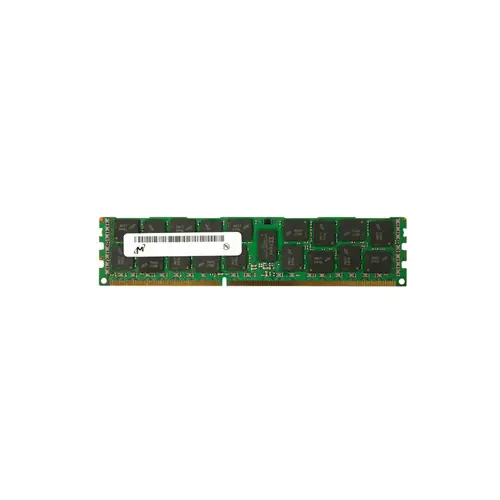
This 8GB DDR3-1600 registered ECC RDIMM is purpose-built for legacy server and workstation platforms handling critical workloads such as virtualization, in-memory databases, and enterprise data processing. Its single-rank x4 configuration and registered signaling reduce bus loading and electrical noise, enhancing signal integrity and long-term reliability in dense, multi-DIMM deployments while integrated ECC actively corrects single-bit errors to protect data integrity.
1. Error-correcting code protection eliminates single-bit memory errors silently corrupting data, a foundational safeguard for transaction integrity in financial and database servers.
2. Registered buffering decouples the memory controller from direct DRAM loading, preserving signal quality across fully populated channels and ensuring stable operation under heavy virtualization.
3. This module density provides an optimal balance between cost and capacity, allowing service providers to allocate adequate memory per virtual machine without stranding resources in multi-tenant hosting nodes.
4. The data rate supplies sufficient throughput to keep modern CPU cores fed, preventing bandwidth starvation during concurrent in-memory analytics and caching workloads.
5. Low-voltage operation reduces overall rack-level power draw and cooling demands, translating directly into lower operational expenditure for hyperscale and edge server deployments.
Based on its registered DIMM form factor, 240-pin layout, and integrated ECC, this 8 GB DDR3 module is purpose‑built for servers and workstations. In real‑world deployments, its four signature capabilities translate directly into uptime and efficiency. First, ECC error correction continuously detects and corrects single‑bit memory faults, eliminating the silent data corruption that can crash a hypervisor or poison a financial database. Second, the registered buffer re‑drives address and command signals, so you can populate all 24 DIMM slots without signal degradation—a non‑negotiable requirement when scaling a virtualization cluster to host dozens of VMs on one node. Third, operating at just 1.35 V, the low‑voltage DDR3L design slashes power draw and cooling costs across a rack filled with always‑on servers, lowering total cost of ownership. Fourth, the single‑rank x4 organization running at 1600 MHz with CL11 delivers consistent, low‑latency access patterns. For in‑memory databases like Redis or SAP HANA, this means predictable sub‑microsecond responses even under heavy thread contention, keeping transactional throughput high when every millisecond impacts revenue.
General Virtualization
For a typical virtualization host running multiple VMs, aggregate memory capacity and stability are paramount. Install a minimum of eight of these 8 GB RDIMMs (64 GB total) evenly across all memory channels to maintain balanced access while leveraging ECC to guard against data corruption. If the platform supports two DIMMs per channel, a 16-module configuration (128 GB) is recommended to host more VMs without swapping.
In-Memory Database
In-memory databases demand the largest possible RAM footprint with reliable data integrity. Populate every available DIMM slot with this 8 GB RDIMM to maximise capacity—common 24-slot servers reach 192 GB. The module’s ECC and registered design ensure stable operation under heavy, sustained loads, reducing the risk of silent data errors that could compromise database consistency.
High Performance Computing
HPC workloads benefit from high sustained memory bandwidth as much as raw capacity. Configure identical DIMMs across all channels, typically one 8 GB RDIMM per channel, to enable symmetric multi-channel interleaving. For dual-socket nodes, populate each CPU’s memory controller in a balanced 8- or 16-DIMM arrangement, ensuring that the low-voltage 1.35 V operation helps contain power consumption in dense compute clusters.
Server-grade, rigorously tested compatibility. Fits Dell PowerEdge R720/R620, HP ProLiant DL380p Gen8, IBM System x3650 M4, and more.
Q: Can I mix this MT18KSF1G72PZ-1G6E1KE with other memory modules of different brands or speeds?
A: Mixing RDIMMs from different vendors or speeds is not recommended. The system defaults to the slowest module's timings and may face stability issues in Enterprise environments. Always populate identical modules per channel for validated reliability.
Q: Is this memory compatible with my system?
A: This 8GB DDR3-1600 Registered ECC DIMM is designed for servers using Intel Xeon E5/E5 v2 or AMD Opteron 6300/4300 platforms. Verify your board supports 1.35V RDIMMs with 240-pin configuration and a maximum CAS latency of CL11.
Q: What is the recommended DIMM population order for optimal performance?
A: For this Single Rank x4 RDIMM, populate identical modules per channel starting with the slots farthest from the CPU. Follow the platform's specific memory population guide, often one DIMM per channel first to maximize interleaving and bandwidth.
Q: Does this module support overclocking or XMP profiles?
A: No. This is an enterprise-grade Registered ECC module operating strictly to JEDEC DDR3-1600/PC3-12800 standards. Overclocking or XMP profiles are not supported, as stability and data integrity are prioritized over experimental clock rates in server environments.
Q: What warranty and typical failure rate can I expect?
A: It includes a one-year warranty covering manufacturing defects. Typical enterprise RDIMM annualized failure rate is under 0.5%. Actual longevity depends on adequate cooling, ambient temperature, and stable power delivery within server specifications.