











 Secure payments
Standard refund policy
Trade Assurance
Secure payments
Standard refund policy
Trade Assurance
| Product Type | Memory Module |
|---|---|
| Compliance Standards | RoHS |
| Memory Capacity | 8 GB |
| Memory Technology | DDR3 |
| Product Voltage | 1.35V |
| RAM Speed | 1600MHz |
| RAM Standard | DDR3-1600/PC3-12800 |
| Error Identifying | ECC |
| Signal Type | Registered |
| Column Access Strobe (CAS) | CL11 |
| Rank | Dual Rank x4 |
| Quantity of Pins | 240-pin |
| RAM Genre | RDIMM |
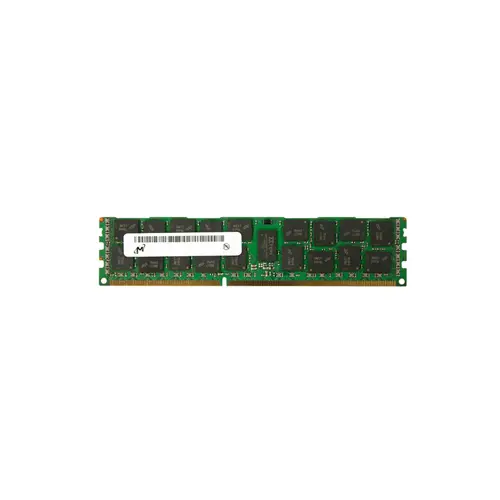
This 8GB DDR3-1600 Registered ECC DIMM with dual-rank x4 organization is purpose-built for server platforms, where the combination of error correction and registered signaling ensures robust data integrity and signal stability under fully populated memory configurations. The 1.35V low-voltage operation and dual-rank architecture make it an ideal, energy-efficient choice for mid-range virtualization hosts and memory-intensive database workloads that require reliable throughput at moderate capacity.
1. ECC memory actively detects and corrects single-bit errors, preventing silent data corruption in financial transactions or database queries that demand absolute integrity.
2. Registered signal type buffers command and address lines, enabling stable operation when populating numerous DIMMs per server to maximize virtualization density.
3. Dual Rank x4 organization interleaves memory accesses across more banks, sustaining high throughput under the concurrent workloads typical of multi-tenant cloud hosts.
4. Operating at a low 1.35V reduces overall power consumption in dense rack deployments, lowering cooling overhead without compromising clock speed.
5. The DDR3-1600 data rate delivers sufficient bandwidth to keep multiple processor cores fed, avoiding memory bottlenecks during heavy in-memory analytics.
In your data centre, the MT36KSF1G72PZ-1G6K1FG DDR3L RDIMM transforms four features into tangible uptime and savings. ECC protection continuously corrects single-bit errors that cosmic radiation or electrical noise can trigger; for an in-memory database like Redis or SAP HANA, this prevents silent data corruption that would otherwise poison transactions and crash financial services. Registered logic buffers re-drive address and command signals, enabling densely populated memory channels to run stable—this lets your virtualization cluster pack more VMs onto each host without risking signal integrity or costly downtime. Dual-rank interleaving accelerates data throughput by overlapping internal accesses, which is crucial when concurrent database queries and hypervisor operations demand peak bandwidth under load. Finally, the 1.35V low-voltage specification slashes power consumption at scale: in a rack full of nodes, the reduced thermal output directly lowers cooling costs and extends component life. From keeping records accurate to maximizing VM density, each characteristic of this 8GB module works to protect your operations and your budget.
General Virtualization
For general virtualization, balance capacity and redundancy by fully populating all memory channels with these 8 GB ECC RDIMMs. A typical dual‑socket host using six modules per CPU (48 GB per socket, 96 GB total) provides ample headroom for dozens of VMs while maintaining symmetrical channel interleaving for optimal throughput. Enable memory sparing or mirroring in the BIOS to add resilience for mission‑critical guests.
In‑Memory Database
In‑memory databases require maximum capacity and absolute data integrity. Fill all available DIMM slots with these registered 8 GB modules—for example, 16 modules in a dual‑socket server to reach 128 GB—leveraging the RDIMM’s ability to support high‑density configurations. Use identical, ECC‑protected sticks and configure memory interleaving; the 1.35 V low‑voltage operation also helps control power and heat in dense deployments.
High‑Performance Computing (HPC)
HPC workloads thrive on bandwidth and balanced channel population. Start with one DIMM per channel (1DPC) using these 8 GB RDIMMs—four modules per quad‑channel CPU for 32 GB—to run at the full 1600 MT/s speed without derating. If capacity‑bound codes need more memory, move to two DIMMs per channel while monitoring any frequency step‑down, but always keep all channels populated identically to sustain peak aggregate bandwidth.
Tested for server reliability. Compatible with Dell PowerEdge R720, HP DL380p Gen8, Lenovo ThinkServer RD430, and more.
Q: Can I mix this MT36KSF1G72PZ-1G6K1FG with other memory modules of different brands or speeds?
A: Mixing is not recommended. This RDIMM requires identical registered ECC modules to maintain signal integrity. Combining different brands, speeds, or non-ECC UDIMMs can cause system instability or failure to POST on server boards.
Q: Is this memory compatible with my system?
A: It is compatible with servers using Intel Xeon E5-2600 v2 or AMD Opteron 6300 series platforms and later DDR3-based boards. Verify your server requires 1.35V or 1.5V dual-rank registered ECC DDR3-1600 modules with a 240-pin socket.
Q: What is the recommended DIMM population order for optimal performance?
A: Populate identical modules per channel, starting with the farthest slot from the CPU. For dual-processor systems, balance DIMMs equally across both memory risers. Always follow your server-specific manual for mirrored or rank interleaving guidelines.
Q: Does this module support overclocking or XMP profiles?
A: No. This enterprise-grade RDIMM adheres to JEDEC DDR3-1600/PC3-12800 standard timings at CL11. It does not support XMP or overclocking, as stability and error correction take priority in server environments.
Q: What warranty and typical failure rate can I expect?
A: This Micron memory carries a 1-year warranty. Being an enterprise RDIMM with built-in ECC, it demonstrates an extremely low annualized failure rate (AFR) under 0.5%, ensuring reliable 24/7 operation in temperature-controlled datacenters.