











 Secure payments
Standard refund policy
Trade Assurance
Secure payments
Standard refund policy
Trade Assurance
| Product Type | Memory Module |
|---|---|
| Compliance Standards | RoHS |
| Memory Capacity | 8 GB |
| Memory Technology | DDR3 |
| Product Voltage | 1.5V |
| RAM Speed | 1600MHz |
| RAM Standard | DDR3-1600/PC3-12800 |
| Error Identifying | ECC |
| Signal Type | Registered |
| Column Access Strobe (CAS) | CL11 |
| Rank | Single Rank x4 |
| Quantity of Pins | 240-pin |
| RAM Genre | RDIMM |
This DDR3-1600 Registered ECC RDIMM is purpose-built for legacy server platforms requiring robust data integrity, making it ideal for virtualization hosts and memory-intensive database applications where uptime and reliability are critical. Its registered signal type ensures stable operation across fully populated memory channels, while the ECC and single-rank x4 configuration provide error correction and reduced electrical loading for consistent performance under sustained workloads.
1. Error correction across every data block eliminates silent memory faults, preserving transactional consistency for financial ledgers and patient records around the clock.
2. Registered buffering strengthens signal integrity on high-density boards, allowing IT architects to scale system memory without compromising command stability across multiple DIMMs.
3. The x4 chip arrangement provides granular per-chip error resilience, enabling servers to survive an entire DRAM failure and sustain operation in always-on service tiers.
4. An eight-gigabyte footprint supplies ample space for moderate virtualization nodes, keeping container and hypervisor overhead balanced while avoiding stranded capacity.
5. Elevated transfer speed reduces data fetch stall cycles under parallel query engines, delivering snappier response times for OLAP and mid-tier database workloads.
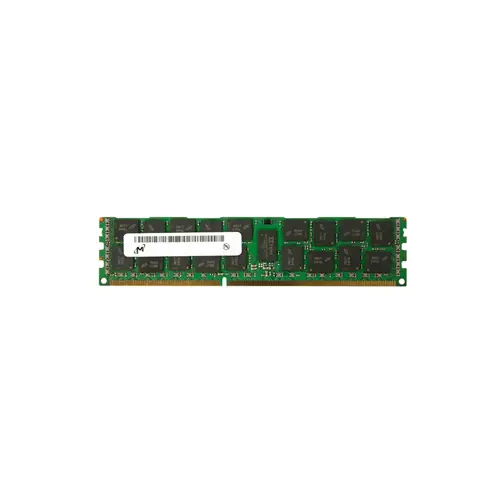
The Micron MT18JSF1G72PZ-1G6E1FG is an 8 GB DDR3-1600 Registered DIMM with ECC, designed specifically for server environments where data integrity and system stability under heavy loads are non-negotiable. Its ECC technology actively detects and corrects single-bit memory errors—a critical safeguard against silent data corruption caused by cosmic radiation or electrical noise. In a virtualized cluster hosting multiple mission-critical VMs, a single uncorrected bit flip can crash an entire host, cascading into downtime that costs thousands per minute. The registered signal buffer is equally vital: by re-driving address and command signals, it stabilizes communication between the memory controller and DRAM chips when populating all memory channels. This allows a database server running an in-memory analytics platform like SAP HANA to scale to hundreds of gigabytes without signal degradation, ensuring consistent low-latency access to large datasets. Running at 1600 MHz with a single-rank x4 organization, this module balances bandwidth and reduced electrical loading, enabling denser configurations that sustain high transaction throughput during peak loads. Together, these characteristics transform raw capacity into reliable, enterprise-grade performance where every bit matters.
General Virtualization
For virtualization, place one 8 GB RDIMM in each memory channel. A dual-socket host with three channels per CPU provides 48 GB, sufficient for moderate VM density. The single-rank construction keeps electrical loading low; adding a second identical DIMM per channel for 96 GB often retains full 1600 MT/s operation, enabling flexible scaling.
In-Memory Database
Achieve maximum in-memory capacity by fully populating all DIMM slots. A 24-slot server equipped with these 8 GB RDIMMs delivers 192 GB of ECC-protected memory. Install two DIMMs per channel to ensure symmetric interleaving, which helps maintain low latency under heavy read/write workloads.
High-Performance Computing
For bandwidth-sensitive HPC, install exactly one DIMM per memory channel to run at the full 1600 MT/s speed. On a dual-socket node with eight channels, eight modules provide 64 GB of high-bandwidth RAM. If larger working sets are required, you may populate a second DIMM per channel, but validate whether the platform down-clocks memory frequency.
Rigorously tested server memory, compatible with Dell PowerEdge R720, HP ProLiant DL380p Gen8, Lenovo ThinkServer RD630, Supermicro X9.
Q: Can I mix this MT18JSF1G72PZ-1G6E1FG with other memory modules of different brands or speeds?
A: Mixing RDIMMs from different vendors or with different speeds is not recommended. All installed modules should match in speed, rank, and timing to ensure reliable ECC operation and prevent POST or stability issues.
Q: Is this memory compatible with my system?
A: This 8GB DDR3-1600 ECC Registered DIMM requires a server platform, typically Intel Xeon E5/E5 v2 or AMD Opteron G34/C32 series. Verify that your board supports 1.5V RDIMMs with 240-pin slots, PC3-12800, and single-rank x4 configuration.
Q: What is the recommended DIMM population order for optimal performance?
A: For single-rank x4 RDIMMs, populate identical modules in sets of three or four per memory channel, respecting the server board’s slot numbering. Always balance across channels to maximize interleaving and maintain correct ECC mirroring.
Q: Does this module support overclocking or XMP profiles?
A: No, this ECC Registered server memory does not support overclocking or XMP. It adheres strictly to JEDEC DDR3-1600 specifications (CL11, PC3-12800) to guarantee signal integrity and error correction in mission-critical environments.
Q: What warranty and typical failure rate can I expect?
A: This Micron module comes with a 1-year warranty. Actual failure rates for ECC RDIMMs are very low (AFR well below 1% annually) under specified operating conditions, backed by extensive manufacturer testing and screening.