











 Secure payments
Standard refund policy
Trade Assurance
Secure payments
Standard refund policy
Trade Assurance
| Product Type | Memory Module |
|---|---|
| Compliance Standards | RoHS |
| Memory Capacity | 8 GB |
| Memory Technology | DDR3 |
| Product Voltage | 1.5V |
| RAM Speed | 1600MHz |
| RAM Standard | DDR3-1600/PC3-12800 |
| Error Identifying | ECC |
| Signal Type | Registered |
| Column Access Strobe (CAS) | CL11 |
| Rank | Single Rank x4 |
| Quantity of Pins | 240-pin |
| RAM Genre | RDIMM |
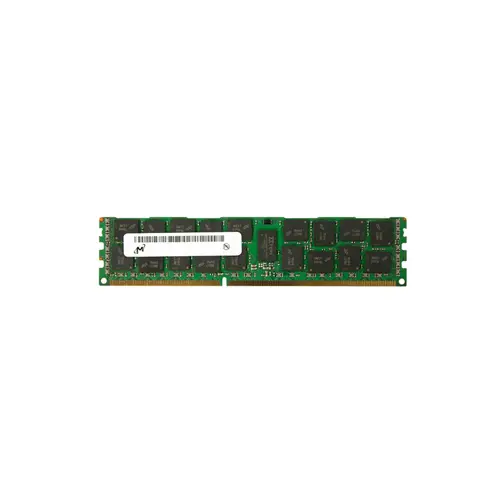
This 8GB DDR3-1600 RDIMM with ECC and a single-rank x4 organization is purpose-built for server platforms, delivering the data integrity and reliability essential for virtualization, in-memory databases, and mission-critical workloads. The registered signal type stabilizes high-capacity memory configurations, while the single-rank design reduces bus loading to enable consistent 1600 MHz operation under sustained access.
1. Registered DIMM architecture decouples the memory bus from DRAM loads, ensuring stable signal integrity when populating multiple slots in dense server racks.
2. ECC memory actively detects and corrects single-bit errors, safeguarding transactional data integrity for mission-critical server applications running nonstop.
3. Single Rank x4 organization optimizes channel bandwidth utilization, delivering predictable memory throughput under heavy virtualization and container sprawl.
4. DDR3-1600 speed supplies a dependable 12.8 GB/s peak bandwidth per channel, keeping database response times low during high-concurrency query bursts.
5. An 8 GB capacity per stick allows granular memory scaling in scale-out clusters, right-sizing VM density while minimizing idle power draw.
The Micron MT18JSF1G72PZ-1G6E1HF is an 8GB DDR3-1600 Registered DIMM with ECC, purpose-built for server environments where reliability is not a luxury but a foundation. When you operate a virtualization cluster hosting dozens of virtual machines, silent data corruption is the enemy. ECC memory actively detects and corrects single-bit errors caused by cosmic rays or electrical interference, preventing a flipped bit from crashing a critical guest or silently corrupting transactional data overnight. Meanwhile, the registered signal buffer stabilizes the command and address lines, allowing this module to coexist reliably in high-density configurations with multiple DIMMs per channel—essential as you scale memory capacity for growing workloads without sacrificing signal integrity. In an in-memory database like Redis or SAP HANA, the single-rank x4 organization and 1600MHz speed enable predictable, low-latency access to hot datasets, accelerating real-time analytics and financial transactions. This combination of ECC protection, registered buffering, and consistent bandwidth means reduced downtime, safeguarded data consistency, and the headroom to confidently consolidate services onto fewer physical servers.
General Virtualization
For a typical virtualization host running multiple VMs, install at least four of these 8GB RDIMMs to reach 32GB, populating one DIMM per channel in a quad-channel platform for balanced performance. To support higher VM density, scale to six or eight modules (48–64GB), ensuring identical ranks and speeds across all populated channels to maintain memory interleaving and consistent latency.
In-Memory Database
In-memory databases like Redis or SAP HANA demand large, contiguous memory spaces and maximum throughput. Populate all memory channels symmetrically with six or eight of these single-rank x4 Registered DIMMs, leveraging their ECC protection to guard against silent data corruption. This configuration delivers the maximum bandwidth and capacity a three-channel or four-channel server board can provide while keeping latency predictable under heavy load.
High-Performance Computing (HPC)
HPC clusters benefit from the high reliability of ECC Registered memory during week-long simulation runs. Deploy these 8GB modules in full channel-interleaved sets—typically six or twelve DIMMs per node—to maximize bandwidth for memory-bound scientific workloads. It is advisable to avoid mixing ranks within a channel and to tune CAS 11 timings in the BIOS to squeeze out marginal improvements in iterative computational kernels.
Rigorously tested for Dell R720/R620, HP DL380p Gen8, IBM x3650 M4, and more.
Q: Can I mix this MT18JSF1G72PZ-1G6E1HF with other memory modules of different brands or speeds?
A: Mixing is not recommended for server environments. Registered ECC modules must match in rank, speed, and timings to ensure signal integrity and prevent system instability or POST failures.
Q: Is this memory compatible with my system?
A: This RDIMM is designed for dual-socket Intel Xeon E5/E5v2 or AMD Opteron 6300 series platforms supporting DDR3-1600 registered ECC memory. Verify your server board's qualified vendor list for 240-pin RDIMMs.
Q: What is the recommended DIMM population order for optimal performance?
A: Populate identical DIMMs per channel, starting with the slots furthest from the CPU. For a single rank x4 RDIMM, balanced 1 DIMM per channel configuration maximizes memory bandwidth and minimizes latency.
Q: Does this module support overclocking or XMP profiles?
A: No. Enterprise Registered ECC DDR3 operates strictly at JEDEC standard 1600MHz with locked timings. Overclocking or XMP is not supported and may compromise data integrity on server platforms.
Q: What warranty and typical failure rate can I expect?
A: This module includes a 1‑year warranty. Enterprise RDIMMs typically demonstrate an annualized failure rate below 0.5% under proper thermal and operating conditions, ensuring high mission-critical reliability.