











 Secure payments
Standard refund policy
Trade Assurance
Secure payments
Standard refund policy
Trade Assurance
| Product Type | Memory Module |
|---|---|
| Compliance Standards | RoHS |
| Memory Capacity | 8 GB |
| Memory Technology | DDR3 |
| Product Voltage | 1.5V |
| RAM Speed | 1600MHz |
| RAM Standard | DDR3-1600/PC3-12800 |
| Error Identifying | ECC |
| Signal Type | Registered |
| Column Access Strobe (CAS) | CL11 |
| Rank | Single Rank x4 |
| Quantity of Pins | 240-pin |
| RAM Genre | RDIMM |
This DDR3-1600 Registered ECC module is purpose-built for server platforms, delivering strong data integrity and stability for virtualization and memory-intensive database workloads. Its single-rank x4 organization and registered signaling reduce electrical loading on the memory bus, enabling reliable operation in high-density systems while meeting the demands of 24/7 mission-critical environments.
1. Registered signal type buffers the command and address lines, allowing the server to scale to massive memory footprints without sacrificing electrical stability in dense rack environments.
2. ECC protection continuously detects and corrects single-bit errors, preventing silent data corruption during months-long uptime in transactional database workloads.
3. Single Rank x4 organization exploits the wider DRAM chip interface to strengthen error correction coverage, while single-rank layout reduces load and improves timing margins for consistent low-latency access.
4. 8 GB capacity per module strikes a practical balance for hosted virtual machines, letting a single socket support dozens of lightweight instances without exhausting typical hypervisor memory budgets.
5. DDR3-1600 transfer rate delivers 12.8 GB/s peak bandwidth per channel, sustaining steady throughput for mid-tier analytics tasks that stream large data sets through the processor.
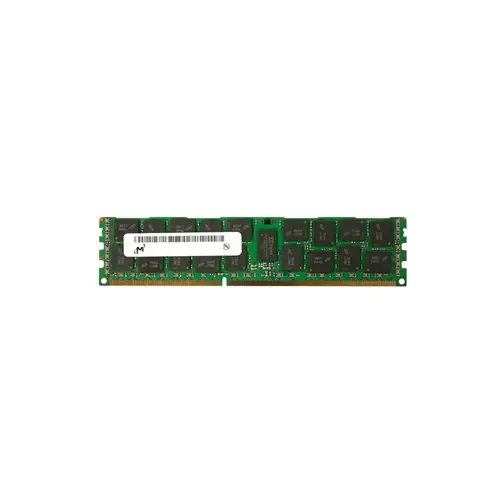
The Micron MT18JSF1G72PZ-1G6E1L is decidedly a server-grade RDIMM, and for any IT professional managing virtualized infrastructure or transactional databases, its four defining characteristics translate directly into operational resilience and cost avoidance. First, ECC is non-negotiable. In a dense virtualisation cluster, where a single host runs dozens of VMs, a background radiation-induced bit flip in kernel memory can silently corrupt guest data. This module corrects single-bit errors on the fly, preserving the logical integrity of your entire stack. Second, its Registered architecture buffers command and address signals, enabling you to populate all available memory channels without signal degradation. This means you can scale to large memory footprints reliably, a critical factor when overcommitting RAM in hypervisors like ESXi. Third, the single-rank x4 configuration is built for mission-critical uptime. x4-wide DRAM chips combined with ECC deliver advanced error containment and often support Chipkill-like recovery, so an entire chip failure during an in-memory database transaction in Redis or SAP HANA simply becomes a correctable event rather than a system crash. Finally, the DDR3-1600 speed provides ample bandwidth to feed multiple CPU cores in these latency-sensitive workloads, ensuring that a financial batch run or a live analytics query completes accurately and on time.
General Virtualization
For a typical virtualization host running multiple VMs, deploy this 8GB RDIMM in multiples of six or eight modules across identical memory channels to maintain balanced NUMA access. Aim for at least 64GB total (8x8GB) for moderate VM density; populate all channels identically to avoid bandwidth penalties and ensure ECC coverage remains active under sustained load.
In-Memory Database
In-memory databases demand both capacity and data integrity, making registered ECC essential. Use the maximum supported DIMMs per server—often 12 or 16 modules—to reach 96–128GB, keeping the dataset fully in RAM. Single-rank x4 configurations like this one are preferred for their lower electrical load, allowing higher population speeds without command-rate degradation.
High-Performance Computing
HPC clusters benefit from uniform node configurations. Per node, install eight or twelve of these modules to populate all memory channels symmetrically, achieving 64–96GB while retaining full 1600 MT/s. The single-rank design minimizes latency and thermal load, which is critical when hundreds of nodes run tightly coupled MPI jobs for days.
Rigorously tested, compatible with Dell PowerEdge R720, HP ProLiant DL380p Gen8, and similar servers.
Q: Can I mix this MT18JSF1G72PZ-1G6E1L with other memory modules of different brands or speeds?
A: Mixing RDIMMs from different vendors or with varying speeds is strongly discouraged. It often forces the memory controller to run at the lowest common speed and may lead to system instability or POST failures.
Q: Is this memory compatible with my server? Which Intel or AMD platforms are supported?
A: This DDR3-1600 Registered ECC module is designed for servers using Intel Xeon E5/E5 v2 series or AMD Opteron 6300/6200 series platforms. Always consult your system’s qualified vendor list to confirm specific board support.
Q: What is the recommended DIMM population order for optimal performance in a server?
A: For optimal performance, populate identical DIMMs per memory channel, starting with the slots furthest from the CPU. On dual-socket boards, balance memory evenly between processors to enable uniform interleaving and maximize bandwidth.
Q: Does this registered server module support overclocking or XMP profiles?
A: No. Enterprise-grade Registered ECC memory adheres strictly to JEDEC standards for reliability. It does not support overclocking or Intel XMP profiles, as operational stability and data integrity take precedence over speed tuning.
Q: What warranty and typical failure rate can I expect with this module?
A: This module is covered by a one-year warranty. Typical failure rate for RDIMM is very low due to rigorous binning and error correction. Premature failure is rare under proper thermal conditions.