











 Secure payments
Standard refund policy
Trade Assurance
Secure payments
Standard refund policy
Trade Assurance
| Model | MT18KDF1G72PZ-1G6P1 |
|---|---|
| Product Type | Memory Module |
| Compliance Standards | RoHS |
| Memory Capacity | 8 GB |
| Memory Technology | DDR3 |
| Product Voltage | 1.35V |
| RAM Speed | 1600MHz |
| RAM Standard | DDR3-1600/PC3-12800 |
| Error Identifying | ECC |
| Signal Type | Registered |
| Column Access Strobe (CAS) | CL11 |
| Rank | Single Rank x4 |
| Quantity of Pins | 240-pin |
| RAM Genre | VLP RDIMM |
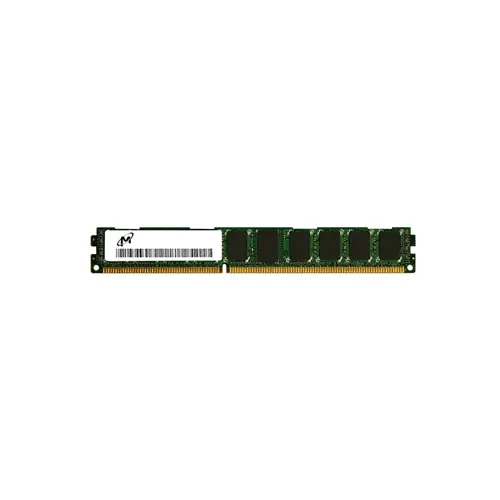
This VLP RDIMM is engineered for dense server environments, combining registered signal integrity with ECC error correction to ensure data reliability in virtualization clusters and in-memory databases. Its single-rank x4 configuration and low 1.35V operating voltage deliver reduced thermal load and improved memory access efficiency, making it ideal for space-constrained 1U/2U rack servers requiring stable 1600MHz performance at CL11 latency.
1. ECC protection automatically detects and corrects single-bit memory errors, preventing silent data corruption in transactional databases and extended uptime services.
2. Registered signal buffering stabilizes high-capacity memory configurations by reducing electrical load on the memory controller, enabling reliable scaling across densely populated server nodes.
3. 1.35V ultra-low operating voltage directly lowers data center energy consumption and reduces waste heat, easing cooling demands in rack-dense deployments without sacrificing clock speed.
4. The Very Low Profile (VLP) form factor fits seamlessly into 1U and blade server chassis, clearing critical airflow pathways so neighboring components stay cooler under continuous load.
5. An eight-gigabyte capacity strikes the density sweet spot for mid-range virtualization hosts, allowing ample headroom for multiple light to medium guest instances while keeping per-slot cost predictable.
The MT18KDF1G72PZ-1G6P1 is an 8GB DDR3-1600 VLP RDIMM purpose-built for servers, where four engineering details directly shape your data center outcomes. First, its ECC silently corrects single-bit errors, a non-negotiable defense in a virtualized cluster where an uncorrected bit flip in hypervisor memory can cascade into corrupted guest states and bring down critical services. Second, the registered buffer restores signal integrity, letting you fully populate multi-socket hosts or run three DIMMs per channel without latency penalties, so dense virtualization workloads never suffer from signal degradation. Third, the single-rank x4 organization strikes a careful balance between bandwidth and access latency. For in-memory databases like Redis or SAP HANA, this means the predictable microsecond response that keeps transactional performance consistent under load. Finally, the 1.35V DDR3L voltage and very low-profile form factor minimize thermal load in 1U blade enclosures while guaranteeing a perfect mechanical fit, directly lowering ongoing cooling and operational costs. This module delivers a hardened foundation where reliability, density, and efficiency converge.
General Virtualization
For a modest virtualization host, deploy four of these 8 GB RDIMMs across all memory channels to achieve 32 GB total. This balanced configuration provides sufficient capacity for 10–15 light to medium VMs while maintaining the bandwidth benefits of a fully populated channel architecture. Leverage the ECC and registered features to ensure data integrity for critical guest workloads.
In-Memory Database
In-memory databases demand both high capacity and reliability. Start with six modules for 48 GB to hold moderately sized datasets entirely in RAM, and scale to the platform’s maximum supported DIMM slots if larger working sets are required. The single-rank x4 organization and 1600 MHz speed minimize latency under heavy random access, while registered ECC protects against silent data corruption essential for transactional consistency.
HPC
HPC clusters benefit from uniform, dense nodes. Populate all available memory channels with two or more identical 8 GB RDIMMs per channel, targeting a minimum of 64 GB per node for moderate-scale MPI jobs. The low 1.35 V operation and VLP form factor reduce power draw and improve airflow in dense rack deployments, helping maintain consistent clock speeds across long-running simulation runs.
Proven compatible after rigorous testing: for Dell PowerEdge R720, HPE DL380p Gen8, Lenovo System x3650 M4.
Q: Can I mix this MT18KDF1G72PZ-1G6P1 with other memory modules of different brands or speeds?
A: Mixing registered ECC modules with unbuffered or non-ECC memory is not supported. For server stability, always install identical RDIMMs with the same speed and rank per channel.
Q: Is this memory compatible with my Intel Xeon E5 or AMD Opteron server platform?
A: Yes, this 8GB DDR3-1600 registered ECC RDIMM is designed for dual-processor servers using Intel C600 or AMD SR56x0 chipsets. Verify your board supports 1.35V VLP modules and 240-pin DDR3 slots.
Q: What is the recommended DIMM population order for optimal performance with this module?
A: Populate identical DIMMs per channel starting with slots farthest from the CPU. For dual-rank systems, install this single-rank x4 module first in blue slots, following your server's specific memory configuration guide.
Q: Does this registered server DIMM support overclocking, XMP profiles, or voltage adjustments?
A: No. This is a JEDEC-compliant RDIMM with fixed CL11 timings and 1.35V operation. Server memory prioritises data integrity, so overclocking or XMP is not available.
Q: What warranty and typical annual failure rate can I expect for this Micron module?
A: It includes a 1-year warranty. Enterprise DDR3 RDIMMs from Micron typically show an AFR below 0.5%, ensuring excellent long-term reliability in 24/7 data centre environments.