











 Secure payments
Standard refund policy
Trade Assurance
Secure payments
Standard refund policy
Trade Assurance
| Product Type | Memory Module |
|---|---|
| Memory Capacity | 8 GB |
| Memory Technology | DDR3 |
| Product Voltage | 1.35V |
| RAM Speed | 1600MHz |
| RAM Standard | DDR3-1600/PC3-12800 |
| Error Identifying | ECC |
| Signal Type | Registered |
| Column Access Strobe (CAS) | CL11 |
| Rank | Dual Rank x8 |
| Quantity of Pins | 240-pin |
| RAM Genre | RDIMM |
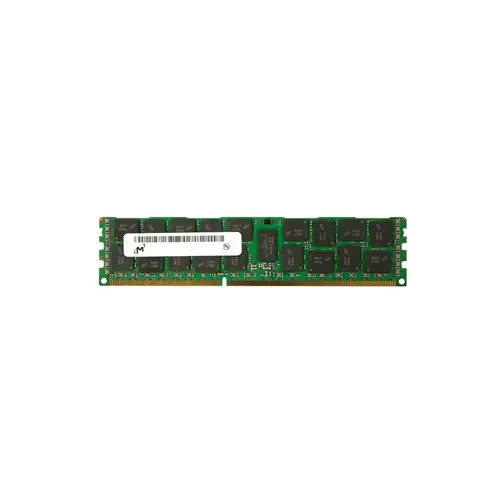
This Micron 8GB DDR3-1600 registered ECC module (Dual Rank x8) is engineered for server platforms where data integrity is critical, making it ideal for virtualization, in-memory databases, and other enterprise workloads. Its 1.35V low-voltage operation reduces power consumption while ECC and registered signal buffering ensure rock-solid stability in dense, high-capacity memory configurations.
1. ECC protection continuously detects and corrects single-bit memory errors, preserving data integrity for mission-critical database and financial workloads in always-on server environments.
2. Registered buffering lowers the electrical load on the memory controller, enabling reliable operation across fully populated 24/7 server platforms without signal degradation.
3. Eight‑gigabyte capacity per module provides a dense memory footprint that increases virtual machine consolidation ratios on a single physical host.
4. A 1600 MT/s transfer rate supplies stable throughput headroom for concurrent enterprise applications such as middleware, caching, and directory services under sustained load.
5. Dual‑rank x8 organization enables rank interleaving that keeps command pipelines busy, reducing access latency spikes during heavy multi‑tenant virtualization traffic.
The MT18KSF1G72PDZ-1G6E1HE is unmistakably a server memory module, classified as an RDIMM with ECC. In a data center, this configuration directly answers the critical needs of reliability and density. First, ECC technology constantly corrects single-bit memory errors, which is non-negotiable for virtualized clusters where a silent bit-flip can corrupt an entire virtual machine’s state or a financial database transaction. For the in-memory databases powering real-time analytics, dual-rank x8 organization steps in: by interleaving access across two internal rank groups, it provides higher sustained bandwidth and concurrency, reducing latency spikes when the CPU is hammering through massive datasets. Meanwhile, the Registered buffer chips stabilize the electrical load on the memory controller, allowing you to populate all 24 slots without signal degradation—essential when adding capacity to avoid costly server sprawl. Finally, the 1.35V low-voltage operation forms a tangible power advantage across a rack full of nodes. It translates to less heat and lower energy bills, all while preserving the 1600MHz throughput needed for dense virtualization workloads. This module is engineered to keep your services up, your data accurate, and your operating costs down.
General Virtualization
For general virtualization, density per core matters. A single 8GB RDIMM is modest, but populating all memory channels with one DIMM each in a typical dual-socket server delivers balanced capacity (e.g., 96GB with 12 modules). This supports dozens of light VMs while the 1.35V low-voltage operation helps reduce power and cooling costs across multi-node clusters.
In-Memory Database
In-memory databases demand integrity and capacity. ECC registered memory like this module is essential to prevent silent data corruption. Fill all available slots with these dual-rank x8 8GB RDIMMs to build a reliable, high-density pool—192GB in a 24-slot server—and leverage the rank interleaving for improved concurrency under heavy cache workloads.
High-Performance Computing (HPC)
HPC requires maximum bandwidth and consistent latency. Install 8GB RDIMMs in multiples matching the platform’s channel count (often 8 or 16 modules) to enable full memory interleaving. The dual-rank design sustains higher throughput per channel. For capacity-hungry simulations, fully populate all slots, scaling to hundreds of gigabytes while the low-voltage rating curbs aggregate power draw.
This rigorously tested server memory is compatible with Dell PowerEdge R720, HP ProLiant DL380p Gen8, and more.
Q: Can I mix this MT18KSF1G72PDZ-1G6E1HE with other memory modules of different brands or speeds?
A: Mixing is not recommended for server environments. It may cause instability or reduced performance. For optimal reliability, we advise using identical modules with the same brand, speed, and rank.
Q: Which server platforms are compatible with this DDR3 registered ECC module?
A: This DDR3L RDIMM is compatible with Intel Xeon E5-2600 v2 series and AMD Opteron 6300 platforms using C600 or SR5690 chipsets. Ensure your server supports registered ECC memory.
Q: What is the recommended DIMM population order for optimal performance?
A: Populate identical DIMMs per memory channel, starting with the blue slots (channel 1 primary slot) first. Follow your server motherboard manual for specific ordering to enable multi-channel interleaving.
Q: Does this module support overclocking or XMP profiles?
A: No. This is a server-grade registered ECC module designed for stability at JEDEC standard DDR3-1600. Overclocking or XMP is not supported to ensure 24/7 data integrity.
Q: What warranty and typical failure rate can I expect?
A: This module comes with a 1-year warranty. Typical annualized failure rate (AFR) is under 0.5% under normal operating conditions, ensuring enterprise-grade reliability.