











 Secure payments
Standard refund policy
Trade Assurance
Secure payments
Standard refund policy
Trade Assurance
| Product Type | Memory Module |
|---|---|
| Compliance Standards | RoHS |
| Memory Capacity | 8 GB |
| Memory Technology | DDR3 |
| Product Voltage | 1.35V |
| RAM Speed | 1600MHz |
| RAM Standard | DDR3-1600/PC3-12800 |
| Error Identifying | ECC |
| Signal Type | Registered |
| Column Access Strobe (CAS) | CL11 |
| Rank | Dual Rank x4 |
| Quantity of Pins | 240-pin |
| RAM Genre | RDIMM |
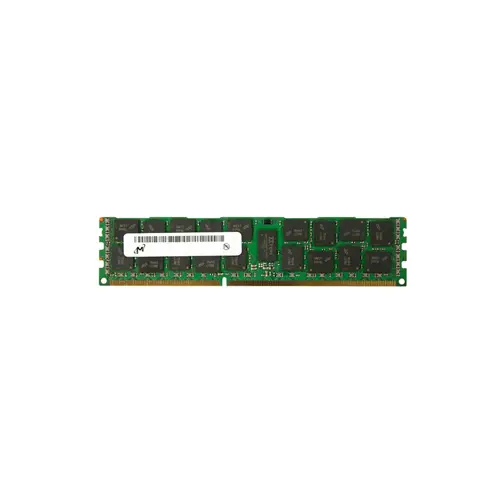
Optimized for entry-level servers and small-scale virtualization hosts, this 8GB DDR3-1600 RDIMM features ECC and registered signal technology to ensure data integrity and signal stability under continuous operation. The dual-rank x4 configuration at 1.35V low voltage enhances memory interleaving efficiency, making it well-suited for memory-resident databases and virtual machine consolidation where reliability and consistent latency are critical.
1. An 8 GB module capacity provides the ideal building block for dense server farms, allowing virtualization hosts to allocate sufficient memory per virtual machine without wasting DIMM slots or budget.
2. Integrated ECC transparently corrects single-bit memory errors in real time, preserving long-term data integrity for financial transactions and database operations where silent corruption is unacceptable.
3. Registered signal buffering decouples the electrical load from the system memory controller, enabling fully populated multi-slot servers to maintain rock‑solid signal integrity at scale.
4. Dual Rank x4 organization leverages rank interleaving to overlap memory access cycles, effectively saturating the data bus and delivering sustained bandwidth for heavy consolidation and in-memory analytics.
5. A 1600 MHz clock speed translates to 12.8 GB/s peak throughput per channel, reducing data retrieval latency during rapid virtualization provisioning and concurrent user access in hosted desktop infrastructures.
Built for mission‑critical enterprise infrastructure, this 8 GB DDR3‑1600 RDIMM is purpose‑engineered to eliminate the top pain points in data centres and virtualised environments. Its four defining characteristics directly translate into measurable operational reliability.
First, Error‑Correcting Code (ECC) continuously detects and corrects single‑bit memory errors. When you run a busy virtualisation cluster hosting dozens of VMs, a single unprotected bit flip can silently corrupt a financial transaction or crash a hypervisor. ECC makes that risk negligible, preserving data integrity around the clock. Second, the Registered architecture buffers address and command signals, enabling multiple DIMMs per channel without overloading the memory controller. For a dense in‑memory database like SAP HANA or VMware‑based private clouds, this lets you scale to 384 GB or more per server while maintaining clean signal timing, so large datasets stay fully available with zero performance degradation under heavy concurrent queries.
Third, the Dual‑Rank x4 organisation improves bandwidth efficiency through rank interleaving. While one rank processes data, the other pre‑charges, cutting effective latency and boosting throughput for analytics workloads that hammer memory with random access streams. Fourth, the 1.35 V operating voltage significantly lowers power draw compared to legacy 1.5 V DDR3. In a rack packed with hundreds of servers, that reduction slashes cooling costs and extends hardware lifespan, which directly impacts your total cost of ownership. Together, these features transform a standard memory module into a risk‑mitigation asset for virtualisation clusters and real‑time database platforms.
This is a server-grade 8GB DDR3L-1600 ECC Registered DIMM (Dual Rank, 1.35V). Capacity planning for typical server workloads:
General Virtualization
Populate all memory channels symmetrically to maximize bandwidth and maintain NUMA balance. In a dual-socket server with four channels per CPU, start with eight 8GB RDIMMs (one per channel) for 64GB, which comfortably hosts a moderate number of VMs. For denser consolidation, move to sixteen modules (two per channel) to reach 128GB, using the low-voltage 1.35V operation to help control power and cooling costs.
In-Memory Database
In-memory databases demand large, low-latency pools; employ as many modules as possible while keeping channel populations equal. Install two 8GB Dual Rank x4 DIMMs per channel in a four-channel platform, giving sixteen modules and 128GB for substantial caches like Redis or Memcached. If more capacity is needed, three DIMMs per channel delivers 192GB, leveraging rank interleaving to boost transaction throughput.
High-Performance Computing
HPC workloads favour peak bandwidth over maximum capacity. Use a one DIMM per channel configuration to sustain the full 1600MT/s speed without frequency drops. In a typical dual-socket system, eight 8GB RDIMMs supply 64GB of balanced, high-bandwidth ECC memory, ideal for simulations, fluid dynamics, and parallel processing, while the 1.35V supply reduces thermal strain in dense cluster deployments.
Rigorously tested for compatibility with Dell PowerEdge R720, HP ProLiant DL380p Gen8, Lenovo ThinkServer RD630, and Cisco UCS C220 M3.
Q: Can I mix this MT18KSF1G72PDZ-1G6J1 with other memory modules of different brands or speeds?
A: Mixing RDIMMs of varying brands or speeds is not recommended. The memory controller applies the lowest common speed and may cause instability; registered ECC features demand matched, validated modules for reliable server operation.
Q: Is this memory compatible with my server system? Which Intel or AMD platforms are supported?
A: This 8 GB DDR3-1600 Registered ECC RDIMM supports Intel Xeon E5-2600 v2/v1 and AMD Opteron 6300/6200 series platforms using the C600-series or equivalent chipsets. Verify your motherboard's QVL for 1.35 V dual-rank x4 modules.
Q: What is the recommended DIMM population order for optimal performance?
A: Populate identical DIMMs in matching channel slots first, typically blue connectors or slots numbered DIMM_A1, B1, C1. For dual-rank x4 RDIMM configurations, follow your server board's manual, usually filling channels 1, 2, 3 per CPU to enable balanced memory interleaving.
Q: Does this module support overclocking or XMP profiles?
A: No. This enterprise-grade Registered ECC memory operates strictly at JEDEC-standard DDR3-1600 (PC3-12800) with 11-11-11 timings at 1.35 V. It does not support XMP or overclocking; stability and data integrity are prioritized.
Q: What warranty and typical failure rate can I expect?
A: This module includes a one-year warranty. As a server-grade RDIMM built by Micron, the annualized failure rate (AFR) is typically well below 0.5% under normal operating conditions, ensuring high reliability for mission-critical workloads.