











 Secure payments
Standard refund policy
Trade Assurance
Secure payments
Standard refund policy
Trade Assurance
| Product Type | Memory Module |
|---|---|
| Memory Capacity | 8 GB |
| Memory Technology | DDR3 |
| Product Voltage | 1.35V |
| RAM Speed | 1600MHz |
| RAM Standard | DDR3-1600/PC3-12800 |
| Error Identifying | ECC |
| Signal Type | Registered |
| Column Access Strobe (CAS) | CL11 |
| Rank | Dual Rank x8 |
| Quantity of Pins | 240-pin |
| RAM Genre | RDIMM |
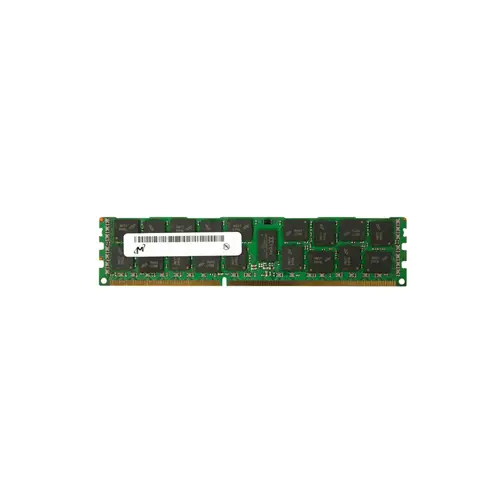
This DDR3-1600 Registered ECC RDIMM is engineered for server platforms handling virtualization, in-memory databases, and other mission-critical workloads where data integrity is non-negotiable. Its 1.35V low-power operation and dual-rank x8 configuration boost memory bandwidth while the registered signal type ensures stable signal integrity across densely populated DIMM slots, and ECC actively corrects single-bit errors to prevent silent data corruption.
1. ECC error correction silently detects and fixes single-bit memory faults, preserving data integrity for transactional databases and financial processing in the data center.
2. Registered signal buffering reduces electrical loading on the memory controller, allowing stable population of high-capacity DIMMs across all channels to maximize virtualization host density.
3. Dual Rank x8 organization keeps memory banks interleaved, sustaining consistent throughput under mixed VM workloads and preventing bandwidth starvation during peak consolidation.
4. 8 GB module capacity hits a sweet spot for mid-scale server nodes, offering sufficient per-socket memory to handle multiple containers or guest OS instances without wasteful overhead.
5. 1600 MHz clock speed delivers the sustained transfer rate needed for in-memory caching and real-time analytics on DDR3-era platforms, ensuring responsive data access under concurrent requests.
The Micron 8GB DDR3-1600 Registered DIMM with ECC operates at 1.35V and is purpose‑built for servers. In a virtualization cluster hosting mission‑critical VMs, ECC corrects single‑bit errors in real time, preventing silent data corruption that could crash a hypervisor or corrupt transactions—your virtual machines stay online and your data remains accurate. The registered buffer stabilizes address and command signals, so even fully loaded memory channels across multiple servers see clean signaling, directly reducing unexplained system hangs and downtime. When you run an in‑memory database such as Redis, the dual‑rank x8 organization leverages rank interleaving to stream data faster, cutting query latencies under heavy loads. And because every watt matters in a dense data center, the 1.35V low‑voltage design slashes power and cooling costs compared to 1.5V modules, while delivering full 1600MHz speed. Each characteristic addresses a real pain point for IT administrators who demand uncompromising data integrity, signal stability, throughput, and energy efficiency in enterprise environments.
General Virtualization
For moderate consolidation of virtual machines, install six of these 8 GB registered ECC modules (48 GB total) across a triple‑channel memory architecture. This configuration balances cost with sufficient headroom for hypervisor overhead and a dozen light‑to‑medium guests. Select a 1.35 V low‑voltage platform to reduce data‑center power draw and cooling demands.
In‑Memory Database
Populate all available channels with identical 8 GB RDIMMs to maximize capacity within a single socket—typically 96 GB to 192 GB using 12 or 24 DIMM slots. The combination of registered buffering and error correction ensures the data integrity and uptime that in‑memory analytic engines require. Where latency is critical, favor dual‑rank x8 configurations, as they offer better interleaving than single‑rank alternatives.
High‑Performance Computing
Deploy one 8 GB DIMM per channel in balanced, populated configurations to sustain peak 1600 MT/s bandwidth under dense floating‑point workloads. Registered ECC memory prevents silent data corruption during multi‑day simulation runs, while the 1.35 V operation reduces thermal stress in dense blade chassis. Scale memory per node to 32 GB–64 GB, matching the typical 4–8 cores per process in clustered HPC jobs.
This server memory has been rigorously tested for compatibility with Dell PowerEdge R720/R730, HP ProLiant DL360p Gen8, and similar systems.
Q: Can I mix this MT18KSF1G72PDZ-1G6N1KF with other memory modules of different brands or speeds?
A: Mixing registered ECC RDIMMs is not recommended. Different brands, speeds or ranks may cause signal integrity issues, leading to system instability or unbootable servers. Always deploy identical modules.
Q: Is this memory compatible with my Intel or AMD server platform?
A: This DDR3L-1600 ECC Registered DIMM is compatible with servers using Intel Xeon E5-series v1/v2 or AMD Opteron 6300/4300 platforms. Verify your board supports 1.35V RDIMMs and 8GB dual-rank x8 configuration.
Q: What is the recommended DIMM population order for optimal performance?
A: Follow your server's manual: typically populate one DIMM per channel starting from slot furthest from the CPU. For dual-socket systems, balance memory evenly across both processors to maximize bandwidth.
Q: Does this module support overclocking or XMP profiles?
A: No, this is a server-grade ECC RDIMM operating at JEDEC-standard DDR3-1600 CL11. It does not support XMP or overclocking; stability and data integrity are prioritized over tunable frequency.
Q: What warranty and typical failure rate can I expect?
A: This module carries a 1-year warranty. Enterprise-class MT18KSF1G72PDZ RDIMMs exhibit very low AFR, typically under 0.2% annually, when operated within specified voltage and thermal limits.