











 Secure payments
Standard refund policy
Trade Assurance
Secure payments
Standard refund policy
Trade Assurance
| Product Type | Memory Module |
|---|---|
| Compliance Standards | RoHS |
| Memory Capacity | 8 GB |
| Memory Technology | DDR3 |
| Product Voltage | 1.35V |
| RAM Speed | 1600MHz |
| RAM Standard | DDR3-1600/PC3-12800 |
| Error Identifying | ECC |
| Signal Type | Registered |
| Column Access Strobe (CAS) | CL11 |
| Rank | Single Rank x4 |
| Quantity of Pins | 240-pin |
| RAM Genre | RDIMM |
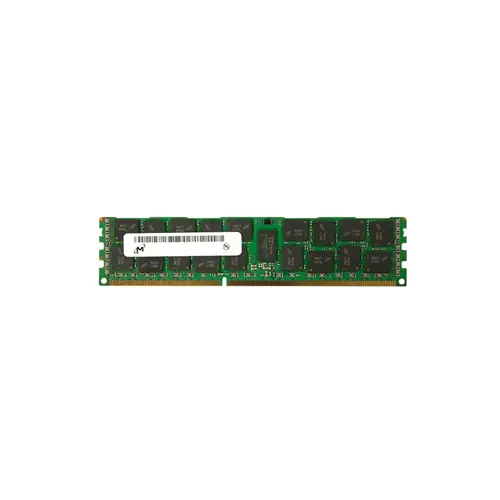
Designed as a server-grade DDR3-1600 Registered ECC module, this 8GB RDIMM is purpose-built for enterprise platforms handling virtualization, in-memory databases, and mission-critical workloads. Its registered signal type ensures stable operation across high-density memory configurations, while ECC and the single-rank x4 organization deliver robust data integrity and efficient memory controller loading for consistent 24/7 reliability.
1. ECC protection detects and corrects single-bit memory errors in real time, preserving data integrity for mission-critical server workloads where even silent corruption is unacceptable.
2. Registered signal buffering stabilizes high-density memory configurations, allowing the memory controller to drive multiple DIMMs per channel without sacrificing command reliability under sustained load.
3. An 8 GB capacity per module provides a cost-efficient building block for moderate virtualization hosts, comfortably supporting multiple light containers or a small number of guest operating systems.
4. 1.35V low-voltage operation reduces power draw across the entire memory subsystem, helping data centers lower cooling overhead and improve energy efficiency in dense rack deployments.
5. Single Rank x4 organization presents a lighter electrical load to the server’s memory controller, ensuring consistent signal quality and stable operation when populating all available DIMM slots.
When provisioning a virtualization cluster or an in-memory database, choosing the right server memory is not a spec sheet formality—it directly governs uptime and transaction integrity. The Micron MT18KSF1G72PZ-1G6E1HF, an 8GB DDR3-1600 RDIMM, embodies four traits that make it essential in these roles. Its ECC circuitry continuously corrects single-bit errors, the kind of silent cosmic-ray or electronic noise flips that can corrupt a virtual machine’s state or poison a Redis node’s dataset without warning. Registered logic buffers address and command signals, so a dual-socket hypervisor can populate all 24 DIMM slots without overloading the memory controller; this stability is what keeps dozens of guest VMs from experiencing unexplained crashes during peak loads. The module’s single-rank x4 organization minimizes bus contention and delivers clean command-to-data timing, which translates directly into faster predicate evaluations for an SAP HANA column store. Meanwhile, operating at 1.35V instead of the older 1.5V standard cuts waste heat inside dense rackmount chassis, lowering cooling overhead and allowing higher ambient temperature thresholds. For an IT manager, this memory means a transactional database that stays consistent, a virtual desktop infrastructure that feels native, and a row of servers that sip power while running flat out.
The given 8GB DDR3-1600 Registered ECC RDIMM (1.35V) is server memory. Below are capacity planning recommendations for key scenarios.
General Virtualization
Deploy eight to sixteen modules to achieve 64–128 GB total and distribute them symmetrically across all memory channels. This provides ample headroom for multiple virtual machines and maximizes interleaving throughput, while ECC ensures multi‑tenant stability.
In‑Memory Database
Maximize capacity by fully populating the server’s DIMM slots—commonly 24 modules (192 GB) on a dual‑socket platform. Use two DIMMs per channel where supported; the single‑rank x4 design minimizes bus loading and helps maintain DDR3‑1600 speed even at high density, which is critical for real‑time analytics.
HPC
Install one 8 GB RDIMM per memory channel (e.g., eight modules per eight‑channel dual‑socket node) to deliver balanced bandwidth to all cores. If more capacity is needed, scale to a homogeneous two‑DIMMs‑per‑channel layout while monitoring speed reductions. The low 1.35 V voltage also benefits dense, energy‑conscious cluster deployments.
Rigorously tested server memory, compatible with Dell PowerEdge R720, HP ProLiant DL380p Gen8, and Lenovo ThinkServer RD630.
Q: Can I mix this MT18KSF1G72PZ-1G6E1HF with other memory modules of different brands or speeds?
A: Mixing Registered ECC modules is strongly discouraged due to potential timing conflicts and signal integrity risks. For mission-critical servers, populate all channels with identical Micron modules to ensure stability and validated coherency.
Q: Is this memory compatible with my system?
A: This RDIMM targets dual-socket Intel Xeon E5-2600 v2/v1 or AMD Opteron 6300 series platforms using C604/C602J chipsets. Verify your board supports 1.35V DDR3L Registered ECC and 8 GB single-rank x4 organization.
Q: What is the recommended DIMM population order for optimal performance?
A: Follow your server’s memory slot numbering guide. Typically, populate identical DIMMs in banks starting farthest from the CPU per channel, balancing load across memory controllers for best interleaving and bandwidth.
Q: Does this module support overclocking or XMP profiles?
A: No. This is an enterprise-grade Registered ECC module adhering to JEDEC DDR3-1600/PC3-12800 at CL11. It operates at fixed 1.35V with no XMP support; overclocking is disabled for data integrity.
Q: What warranty and typical failure rate can I expect?
A: This Micron module includes a 1-year warranty. Enterprise RDIMMs exhibit an annualized failure rate (AFR) typically below 0.5% under specified thermal and voltage conditions, ensuring high reliability for 24/7 operations.