











 Secure payments
Standard refund policy
Trade Assurance
Secure payments
Standard refund policy
Trade Assurance
| Product Type | Memory Module |
|---|---|
| Compliance Standards | RoHS |
| Memory Capacity | 8 GB |
| Memory Technology | DDR3 |
| Product Voltage | 1.35V |
| RAM Speed | 1600MHz |
| RAM Standard | DDR3-1600/PC3-12800 |
| Error Identifying | ECC |
| Signal Type | Registered |
| Column Access Strobe (CAS) | CL11 |
| Rank | Single Rank x4 |
| Quantity of Pins | 240-pin |
| RAM Genre | RDIMM |
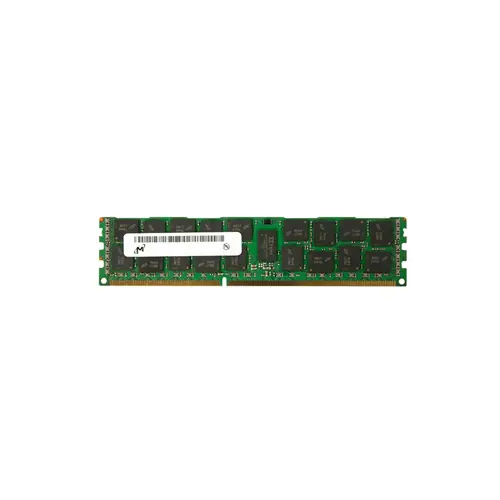
This Micron 8GB DDR3-1600 Registered ECC RDIMM, configured as single-rank x4, is purpose-built for entry-level servers and small-scale virtualization hosts where data integrity under continuous operation is critical. Its 1.35V low-power operation, combined with ECC error correction and registered signal buffering, ensures stable memory subsystem performance ideal for memory-resident databases and lightweight hypervisor workloads on platforms requiring reliable uptime.
1. End-to-end error correction silently detects and corrects bit-flips in real time, shielding virtualized databases and mission-critical applications from silent data corruption that could otherwise cascade into costly downtime.
2. Registered buffer logic isolates the memory controller from heavy electrical loads, stabilizing multi-slot server boards to keep large in-memory workloads and dense virtualization deployments running without signal degradation.
3. Low-voltage operation substantially reduces both active and standby thermal output per module, cutting data center cooling overhead and extending service life in always-on rack environments.
4. This capacity density supports substantial VM and container packing per node, helping IT teams meet consolidation targets while preserving headroom for memory-hungry enterprise services.
5. Single Rank x4 organization reduces per-channel bus loading so servers can maintain full rated speed even with all DIMM slots populated, delivering predictable throughput under strict application SLAs.
When deploying mission-critical server infrastructure, the Micron MT18KSF1G72PZ-1G6P1 RDIMM is engineered to eliminate the silent threats that undermine data integrity and system uptime. As a registered DDR3L module operating at 1.35V, it directly addresses the pain points of IT architects managing dense virtualization clusters and in-memory databases. Its ECC technology continuously detects and corrects single-bit errors caused by cosmic radiation or electrical interference—a non-negotiable safeguard when a flipped bit in a financial transaction or a hypervisor memory page could cascade into data corruption or instance failure. The registered buffer stabilizes signal integrity by reducing the electrical load on the memory controller, which becomes critical as you populate multiple DIMMs per channel in a VMware ESXi host or a Redis cluster; without it, command/address signal degradation triggers unpredictable crashes under heavy consolidation. The single-rank x4 organization optimizes bank-level parallelism, delivering consistent 1600MHz bandwidth under the low latency of CL11, which directly accelerates large-scale database queries where every microsecond of access time impacts transaction throughput. This combination means your virtualized workloads stay resilient and responsive, even as memory demands scale.
This is an 8 GB DDR3L-1600 Registered ECC DIMM (1.35 V, single-rank x4), suitable only for servers. Below is capacity planning for three key workloads.
General Virtualization
Start with four modules (32 GB) in quad-channel mode for hosting roughly 10 light VMs. For higher consolidation, add more modules up to eight (64 GB); registered ECC protects guest data. The 1.35V operating voltage reduces server power draw, important for 24/7 operation.
In-Memory Database
Deploy six modules per CPU in a dual-socket server (48 GB) for caching mid-size datasets. For large-scale Redis or Memcached, maximize to 192 GB using all 24 slots, leveraging the module’s low voltage for dense rack power efficiency. Single-rank x4 DIMMs can maintain 1600 MT/s even with high slot population.
High-Performance Computing
Populate eight modules per node (64 GB) across memory channels for bandwidth-heavy parallel codes. For memory-bound CFD or simulation workloads, double to sixteen DIMMs (128 GB) to fully utilize all channels and avoid performance-degrading NUMA effects.
Rigorously tested server RAM, compatible with Dell PowerEdge R720, HP DL380p Gen8, Lenovo ThinkServer RD430.
Q: Can I mix this MT18KSF1G72PZ-1G6P1 with other memory modules of different brands or speeds?
A: Mixing RDIMMs of different brands or speeds is not recommended. The system will clock all modules to the lowest common speed, and subtle timing or rank variances can lead to instability in server environments.
Q: Is this memory compatible with my Intel Xeon E5 or AMD Opteron server platform?
A: This DDR3-1600 1.35V Registered ECC RDIMM is compatible with Intel Xeon E5-2600 v1/v2 series and select AMD Opteron 6300 platforms. Please verify your board's qualified vendor list for 1.35V support.
Q: What is the recommended DIMM population order for optimal performance?
A: For a single rank x4 RDIMM, populate identical modules per channel starting with the farthest slot from the CPU. Follow the server motherboard's memory configuration guide to balance channels and maximize interleaving.
Q: Does this module support overclocking or XMP profiles?
A: No, this is an enterprise-grade RDIMM. It runs exclusively at JEDEC standard DDR3-1600 CL11 timings. Reliable 24/7 operation is prioritized over overclocking; XMP is not supported.
Q: What warranty and typical failure rate can I expect?
A: This Micron module is covered by a 1-year warranty. As a quality RDIMM, its AFR (annualized failure rate) is typically between 0.1% and 0.3% under specified operating conditions.