











 Secure payments
Standard refund policy
Trade Assurance
Secure payments
Standard refund policy
Trade Assurance
| Product Type | Memory Module |
|---|---|
| Compliance Standards | RoHS |
| Memory Capacity | 8 GB |
| Memory Technology | DDR3 |
| Product Voltage | 1.5V |
| RAM Speed | 1600MHz |
| RAM Standard | DDR3-1600/PC3-12800 |
| Error Identifying | ECC |
| Signal Type | Registered |
| Column Access Strobe (CAS) | CL11 |
| Rank | Dual Rank x4 |
| Quantity of Pins | 240-pin |
| RAM Genre | RDIMM |
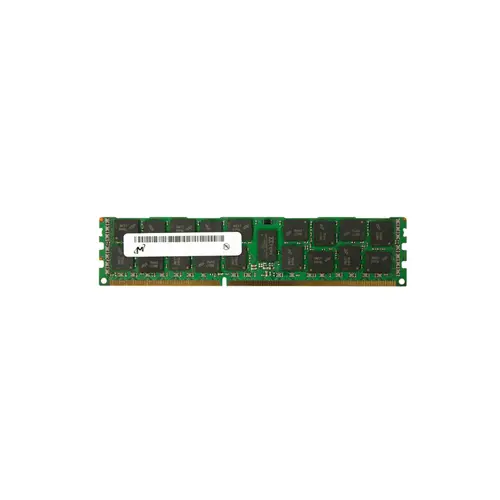
This Micron 8GB DDR3-1600 RDIMM, with its registered signal type and ECC, is purpose-built for server platforms handling virtualization or in-memory databases where data integrity and 24/7 stability are paramount. Its dual-rank x4 organization enhances memory bandwidth utilization, and the CL11 latency keeps access times competitive for legacy enterprise workloads.
1. Registered DIMM architecture ensures signal integrity across densely populated server boards, enabling massive memory scalability for enterprise virtualization without compromising stability.
2. ECC protection proactively detects and corrects single-bit errors, safeguarding transactional databases and preventing silent data corruption in 24/7 operations.
3. DDR3-1600 throughput balances cost-effective bandwidth with reliable multi-core processing, effectively handling concurrent requests in mid-range hosting environments.
4. Eight-gigabyte capacity per module strikes a practical density for consolidating moderate workloads, optimizing virtual machine counts without over-provisioning budgets.
5. Dual Rank x4 organization uses rank interleaving to accelerate data access streams, significantly improving cache-line efficiency for analytics engines under sustained load.
The moment you spot Registered DIMM, ECC, and 240-pin in the spec, it is clear this is server memory built for data centers, not desktops or notebooks. The MT36JSF1G72PZ-1G6K1F is an 8 GB DDR3-1600 RDIMM, and its four core attributes directly address the pain points of IT infrastructure.
First, ECC corrects single-bit memory errors on the fly, which is non-negotiable for a virtualization cluster. When dozens of VMs share a host, a cosmic-ray-induced bit flip in unprotected RAM can silently corrupt a financial transaction or a customer database record; ECC turns that risk into an instant, logged correction that keeps your services trustworthy. Second, the registered buffer stabilizes high-density populations—your server board can take multiple modules without signal degradation, so scaling to 128 GB or more across all channels remains rock-solid under sustained load. Third, the dual-rank x4 organization enables rank interleaving, which overlaps consecutive memory accesses and measurably boosts bandwidth for in-memory databases like Redis. While one rank is busy, the controller can already queue the next command on the other rank, cutting latency in real-time analytics. Finally, the 1.5V DDR3-1600 pace delivers that bandwidth at a proven thermal and power envelope, maintaining consistent performance during 24/7 operation without introducing the heat surprises that destabilize dense rack environments. Together, these features mean fewer crashes, higher VM density, and faster query response for the enterprise.
General Virtualization
Populate all memory channels evenly with identical 8 GB RDIMMs to maintain balanced bandwidth and ECC reliability. A quad‑channel configuration using 4 modules delivers 32 GB, sufficient for 5–8 lightweight VMs. For heavier consolidation or memory‑intense services, scale to 8 modules (64 GB) or more, always keeping channel populations symmetric.
In‑Memory Database
Maximise capacity by filling every available DIMM slot. In a dual‑socket server with 12 slots per CPU, 24 × 8 GB provides 192 GB for in‑memory datasets. Keep all memory channels populated equally to avoid NUMA penalties, and rely on the registered ECC to prevent data corruption during extreme loads.
High‑Performance Computing
Install at least one DIMM per memory channel to deliver peak bandwidth per core. A balanced node often uses 8 modules (64 GB) across eight channels, enabling low‑latency interleaved access. For larger working sets, fully populate all slots to maximise aggregate throughput while accepting the 8 GB density ceiling.
Rigorously tested server memory. Compatible with Dell PowerEdge R720, HP ProLiant DL380p Gen8, and more.
Q: Can I mix this MT36JSF1G72PZ-1G6K1F with other memory modules of different brands or speeds?
A: Mixing is not recommended in servers. Disparate modules may default to the lowest common speed or cause instability. For optimal reliability, populate all channels with identical Micron RDIMMs validated for your platform.
Q: Is this memory compatible with my system?
A: It fits servers supporting DDR3 Registered ECC RDIMMs, such as Intel Xeon E5-2600 v1/v2 or AMD Opteron 6300 series platforms. Verify your motherboard’s qualified vendor list and supports 1.5V dual-rank x4 modules.
Q: What is the recommended DIMM population order for optimal performance?
A: Follow your server manual’s memory population guidelines. Typically, populate identical DIMMs per channel starting from the slots furthest from the CPU, balancing capacity across all memory channels for maximum throughput.
Q: Does this module support overclocking or XMP profiles?
A: No. This is an enterprise-grade Registered ECC module operating exclusively at JEDEC-standard DDR3-1600 CL11 timings. Server platforms prioritize stability and data integrity over overclocking features.
Q: What warranty and typical failure rate can I expect?
A: It includes a 1-year warranty. Enterprise RDIMMs like this Micron module demonstrate very low annualized failure rates (AFR), typically under 0.5% in properly cooled environments, ensuring mission-critical reliability.