











 Secure payments
Standard refund policy
Trade Assurance
Secure payments
Standard refund policy
Trade Assurance
| Product Type | Memory Module |
|---|---|
| Compliance Standards | RoHS |
| Memory Capacity | 8 GB |
| Memory Technology | DDR3 |
| Product Voltage | 1.5V |
| RAM Speed | 1600MHz |
| RAM Standard | DDR3-1600/PC3-12800 |
| Error Identifying | ECC |
| Signal Type | Registered |
| Column Access Strobe (CAS) | CL11 |
| Rank | Dual Rank x4 |
| Quantity of Pins | 240-pin |
| RAM Genre | RDIMM |
This registered DDR3-1600 RDIMM with ECC and a dual-rank x4 organization is purpose-built for enterprise servers and workstations, where it ensures data integrity in memory-intensive workloads such as virtualization and in-memory databases. Its 1.5V operation and CL11 timing provide a balance of reliable registered signal stability and efficient memory access, while the dual-rank configuration optimizes memory bank interleaving for improved throughput in multi-DIMM platforms.
1. Error-correcting code detects and corrects single-bit data errors silently, preventing downtime and preserving data integrity in mission-critical enterprise applications.
2. Registered buffering strengthens command and address signal integrity, enabling large-capacity memory populations essential for dense virtualization without compromising stability.
3. Dual rank interleaving maximizes memory channel utilization, delivering sustained bandwidth that keeps multiple virtual machines responsive under heavy consolidation workloads.
4. Per-module capacity offers generous headroom, allowing IT infrastructure to increase virtual machine density and support memory-hungry in-memory databases on each server node.
5. Elevated clock speed accelerates data transfer rates, reducing latency for caching tiers and real-time analytics that demand rapid, constant access to working datasets.
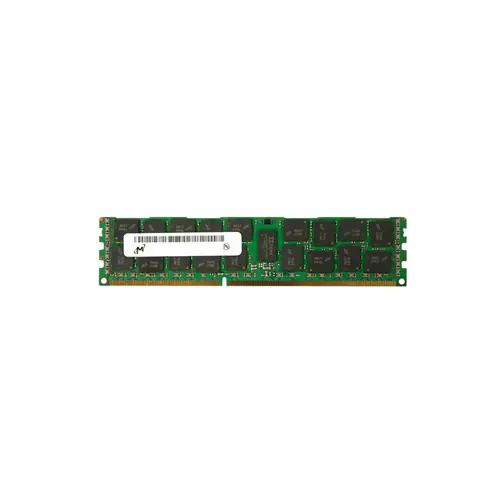
The Micron MT36JSF1G72PZ-1G6K1FF is an 8GB DDR3-1600 Registered DIMM purpose-built for servers, and its four defining characteristics directly address the relentless demands of enterprise data centers. First, the ECC engine corrects single-bit memory errors in real time—a safeguard that prevents silent data corruption during financial transaction processing or when a virtual machine’s memory state resides in a hypervisor cluster over months of uptime. Second, the registered signal buffer stabilizes the command and address bus, so a fully populated 24‑DIMM server can run memory‑intensive database platforms like Microsoft SQL Server or SAP HANA without signal degradation or boot failures. Third, the dual‑rank x4 organization maximizes interleaved access across ranks, delivering higher continuous bandwidth that shortens query response times in large in‑memory databases. Finally, the industry‑standard 1600 MT/s speed at 1.5V balances performance with thermal headroom, essential when banks of these modules operate inside a dense virtualization host where every watt saved reduces cooling cost and extends hardware longevity. In short, this RDIMM turns raw silicon into reliable, always‑on capacity that enterprise workloads cannot afford to compromise.
General Virtualization
For a foundation in virtualization, populate your servers with RDIMMs in multiples of six or eight per CPU to leverage balanced memory channels. A standard 2-socket host using 16 GB modules (two per channel) provides 128–192 GB, comfortably supporting 20–30 typical VMs. Always fill identical DIMMs in each channel to maintain uniform access times and avoid NUMA penalties.
In-Memory Database
In-memory databases demand the lowest latency and highest reliability, making registered ECC memory essential. Deploy this 8 GB RDIMM in a fully populated configuration—often 24 DIMMs per 2-socket server—to reach up to 192 GB, suitable for moderate Redis or SAP HANA datasets. For larger working sets, consider 16 GB or 32 GB modules of the same speed and rank to preserve bandwidth while scaling capacity.
HPC
HPC workloads require maximum memory bandwidth; populate all channels equally with identical Dual Rank x4 DIMMs to enable rank interleaving. Using these 1600 MT/s RDIMMs, a configuration such as 4 DIMMs per channel on an 8-channel platform yields 256 GB and high throughput for simulation or modelling. Match DIMM ranks and speed across all sockets to guarantee deterministic, repeatable performance under parallel processing.
Server memory, rigorously tested for compatibility with Dell PowerEdge R720, HPE DL380p Gen8, and Lenovo x3650 M4.
Q: Can I mix this MT36JSF1G72PZ-1G6K1FF with other memory modules of different brands or speeds?
A: Mixing RDIMMs of different brands or speeds is not recommended. Mismatched timings or registers can cause instability. For reliable operation, use identical modules with the same part number.
Q: Is this memory compatible with my Intel Xeon or AMD Opteron server platform?
A: This DDR3-1600 Registered ECC RDIMM is compatible with servers using Intel Xeon E5/E5 v2 or AMD Opteron 6300/4300 series processors and corresponding chipset. Verify mainboard support for 1.5V and 8 GB Dual Rank x4 modules.
Q: What is the recommended DIMM population order for optimal performance on a dual-socket server?
A: Follow the server board manual. Typically, populate identical DIMMs in the first slot of each memory channel memory channel, balancing across CPU sockets to achieve optimal interleaving and bandwidth.
Q: Does this module support overclocking or XMP profiles?
A: No. This is an enterprise server RDIMM with fixed JEDEC-standard timings (DDR3-1600 CL11). It does not support overclocking or Intel XMP. It is engineered for 24/7 stability at rated specifications.
Q: What warranty and typical failure rate can I expect?
A: This module carries a 1-year warranty. As a rigorously tested, Micron-branded server component with ECC, it demonstrates an extremely low annualized failure rate under specified operating conditions.