











 Secure payments
Standard refund policy
Trade Assurance
Secure payments
Standard refund policy
Trade Assurance
| Product Type | Memory Module |
|---|---|
| Memory Capacity | 8 GB |
| Memory Technology | DDR3 |
| Product Voltage | 1.5V |
| RAM Speed | 1600MHz |
| RAM Standard | DDR3-1600/PC3-12800 |
| Error Identifying | ECC |
| Signal Type | Registered |
| Column Access Strobe (CAS) | CL11 |
| Rank | Dual Rank x4 |
| Quantity of Pins | 240-pin |
| RAM Genre | RDIMM |
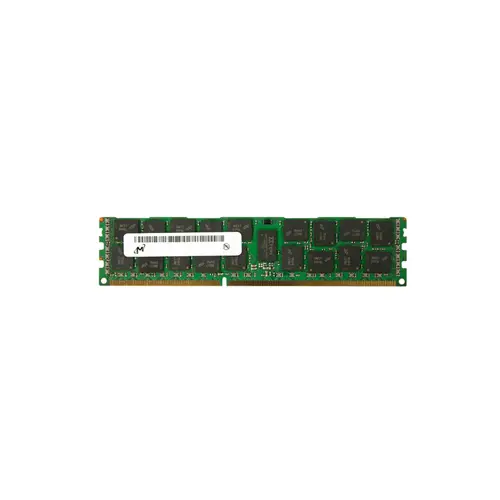
This DDR3-1600 Registered ECC RDIMM, with its dual-rank x4 configuration and CL11 latency, ensures robust signal integrity and data reliability for memory-intensive server workloads. It is ideally suited for virtualization platforms and in-memory database applications where error correction and stable operation under heavy load are critical.
1. ECC memory detects and corrects single-bit errors inline, fortifying data integrity for 24/7 server operations where silent corruption could jeopardize financial or healthcare records.
2. Registered buffering stabilizes signal integrity across high-density server memory channels, enabling seamless scalability for large virtualization farms without data loss.
3. Dual Rank x4 organization interleaves access across internal banks, maximizing memory bandwidth to eliminate throughput bottlenecks during heavy multi-tenant workloads.
4. An 8GB module capacity serves as an efficient building block for virtualized environments, boosting VM density while keeping memory footprint lean for cost-effective consolidation.
5. 1600MHz clock speed accelerates data transfers, slashing latency for real-time database queries and high-traffic online transaction processing.
When deploying mission‑critical virtualization clusters or in‑memory databases, the Micron MT36JSF1G72PZ-1G6M1HI 8 GB DDR3‑1600 RDIMM is not just a memory module—it is a safeguard for your data and a foundation for consistent performance. Its four defining characteristics directly address the pain points you face every day.
The moment you run a dozen virtual machines on a single host, single‑bit errors from cosmic radiation or electrical noise become a real threat. The integrated ECC engine detects and corrects those errors on the fly, preventing silent data corruption that could crash a hypervisor or poison a database record. Meanwhile, the registered signal buffering isolates the memory controller from the electrical load of multiple DIMMs, allowing you to populate all 24 slots of a dual‑socket server without sacrificing stability—exactly what you need to hit 384 GB of RAM for dense consolidation.
For memory‑hungry workloads like SAP HANA or Redis, the dual‑rank x4 organization steps in. It enables better interleaving and higher sustained bandwidth, reducing transaction latency and letting the database engine breathe under heavy concurrency. Together with the 1.5 V operating voltage, which keeps power draw and cooling costs in check inside a packed data center rack, this RDIMM ensures that every clock cycle at 1600 MT/s translates into reliable, deterministic throughput—not a gamble. In short, it turns raw capacity into resilient performance that keeps your services online and your data intact.
This server-grade 8GB DDR3-1600 Registered ECC RDIMM (PC3-12800, CL11, dual-rank x4) delivers error-correcting reliability for multi-socket platforms. Below are capacity planning suggestions for three typical server workloads.
General Virtualization
Install two identical 8GB RDIMMs per memory channel across all populated CPU sockets. In a quad-channel architecture this yields 64GB per processor, providing ample headroom for dozens of virtual machines while keeping power and cost in check.
In-Memory Database
Maximize capacity by filling every DIMM slot per channel—often three 8GB dual-rank modules—to reach 96GB per CPU. Be aware that three dual-rank RDIMMs per channel may force the memory controller to reduce operating speed, yet the additional capacity is vital for large in-memory datasets and caches.
High-Performance Computing (HPC)
For peak bandwidth, install exactly one 8GB DIMM per channel to sustain the full 1600MT/s speed. This gives 32GB per socket in quad-channel designs, sufficient for most node-level simulations. If greater capacity is required, keep one DIMM per channel and migrate to 16GB RDIMMs rather than adding a second rank per channel.
Verified compatible via rigorous testing with Dell PowerEdge R720, HP DL380p Gen8, Cisco UCS C220 M3, and similar servers.
Q: Can I mix this MT36JSF1G72PZ-1G6M1HI with other memory modules of different brands or speeds?
A: Mixing different brands or speeds is not recommended for registered ECC memory. The system will clock all modules to the slowest common speed and may experience stability issues. Use identical modules to guarantee server reliability.
Q: Is this memory compatible with my server system?
A: This DDR3-1600 RDIMM with ECC is compatible with servers supporting registered DDR3 memory, such as Intel Xeon E5 series or AMD Opteron 6300 platforms. Confirm your board's qualified vendor list before purchase.
Q: What is the recommended DIMM population order for optimal performance?
A: Populate identical RDIMMs per channel starting with the farthest slot from the CPU. For a dual rank x4 module, follow your server's manual to balance channels and enable interleaving for maximum throughput.
Q: Does this module support overclocking or XMP profiles?
A: No. This is a JEDEC-compliant, registered ECC server module operating at 1.5V and CL11. It does not support XMP or overclocking; stability and data integrity are prioritized over variable speeds.
Q: What warranty and typical failure rate can I expect?
A: This module includes a one-year warranty. Typical annualized failure rate for Micron DDR3 RDIMMs is well below 1% under normal operating conditions, reflecting high reliability for enterprise workloads.