











 Secure payments
Standard refund policy
Trade Assurance
Secure payments
Standard refund policy
Trade Assurance
| Product Type | Memory Module |
|---|---|
| Memory Capacity | 8 GB |
| Memory Technology | DDR3 |
| Product Voltage | 1.35V |
| RAM Speed | 1600MHz |
| RAM Standard | DDR3-1600/PC3-12800 |
| Error Identifying | ECC |
| Signal Type | Registered |
| Column Access Strobe (CAS) | CL11 |
| Rank | Dual Rank x8 |
| Quantity of Pins | 240-pin |
| RAM Genre | RDIMM |
Designed for server platforms, this 8GB DDR3-1600 RDIMM with ECC and registered signal technology ensures robust data integrity and stability for demanding workloads such as virtualization and in-memory databases. Its dual-rank x8 configuration boosts memory bandwidth through interleaving, while the low 1.35V operating voltage reduces power consumption in dense deployments.
1. ECC protection detects and corrects single-bit errors in real time, preventing silent data corruption in mission-critical database and virtualization servers.
2. Registered signal buffering stabilizes command and address lines, enabling dense memory configurations essential for scaling virtual machine hosts without signal degradation.
3. Dual Rank x8 organization interleaves memory accesses to keep server memory channels fully saturated, improving throughput under heavy multi-VM consolidation workloads.
4. CL11 low column access latency reduces the delay between memory read requests and data delivery, accelerating transaction processing in latency-sensitive enterprise applications.
5. 1600MHz operating frequency delivers ample per-channel bandwidth for concurrent data streams in mid-range servers, balancing performance and power efficiency in always-on deployments.
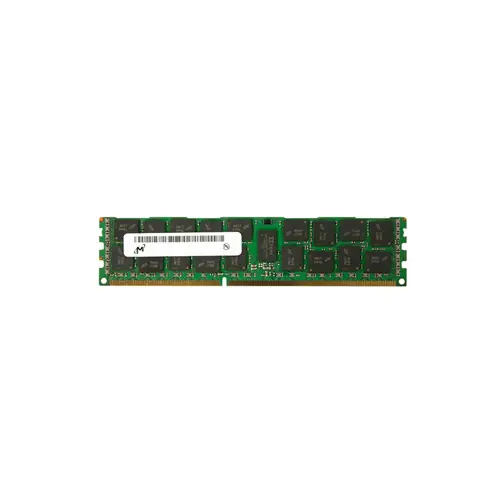
The Micron MT36KSF1G72PZ-1G6K1HE is a server-grade DDR3-1600 RDIMM that turns 8 GB into a resilient foundation for mission-critical workloads. Its ECC engine continuously detects and repairs single-bit errors, preventing silent data corruption from infiltrating financial transactions or electronic health records—situations where a flipped bit could mean a wrong trade or a misreported diagnosis. The registered buffer design minimizes electrical loading, enabling stable operation even when servers are fully populated with memory; this is essential for dense virtualization clusters running VMware or Hyper-V, where dozens of guests share the same physical hardware and an unbuffered module’s instability could crash the entire host. The 1.35 V low-power operation reduces thermal strain and electricity costs across large server farms. Dual rank x8 organization unlocks rank interleaving, which elevates sustained memory bandwidth. This directly benefits in-memory databases like Redis or SAP HANA, allowing them to handle massive concurrent queries with lower latency and without throttling during peak periods.
General Virtualization
For general virtualization, plan for balanced capacity and channel population. Deploy eight of these 8 GB RDIMMs (64 GB total) per server—populate one DIMM per memory channel on a dual‑socket platform to sustain DDR3‑1600 speeds and avoid bandwidth penalties. This configuration supports a moderate density of virtual machines while leaving room for future expansion; the 1.35 V operating voltage also helps restrain power and cooling costs in multi‑node environments.
In‑Memory Database
In‑memory databases thrive on capacious, reliable memory. Fully populate all available DIMM slots—sixteen 8 GB modules (128 GB) or more—to keep entire datasets resident in RAM. The registered ECC design safeguards against single‑bit errors, which is critical for transactional consistency and persistent in‑memory tables. Prioritize identical module batches to maintain signal integrity when using multiple dual‑rank RDIMMs per channel.
High‑Performance Computing (HPC)
HPC workloads prize memory bandwidth and predictability. Install one 8 GB RDIMM per channel (typically eight modules for dual‑socket nodes) to run at the module’s full 1600 MT/s rating, avoiding the down‑clock that occurs with multiple DIMMs per channel. The low 1.35 V power envelope reduces node‑level thermals in dense clusters, and the registered buffer enables stable operation across many nodes—essential for tightly‑coupled MPI jobs that demand consistent latency.
Validated for Dell PowerEdge R720, R620, HP DL380p Gen8, and Lenovo ThinkServer RD630—rigorously tested for seamless compatibility.
Q: Can I mix this MT36KSF1G72PZ-1G6K1HE with other memory modules of different brands or speeds?
A: Mixing is not recommended in server environments. Even identical specs from different vendors may cause signaling issues. For guaranteed stability, populate exclusively with this Micron RDIMM, matching speed, rank, and ECC Registered design.
Q: Is this memory compatible with my system?
A: This 240-pin DDR3 Registered ECC DIMM fits servers using Intel Xeon E5/E7 or AMD Opteron 6300/8300 platforms. Verify your board supports 1.35V low-voltage RDIMMs and 8GB dual-rank x8 modules to ensure proper recognition.
Q: What is the recommended DIMM population order for optimal performance?
A: For dual-processor servers, balance channels per CPU. Start with identical DIMMs in the first slot of each memory channel (often blue slots). Follow your server manual’s RFU order to maintain interleaving and full ECC protection.
Q: Does this module support overclocking or XMP profiles?
A: No. As a server-class Registered ECC DIMM, it adheres strictly to JEDEC DDR3-1600 standard timings (CL11) with no XMP. Overclocking is locked to uphold RAS and data integrity in mission-critical environments.
Q: What warranty and typical failure rate can I expect?
A: This Micron module comes with a 1-year warranty. Enterprise RDIMMs demonstrate an annualized failure rate well below 0.5% under specified thermal conditions. Proper cooling further ensures long-term reliability in 24/7 operations.