











 Secure payments
Standard refund policy
Trade Assurance
Secure payments
Standard refund policy
Trade Assurance
| Product Type | Memory Module |
|---|---|
| Compliance Standards | RoHS |
| Memory Capacity | 8 GB |
| Memory Technology | DDR3 |
| Product Voltage | 1.35V |
| RAM Speed | 1600MHz |
| RAM Standard | DDR3-1600/PC3-12800 |
| Error Identifying | ECC |
| Signal Type | Registered |
| Column Access Strobe (CAS) | CL11 |
| Rank | Dual Rank x4 |
| Quantity of Pins | 240-pin |
| RAM Genre | RDIMM |
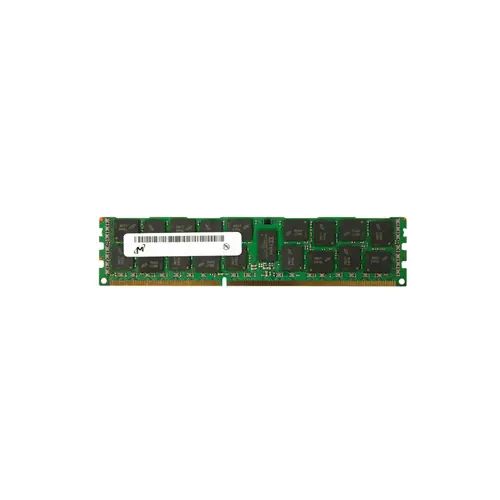
This DDR3-1600 registered ECC memory module is engineered for server platforms demanding data integrity and stability, making it ideal for virtualization and in-memory database workloads. Its dual-rank x4 organization and registered signal type enhance signal integrity and memory channel efficiency, while ECC error correction ensures reliable operation under continuous heavy loads.
1. ECC error correction detects and corrects single-bit memory errors in real time, preventing silent data corruption that could compromise transaction integrity in always-on financial databases.
2. Registered signal buffering isolates the memory controller from the electrical load of multiple DIMMs, enabling stable operation with fully populated channels in high-density virtualization servers.
3. Dual Rank x4 organization leverages rank interleaving to keep data pipelines saturated, minimizing latency spikes when dozens of virtual machines issue concurrent memory requests.
4. Low 1.35V supply voltage significantly curbs power draw per DIMM, directly translating to reduced thermal strain and lower energy bills in blade and rack-scale data center deployments.
5. 1600MHz clock speed provides 12.8 GB/s of peak bandwidth per channel, ensuring balanced throughput for bandwidth-sensitive workloads like in-memory analytics and large-scale content caching.
When deploying this Micron RDIMM (MT36KSF1G72PZ-1G6M2H) in your server infrastructure, its four defining characteristics translate directly into hardened uptime and performance. The ECC capability is your silent guardian against single-bit memory errors that cosmic rays or electrical noise can trigger—within a dense virtualization cluster hosting dozens of VMs, a flipped bit in a guest’s kernel space can silently corrupt data or crash critical services. ECC corrects these errors automatically, preserving transactional integrity for financial databases and SaaS platforms around the clock.
Coupled with ECC, the Registered signal buffer on this dual-rank module allows you to populate all 24 DIMM slots on a typical dual-socket board without overloading the memory controller. That scalability is non-negotiable when an in-memory database like Redis or SAP HANA demands 256GB of stable, synchronously clocked RAM to eliminate swap latency. Meanwhile, the 1.35V low-voltage operation dramatically lowers thermal output in a 1U rack chassis, reducing fan power draw and mitigating throttling during sustained analytical workloads. Finally, the dual-rank x4 organization boosts memory bandwidth by interleaving accesses, so virtual switches and storage I/O operations achieve higher throughput per channel—meaning your hypervisor spends less time waiting on memory and more time servicing user requests. Every choice here targets real-world data center resilience.
General Virtualization
Populate all memory channels symmetrically with identical 8GB RDIMMs to enable interleaving; a typical dual-socket configuration with 16 such modules delivers 128GB, accommodating 25–40 general-purpose VMs. The 1.35V operation reduces total power draw, a crucial factor in continuously running virtualization hosts.
In-Memory Database
To maximize capacity, install these dual-rank 8GB RDIMMs in every available DIMM slot—for instance, 24 modules across two sockets provide 192GB for a moderate in-memory dataset. Balanced configurations sustain bandwidth under transaction spikes, and ECC guarantees data integrity for critical database operations. For larger footprints, plan for higher-capacity DIMMs while using these as building blocks.
High-Performance Computing
Equip each memory channel with one 8GB RDIMM (four modules per socket on a quad-channel server) to achieve balanced memory access for HPC workloads. Scale horizontally by adding another identical DIMM per channel to reach 64GB or more per socket without sacrificing interleaving; the low-voltage 1.35V specification helps control thermals in dense, fan-cooled clusters.
This server memory is rigorously tested and compatible with Dell PowerEdge R720, HP DL380p Gen8, and similar DDR3 servers.
Q: Can I mix this MT36KSF1G72PZ-1G6M2H with other memory modules of different brands or speeds?
A: Mixing is not recommended for server-class RDIMMs. Even slight variances in rank, timing, or voltage can compromise signal integrity and cause system instability. Always populate with identical part numbers.
Q: Is this memory compatible with my system?
A: It requires a server board supporting DDR3 ECC Registered DIMMs. Compatible with Intel Xeon E5/E5-2600 (v1/v2) and AMD Opteron 4300/6300 series platforms. Verify your board supports 1.35V low-voltage operation.
Q: What is the recommended DIMM population order for optimal performance?
A: Populate identical dual-rank modules per channel starting with slots farthest from the CPU. For dual-processor boards, balance memory equally across both sockets. Consult your server’s manual for channel interleaving rules.
Q: Does this module support overclocking or XMP profiles?
A: No. This JEDEC-compliant ECC RDIMM is designed for mission-critical stability, not overclocking. It does not carry XMP profiles; timing and speed are fixed at CL11-1600MHz for deterministic server operation.
Q: What warranty and typical failure rate can I expect?
A: This module includes a 1-year warranty. As an enterprise-grade Micron RDIMM, it delivers a typical annualized failure rate (AFR) well below 0.5%, ensuring high reliability in 24/7 datacenter environments.