











 Secure payments
Standard refund policy
Trade Assurance
Secure payments
Standard refund policy
Trade Assurance
| Product Type | Memory Module |
|---|---|
| Compliance Standards | RoHS |
| Memory Capacity | 8 GB |
| Memory Technology | DDR3 |
| Product Voltage | 1.35V |
| RAM Speed | 1600MHz |
| RAM Standard | DDR3-1600/PC3-12800 |
| Error Identifying | ECC |
| Signal Type | Registered |
| Column Access Strobe (CAS) | CL11 |
| Rank | Dual Rank x4 |
| Quantity of Pins | 240-pin |
| RAM Genre | RDIMM |
This RDIMM is engineered for server platforms, ideal for virtualization and in-memory database workloads where the registered signal type ensures robust signal integrity and ECC actively corrects single-bit errors to maintain critical data accuracy. Its dual-rank x4 configuration with 1.35V low-voltage operation further optimizes memory density and power efficiency in dense, data-intensive environments.
1. Hardware error correction neutralizes single-bit memory faults transparently, preserving uptime and data accuracy for always-on transactional databases and critical enterprise services.
2. A registered clock driver buffers command and address signals, enabling the memory controller to reliably scale up to high-capacity configurations essential for dense virtualization environments.
3. The dual-rank organization with narrow-interface DRAMs interleaves accesses to keep server memory channels saturated, delivering consistent throughput under heavy multi-tenant workloads.
4. Low-voltage DDR3L operation slashes per-DIMM energy consumption, directly trimming power and cooling costs across large-scale data center deployments.
5. This speed grade provides the memory bandwidth needed to handle simultaneous requests smoothly, accelerating response times for mid-tier web hosting and business intelligence applications.
Based on the part number MT36KSF1G72PZ-1G6M2HF and its RDIMM genre, this is unequivocally a server-grade memory module engineered for mission-critical enterprise environments. Its four defining characteristics are not merely technical bullet points; they are the foundation of infrastructure reliability for your data center.
The integrated ECC error correction is your primary defense against silent data corruption. Single-bit errors caused by background radiation, which are statistically inevitable at scale, are detected and corrected in real time. This means that in a virtualized cluster running dozens of VMs, a memory error won’t silently crash a critical database transaction or corrupt a financial record. The registered buffer directly addresses signal integrity when you populate all memory channels for maximum capacity. It acts as a dedicated controller, stabilizing the electrical load so you can confidently scale to hundreds of gigabytes per server without sacrificing boot-up reliability. Furthermore, the dual-rank x4 organization enhances bandwidth through rank interleaving; the memory controller can begin a read on one rank while the other is still finishing its cycle, significantly improving throughput for in-memory databases like Redis or SAP HANA where microseconds of latency during analytics directly impact business outcomes. Finally, the 1.35V low-voltage operation cuts power draw and thermal output substantially across a server farm, lowering your operating expenditure on cooling and energy without compromising the 1600MHz speed. This isn't just a component—it's an insurance policy for your data, uptime, and total cost of ownership.
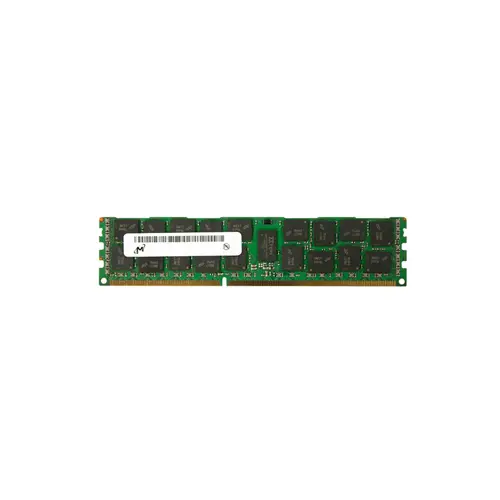
This is a server-class memory module: an 8GB DDR3-1600 Registered ECC DIMM (RDIMM) operating at 1.35V. It is designed for enterprise servers and workstations where data integrity and stable multi-DIMM configurations are critical. Capacity planning should leverage its ECC and registered signal type for mission‑critical workloads.
General Virtualization
For general virtualization hosts, balance capacity and memory bandwidth by populating all memory channels symmetrically. Deploy groups of eight identical 8GB RDIMMs (64GB total) in a dual‑socket server with one DIMM per channel to avoid performance penalties. Scale to 128GB or 192GB using additional identical modules as VM density grows, always maintaining balanced channel configuration for consistent NUMA performance.
In-Memory Database
In‑memory databases demand maximum capacity and fault tolerance. Fill every available DIMM slot with these 8GB RDIMMs to maximize total RAM – for example, 24 modules deliver 192GB in a typical dual‑socket system. This honors ECC protection and registered buffering, reducing memory errors and signal integrity issues under heavy load. Use the low‑voltage 1.35V variant to lower thermal stress in densely populated servers.
High-Performance Computing (HPC)
HPC nodes require peak bandwidth and capacity fit for working sets. Install one 8GB RDIMM per memory channel (e.g., eight modules per dual‑socket platform) to achieve maximum memory throughput at 1600MT/s. Dual‑rank x4 modules help increase interleaving without exceeding channel limits. The 1.35V power profile further improves energy efficiency across large clusters, which is essential for sustained compute‑intensive jobs.
Proven server RAM: DDR3-1600 ECC Registered, compatible with Dell PowerEdge R720/R620, HP DL380p Gen8, Lenovo RD430, etc.
Q: Can I mix this MT36KSF1G72PZ-1G6M2HF with other memory modules of different brands or speeds?
A: Mixing this registered ECC module with different brands or speeds is strongly discouraged. It may cause signal integrity issues and system instability. For server reliability, always install identical modules with the same Micron part number.
Q: Is this memory compatible with my system?
A: This is a DDR3-1600 registered ECC RDIMM, 1.35V low voltage. It is compatible with platforms such as Intel Xeon E5-2400/2600 v1 and v2 series or AMD Opteron 6300 series that explicitly support registered DDR3 memory. Check your motherboard’s RDIMM support.
Q: What is the recommended DIMM population order for optimal performance?
A: For dual-rank RDIMMs, follow your server vendor’s slot numbering: populate identical modules per channel, typically filling the farthest slot from the CPU first for each channel. Balance total ranks evenly across all memory channels for maximum throughput.
Q: Does this module support overclocking or XMP profiles?
A: No. This registered ECC server memory does not support overclocking or XMP profiles. It operates strictly at JEDEC standard DDR3-1600 with CL11 timings, prioritizing data integrity and stability for enterprise workloads.
Q: What warranty and typical failure rate can I expect?
A: This Micron module includes a 1-year warranty. Enterprise-grade RDIMMs like this one have an expected annualized failure rate (AFR) well below 0.5%, delivering the reliability required for mission-critical server environments.