











 Secure payments
Standard refund policy
Trade Assurance
Secure payments
Standard refund policy
Trade Assurance
| Product Type | Memory Module |
|---|---|
| Compliance Standards | RoHS |
| Memory Capacity | 8 GB |
| Memory Technology | DDR3 |
| Product Voltage | 1.5V |
| RAM Speed | 1600MHz |
| RAM Standard | DDR3-1600/PC3-12800 |
| Error Identifying | ECC |
| Signal Type | Registered |
| Column Access Strobe (CAS) | CL11 |
| Rank | Single Rank x4 |
| Quantity of Pins | 240-pin |
| RAM Genre | RDIMM |
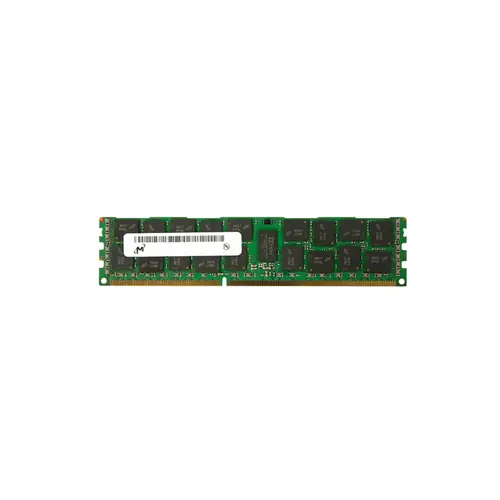
This 8GB DDR3-1600 RDIMM with ECC and registered buffering is engineered for server platforms running memory-intensive workloads such as virtualization, in-memory databases, and mission-critical enterprise applications. Its single-rank x4 organization paired with registered signal technology ensures superior signal integrity and bus stability, while ECC actively corrects single-bit errors to safeguard long-term data integrity under sustained 1.5V operation at CL11 latency.
1. The registered signal type buffers command and address lines, allowing servers to scale up memory channels reliably across densely populated DIMM slots without compromising signal integrity.
2. ECC protection silently corrects single-bit errors and detects multi-bit corruption, safeguarding transactional databases and critical workloads from in-memory data corruption.
3. A single-rank design reduces electrical loading on the memory channel, enabling consistent access latency and stable operation in heavily populated server nodes.
4. The memory capacity provides sufficient headroom for mid-sized virtualized environments, allowing more VMs to run concurrently without paging-induced slowdowns.
5. The speed tier balances throughput and power consumption, sustaining high bandwidth for streaming analytics workloads while meeting tight data center power envelopes.
When you install the Micron MT18JSF1G72PZ-1G6D1FE in your server, you are not merely expanding capacity—you are hardening your environment against silent corruption and performance loss. This 8GB DDR3-1600 Registered DIMM combines four critical attributes designed for enterprise workloads. ECC actively detects and corrects single-bit memory errors, preventing flipped bits from cascading into VM crashes or database inconsistencies in your always-on virtualization cluster. Registered buffering stabilizes electrical loads, so you can populate all memory banks reliably when scaling VMware ESXi hosts or growing in-memory databases like Redis. The 1600 MT/s bandwidth and CL11 timing deliver rapid access to hot data, while its single-rank x4 configuration reduces bus contention for higher command throughput per channel. For your SAP HANA or SQL Server instance, these features mean every transaction remains accurate, response times stay predictable under multi-tenant pressure, and unplanned downtime becomes less likely. It is the foundation for lower TCO and trusted uptime.
General Virtualization
For lightweight to moderate virtualization with 8 GB Registered DDR3-1600 modules, a dual-socket server should be populated with at least six to eight identical DIMMs per CPU to balance memory channels and maximize bandwidth. This configuration provides 48–64 GB per processor, sufficient for 10–15 general-purpose VMs, while leaving room for future expansion if all channels are utilized.
In-Memory Database
In-memory databases demand low latency and high reliability, making ECC Registered DIMMs critical. Populate all memory channels symmetrically with these 8 GB RDIMMs, aiming for 128 GB or more across the system to hold entire datasets in RAM. Be aware that the 8 GB density limits total capacity; for larger working sets, plan to scale out with additional nodes rather than relying on a single host.
High Performance Computing (HPC)
HPC workloads benefit from balanced memory configurations that match the CPU’s memory bandwidth. Install one 8 GB RDIMM per channel (e.g., 8 DIMMs for an 8-channel platform) to achieve peak throughput for simulation and modeling codes. Since capacity per module is modest, cluster nodes can be configured with 64–128 GB total, which suits many traditional HPC applications where data can be staged in and out efficiently.
Rigorously tested server module, fully compatible with Dell PowerEdge R720, R620, HPE DL380p Gen8, and Lenovo x3650 M4.
Q: Can I mix this MT18JSF1G72PZ-1G6D1FE with other memory modules of different brands or speeds?
A: Mixing is not recommended. For reliable server operation, all DIMMs should match in speed, rank, and timings. Mismatched Registered ECC modules can cause POST failures or silent data corruption, undermining platform stability.
Q: Is this memory compatible with my system?
A: This 240-pin DDR3-1600 Registered ECC RDIMM is compatible with Intel Xeon E5-2600 v1/v2 and AMD Opteron 6300/6200 platforms. Please verify your server board requires 1.5V RDIMMs in its qualified vendor list.
Q: What is the recommended DIMM population order for optimal performance?
A: Follow your server board manual. Generally, populate identical DIMMs per channel starting with the farthest slot from CPU (e.g., A1, B1, C1). Balance ranks across channels to maximize bandwidth and maintain proper NUMA affinity.
Q: Does this module support overclocking or XMP profiles?
A: No. This is a standard JEDEC-compliant server RDIMM rated at DDR3-1600 CL11. Overclocking and XMP are not supported; it is engineered for 24/7 stability within tolerance, not frequency scaling.
Q: What warranty and typical failure rate can I expect?
A: This module includes a 1-year warranty. As an OEM-grade server DIMM, it exhibits a very low annualized failure rate, typically under 0.5%, ensuring dependable performance in mission-critical environments.