











 Secure payments
Standard refund policy
Trade Assurance
Secure payments
Standard refund policy
Trade Assurance
| Product Type | Memory Module |
|---|---|
| Compliance Standards | RoHS |
| Memory Capacity | 8 GB |
| Memory Technology | DDR3 |
| Product Voltage | 1.35V |
| RAM Speed | 1600MHz |
| RAM Standard | DDR3-1600/PC3-12800 |
| Error Identifying | ECC |
| Signal Type | Registered |
| Column Access Strobe (CAS) | CL11 |
| Rank | Single Rank x4 |
| Quantity of Pins | 240-pin |
| RAM Genre | RDIMM |
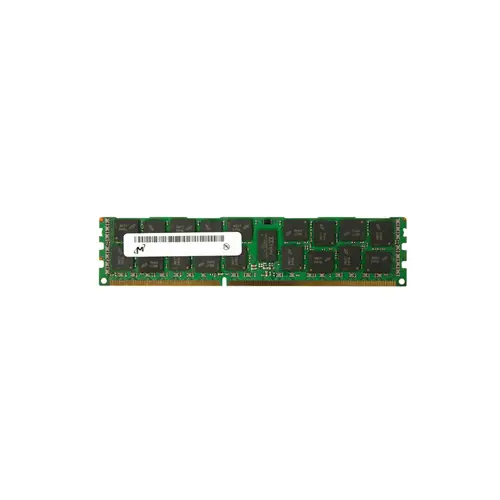
This Micron 8GB DDR3-1600 RDIMM, with its registered ECC architecture and 1.35V low-voltage operation, is purpose-built for entry-level servers and small-scale virtualization hosts where data integrity and power efficiency are critical. The single-rank x4 configuration reduces electrical loading on the memory bus, enabling stable operation at 1600MT/s in dense memory configurations for workloads like light caching or file serving.
1. The module’s capacity tier allows balanced virtual machine packing, ensuring each guest gets adequate memory without overprovisioning in cost-sensitive data centers.
2. Its data transfer rate delivers steady throughput for concurrent database queries, keeping latency low under heavy consolidation workloads.
3. Operating at an energy-conscious voltage level dramatically reduces power and cooling overhead in multi-node rack deployments.
4. Integrated error correction silently repairs single-bit memory faults, safeguarding long-running, mission-critical services from silent data corruption.
5. The registered signal buffer stabilizes command and address lines, enabling reliable operation when multiple DIMMs populate a single channel in dense server configurations.
The Micron MT18KSF1G72PZ-1G6 is a server-grade 8GB DDR3L-1600 RDIMM that tackles four critical data center challenges. ECC error correction eliminates silent data corruption from cosmic radiation, which is vital for virtualized clusters where a single bit flip in the hypervisor can crash dozens of VMs and cause costly downtime. The registered buffer ensures signal integrity across fully populated memory channels, allowing dense 2U servers to run in-memory databases like SAP HANA with large 8GB module configurations without sacrificing speed. Operating at a low 1.35V instead of 1.5V slashes power and cooling requirements, directly reducing your total cost of ownership as you scale. The single-rank x4 organization optimizes bandwidth for latency-sensitive applications such as high-frequency trading, where every microsecond counts. For server architects, this means maximum uptime, seamless capacity scaling, and leaner energy bills.
General Virtualization
For moderate-density VM hosts, populate at least six identical 8 GB RDIMMs across triple-channel or quad-channel memory banks to provide 48–64 GB of balanced capacity. Stagger DIMMs evenly per CPU socket to avoid memory bandwidth bottlenecks, and retain identical rank and speed for stable virtual machine failover.
In-Memory Database
In-memory workloads demand low latency and high reliability, so install registered ECC modules in quantities that fill all available channels—typically eight to twelve 8 GB sticks for a 96 GB pool. This configuration maximizes data integrity with single-rank x4 organization while keeping access times predictable under heavy transactional loads.
High-Performance Computing
HPC clusters benefit from maximum channel concurrency; deploy one 8 GB RDIMM per channel across all memory channels to hit 128 GB or more in dual-socket nodes. Stick to identical 1.35V, CL11 modules to balance power draw with consistent bandwidth, and avoid mixing ranks to sustain steady throughput during parallel simulation runs.
Rigorously tested, this server memory is compatible with Dell PowerEdge R720, R620, HP DL380p Gen8, and more.
Q: Can I mix this MT18KSF1G72PZ-1G6 with other memory modules of different brands or speeds?
A: Mixing is not recommended. The system will default to the lowest common speed and may disable ECC or cause instability. For mission‑critical servers, use identical modules to ensure reliability.
Q: Is this memory compatible with my server? Which Intel or AMD platforms support it?
A: It is designed for servers using Intel Xeon E5-2600 v2 or AMD Opteron 6300 series platforms with DDR3 Registered DIMM slots. Verify your board supports 1.35V, 1600MT/s RDIMMs.
Q: What is the recommended DIMM population order for optimal performance with this single‑rank module?
A: Populate identical DIMMs in balanced channels, starting with slot 1 of each memory channel (e.g., A1, B1). Follow your server’s manual; single‑rank x4 modules often benefit from populating one DIMM per channel.
Q: Does this DDR3 Registered module support overclocking or XMP profiles?
A: No. This is an enterprise‑grade RDIMM built for stability and data integrity. It does not support overclocking or XMP; it operates strictly at JEDEC‑standard DDR3-1600 with CL11 timing.
Q: What warranty and typical failure rate can I expect with this module?
A: It comes with a 1‑year warranty. The AFR (Annualized Failure Rate) is extremely low, typical of Tier‑1 server memory, and is backed by rigorous burn‑in testing for 24x7 operation.