











 Secure payments
Standard refund policy
Trade Assurance
Secure payments
Standard refund policy
Trade Assurance
| Product Type | Memory Module |
|---|---|
| Compliance Standards | RoHS |
| Memory Capacity | 8 GB |
| Memory Technology | DDR3 |
| Product Voltage | 1.35V |
| RAM Speed | 1600MHz |
| RAM Standard | DDR3-1600/PC3-12800 |
| Error Identifying | ECC |
| Signal Type | Registered |
| Column Access Strobe (CAS) | CL11 |
| Rank | Dual Rank x4 |
| Quantity of Pins | 240-pin |
| RAM Genre | RDIMM |
This DDR3L-1600 Registered ECC RDIMM is engineered for legacy server platforms where data integrity and stability under heavy memory loads are critical, making it ideal for virtualization farms and in-memory database applications. Its dual-rank x4 organization enhances interleaving efficiency and overall throughput, while the 1.35V low-voltage operation reduces thermal footprint without compromising the error-correction reliability demanded by 24/7 enterprise environments.
1. ECC protection detects and corrects single-bit memory errors in real time, ensuring transactional data integrity and reducing unexpected server downtime in mission-critical enterprise environments.
2. Registered signal buffering stabilizes command and address lines across high-density memory configurations, enabling reliable operation when scaling up to large DIMM populations in virtualized data centers.
3. 8 GB capacity per module strikes an efficient balance between density and cost, ideal for building mid-range virtualization hosts that support a high number of lightweight workloads without over-provisioning.
4. 1600 MHz data rate delivers solid memory bandwidth per channel, accelerating in-memory databases and analytics queries by feeding modern multi-core server CPUs without creating latency bottlenecks.
5. Dual Rank x4 organization interleaves access across two internal ranks per DIMM, maximizing channel utilization and consistent throughput for large-scale virtual machine consolidation under constant load.
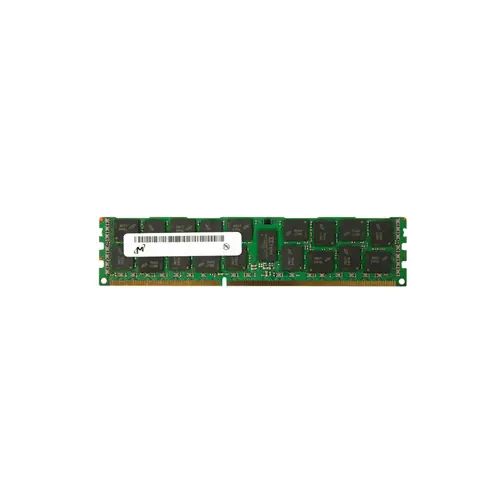
The MT36KSF1G72PZ-1G6M is an 8GB DDR3 RDIMM. Its four defining characteristics directly translate into mission-critical reliability and performance. First, ECC correction detects and fixes single-bit memory errors, which is non-negotiable for a virtualization cluster running dozens of VMs—a silent bit flip could corrupt a financial transaction or crash a hypervisor. Second, the Registered signal buffering stabilizes address and command lines, allowing you to fully populate server boards with 24 or more DIMMs without signal integrity loss; this scalability is essential when consolidating workloads under VMware or Hyper-V. Third, the 1.35V low-voltage design cuts power consumption compared to standard 1.5V DDR3, reducing thermal stress in dense rack deployments and lowering total cost of ownership. Fourth, the Dual Rank x4 organization interleaves two internal rank arrays, raising sustained bandwidth for read-heavy in-memory databases like Redis, where sub-millisecond latency and throughput are critical.
General Virtualization
For moderate-density virtualization hosts, populate six to eight identical 8 GB RDIMMs per CPU to reach 48–64 GB total capacity, balancing guest count and memory overhead. Deploy modules in matched sets across memory channels to maintain balanced NUMA access and maximize throughput. With 1.35 V low-voltage operation, these DIMMs also help reduce overall power draw in multi-node environments.
In-Memory Database
In-memory database workloads demand both capacity and reliability, so install at least twelve 8 GB RDIMMs per socket for 96 GB or more, strictly using identical ECC Registered DIMMs. Configure memory mirroring or sparing if the platform supports it to reduce downtime risk. The dual-rank x4 organization and CL11 latency provide the consistent error-corrected performance essential for large caching and real-time analytics.
High-Performance Computing
For HPC clusters, populate all memory channels symmetrically with eight 8 GB RDIMMs per node to achieve 64 GB, ensuring peak bandwidth under sustained floating-point loads. Use only validated Registered ECC modules to maintain node stability during multi-day simulation runs. The 1600 MT/s speed and dual-rank design help saturate memory bandwidth per channel while meeting typical power and thermal constraints of dense rack deployments.
Rigorously tested server memory: compatible with Dell PowerEdge R720, HP DL380p Gen8, Lenovo RD430, etc.
Q: Can I mix this MT36KSF1G72PZ-1G6M with other memory modules of different brands or speeds?
A: Mixing is not recommended. Server platforms require identical modules for stability. Different brands, speeds, or ranks can cause POST failures or signal integrity issues. Always populate with the exact same part number.
Q: Is this memory compatible with my system?
A: This RDIMM is designed for Intel Xeon E5-2400/E5-2600 v1 and v2 platforms, or select AMD Opteron 4300/6300 series. Please verify your server board supports registered DDR3 ECC 1.35V memory.
Q: What is the recommended DIMM population order for optimal performance?
A: Follow your server board's manual. Typically, populate identical DIMMs in the first slot of each memory channel (e.g., A1, B1) for balanced interleaving. Use all three channels per CPU when possible.
Q: Does this module support overclocking or XMP profiles?
A: No. It operates at fixed JEDEC standard DDR3-1600 with CL11 timings. Overclocking and XMP are not supported; this module prioritizes data integrity and 24/7 enterprise reliability.
Q: What warranty and typical failure rate can I expect?
A: This module includes a 1-year warranty. Enterprise RDIMMs demonstrate extremely low Annualized Failure Rates (AFR), typically below 0.2%, due to rigorous testing and ECC capabilities.