











 Secure payments
Standard refund policy
Trade Assurance
Secure payments
Standard refund policy
Trade Assurance
| Product Type | Memory Module |
|---|---|
| Compliance Standards | RoHS |
| Memory Capacity | 8 GB |
| Memory Technology | DDR3 |
| Product Voltage | 1.35V |
| RAM Speed | 1600MHz |
| RAM Standard | DDR3-1600/PC3-12800 |
| Error Identifying | ECC |
| Signal Type | Registered |
| Column Access Strobe (CAS) | CL11 |
| Rank | Single Rank x4 |
| Quantity of Pins | 240-pin |
| RAM Genre | RDIMM |
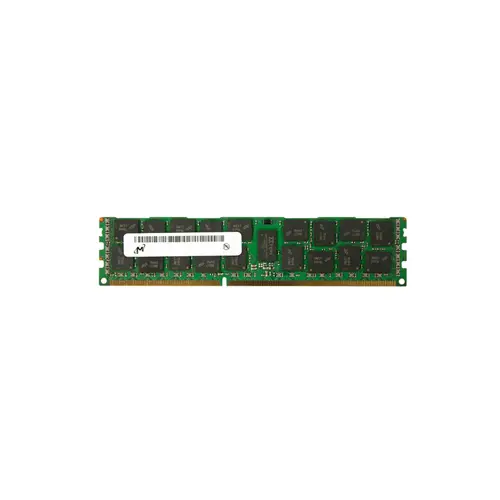
This 8GB DDR3-1600 RDIMM, featuring ECC and a registered signal architecture, is purpose-built for server platforms running virtualization or in-memory database workloads where absolute data integrity is critical. Its single-rank x4 configuration and low 1.35V operating voltage minimize electrical loading and power draw, directly enhancing memory channel stability and efficiency in dense rack deployments.
1. ECC error correction safeguards transactional data integrity, preventing silent memory corruption that could crash critical enterprise workloads.
2. Registered signalling buffers the command and address lines, enabling the deployment of high-capacity memory populations without sacrificing signal stability in dense server racks.
3. An 8 GB module provides ample headroom for mid-scale virtualization hosts, allowing more simultaneous VMs per node without immediate DIMM slot exhaustion.
4. 1600 MHz speed delivers the necessary throughput to keep pace with multi-core server processors, reducing memory-side latency under concurrent database queries.
5. Low 1.35V operation trims power consumption across a fleet of servers, lowering both electricity costs and cooling demands in always-on data centers.
Designed as a DDR3L Registered ECC DIMM (MT18KSF1G72PZ-1G6E1), this 8 GB module directly tackles the critical pain points of server infrastructure through four essential characteristics. Error Correction Code (ECC) automatically detects and corrects single-bit memory errors, silently preventing data corruption that could crash a virtualized cluster or compromise a financial transaction database—delivering the integrity that always-on services demand. The registered buffer stabilizes command and address signals, allowing you to fully populate all memory channels across a virtualization host without signal degradation, so you can confidently run dozens of VMs with rock‑solid stability. Operating at just 1.35 V, the low‑voltage design dramatically lowers power consumption and cooling requirements inside dense data centers, directly reducing your total cost of ownership. Finally, its single‑rank x4 organization at 1600 MHz (PC3‑12800) provides consistent, low‑latency bandwidth perfectly suited for in‑memory databases like Redis or SAP HANA, where every nanosecond of access time directly affects query throughput. Together, these features give you uncompromised reliability, energy efficiency, and the predictable performance your mission‑critical workloads rely on.
General Virtualization
For a lightly consolidated environment, start with four 8 GB RDIMMs (32 GB total) per server to support 10–15 typical virtual machines. Scale to six or eight modules to reach 48–64 GB when hosting heavier workloads, always populating channels symmetrically for balanced memory bandwidth and reliable ECC coverage.
In-Memory Database
In-memory databases demand capacity and resilience. Populate at least six modules (48 GB) to keep an active dataset resident, and expand to twelve or more modules for larger instances. Using single-rank x4 RDIMMs at 1.35 V helps control power while registered ECC preserves data integrity under sustained load.
High-Performance Computing
HPC nodes require bandwidth before outright capacity. Install one DIMM per channel (typically six or eight modules for 48–64 GB) to maximize memory throughput on dual-socket platforms. Scale only when the working set exceeds node memory; prefer additional identical 8 GB RDIMMs to maintain uniform rank and timing, avoiding NUMA imbalance and latency penalties from mixed configurations.
Rigorously tested RDIMM, compatible with Dell PowerEdge R720, R620, HP ProLiant DL360p Gen8, and more.
Q: Can I mix this MT18KSF1G72PZ-1G6E1 with other memory modules of different brands or speeds?
A: Mixing is strongly discouraged. In a registered ECC server environment, mismatched brands, speeds, or ranks can cause signal degradation and system instability. Always use identical modules to maintain data integrity.
Q: Is this memory compatible with my Intel or AMD server platform?
A: This 8GB DDR3-1600 RDIMM is compatible with platforms like Intel Xeon E5-2600 v2 and AMD Opteron 6300 series that support 1.35V registered ECC memory. Consult your motherboard QVL for exact validation.
Q: What is the recommended DIMM population order for optimal performance?
A: Follow your server board’s population guide. Generally, install identical RDIMMs in matched sets per memory channel, starting with the blue or farthest slots from the CPU, to enable balanced interleaving and maximum throughput.
Q: Does this module support overclocking or XMP profiles?
A: No. This is a JEDEC-compliant, enterprise-grade registered ECC DIMM designed for stability and error correction. Overclocking and XMP profiles are not supported; reliability takes absolute precedence over speed margins.
Q: What warranty and typical failure rate can I expect?
A: This Micron module includes a 1-year warranty. Registered server memory exhibits very low annualized failure rates, typically under 0.5% with adequate cooling, delivering the reliability required for critical workloads.