











 Secure payments
Standard refund policy
Trade Assurance
Secure payments
Standard refund policy
Trade Assurance
| Product Type | Memory Module |
|---|---|
| Compliance Standards | RoHS |
| Memory Capacity | 8 GB |
| Memory Technology | DDR3 |
| Product Voltage | 1.5V |
| RAM Speed | 1600MHz |
| RAM Standard | DDR3-1600/PC3-12800 |
| Error Identifying | ECC |
| Signal Type | Registered |
| Column Access Strobe (CAS) | CL11 |
| Rank | Single Rank x4 |
| Quantity of Pins | 240-pin |
| RAM Genre | VLP RDIMM |
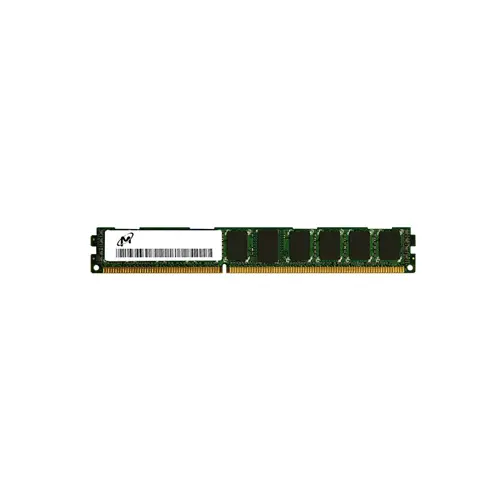
This 8GB DDR3-1600 Registered ECC VLP RDIMM is purpose-built for virtualization and memory-intensive database servers, ensuring robust data integrity through ECC and stable signal paths via its registered architecture. Its Single Rank x4 configuration enhances error containment with x4-drive granularity, while the Very Low Profile form factor optimizes airflow in dense 1U and blade chassis, making it ideal for space-constrained enterprise deployments.
1. ECC protection detects and corrects single-bit errors in real time, safeguarding transactional data integrity in mission-critical server workloads.
2. Registered signal buffering stabilizes electrical loads on the memory bus, enabling dense server configurations to operate reliably across fully populated DIMM slots.
3. Very low profile form factor minimizes airflow obstruction in tightly packed rack servers, preserving thermal headroom for processors under sustained compute loads.
4. 8 GB capacity per module strikes a balance that maximizes virtual machine density in hypervisor hosts without oversubscribing memory channels.
5. 1600 MT/s transfer rate delivers sufficient bandwidth for database caching and in-memory analytics, reducing query latency in data-center applications.
The Micron MT18JDF1G72PZ-1G6 is an 8GB DDR3-1600 VLP RDIMM engineered specifically for server environments where uptime and data integrity are non-negotiable. Its four defining characteristics turn into mission-critical advantages the moment you deploy it.
First, ECC error correction silently detects and corrects single-bit memory errors caused by cosmic radiation or electrical noise. In a virtualisation cluster running dozens of VMs, a flipped bit in memory can corrupt a financial transaction or silently propagate corrupted data for days; ECC stops this outright, protecting your workload from invisible, costly failures. Second, the registered signal buffer stabilises the address and command lines, allowing you to fully populate all memory channels without signal degradation. This translates directly to achieving the 256GB or 512GB capacities demanded by dense ESXi hosts or an in-memory database like Redis, where swapping to disk would crater response times. Third, the single‑rank x4 organisation balances low electrical loading with sufficient bank groups, helping maintain the full 1600MT/s speed even when three DIMMs per channel are installed. For an in‑memory analytics platform, that sustained bandwidth is what lets you scan billion-row tables in seconds. Finally, the very‑low‑profile form factor optimises airflow in 1U and blade chassis, preventing thermal throttling so your virtualised infrastructure stays responsive under constant load. In essence, this module is purpose‑built to eliminate the three things a data centre fears most: silent data corruption, capacity bottlenecks, and thermally‑induced instability.
General Virtualization
For moderate-density virtualization with DDR3-era platforms, populate all memory channels identically using these 8 GB RDIMMs to enable balanced interleaving. Deploy at least six modules (48 GB total) per dual-socket server to comfortably host 10–15 lightweight VMs, scaling to 12 modules (96 GB) for higher consolidation ratios while maintaining 1.5 V power efficiency.
In-Memory Database
Memory-resident workloads demand maximum capacity and fault tolerance, making registered ECC essential. Fully populate each memory channel with 8 GB VLP RDIMMs to reach 128–256 GB in dual-socket servers, enabling Redis or Memcached instances to store large datasets entirely in RAM without swapping, while ECC corrects single-bit errors that could corrupt database integrity.
High-Performance Computing
HPC clusters benefit from the registered signal type’s stability under sustained parallel loads. Configure nodes with one DIMM per channel (e.g., eight modules for 64 GB) to preserve peak 1600 MT/s bandwidth, critical for MPI-based simulations. The very low-profile (VLP) design improves airflow in dense blade enclosures, reducing thermal throttling during multi-day compute runs.
Rigorously tested server memory, compatible with Dell PowerEdge R720, HPE ProLiant DL380p Gen8, and Cisco UCS C220 M3.
Q: Can I mix this MT18JDF1G72PZ-1G6 with other memory modules of different brands or speeds?
A: Mixing registered ECC modules from different brands or speeds is not recommended. Mismatched timings or ranks can cause instability and may disable ECC functionality on server platforms.
Q: Is this memory compatible with my system?
A: This is a DDR3-1600 VLP RDIMM for servers. It requires a motherboard with 240-pin slots, Intel Xeon E5 or AMD Opteron platforms, and a chipset supporting registered ECC memory. Verify your system’s qualified vendor list.
Q: What is the recommended DIMM population order for optimal performance?
A: Follow your server board’s manual for balanced memory channels. Typically, populate identical DIMMs per channel starting with the farthest slot from the CPU, using identical ranks and speeds for best performance.
Q: Does this module support overclocking or XMP profiles?
A: No. This is an enterprise registered DIMM meeting JEDEC standards for stability. It does not include XMP profiles and is not designed for overclocking; reliable operation at rated 1600MHz is guaranteed.
Q: What warranty and typical failure rate can I expect?
A: This Micron module includes a 1-year warranty. Enterprise-grade registered ECC memory has an extremely low annualized failure rate, typically under 0.5%, ensuring dependable 24/7 operation in server environments.