











 Secure payments
Standard refund policy
Trade Assurance
Secure payments
Standard refund policy
Trade Assurance
| Product Type | Memory Module |
|---|---|
| Compliance Standards | RoHS |
| Memory Capacity | 8 GB |
| Memory Technology | DDR3 |
| Product Voltage | 1.5V |
| RAM Speed | 1600MHz |
| RAM Standard | DDR3-1600/PC3-12800 |
| Error Identifying | ECC |
| Signal Type | Registered |
| Column Access Strobe (CAS) | CL11 |
| Rank | Single Rank x4 |
| Quantity of Pins | 240-pin |
| RAM Genre | RDIMM |
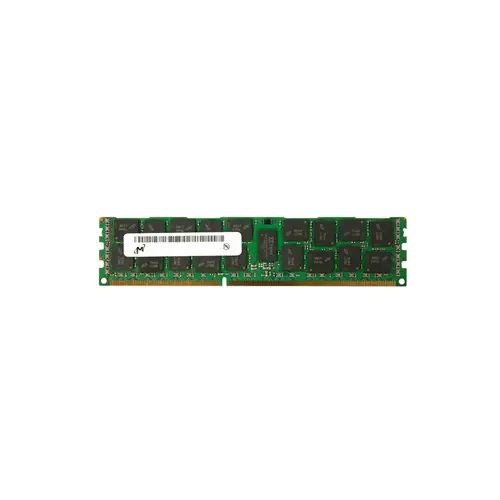
Designed for server-class platforms, this 8GB DDR3-1600 Registered ECC module ensures data integrity and system stability for virtualization clusters and in-memory database workloads. Its registered signal architecture with Single Rank x4 organization reduces bus loading on high-density memory channels while ECC corrects single-bit errors, making it ideally suited for mission-critical enterprise environments.
1. Registered signal type buffers command and address lines, stabilizing multi-DIMM server configurations and preventing signal degradation when all memory channels are populated to maximum capacity.
2. ECC error identification corrects single-bit memory errors on the fly, safeguarding long-running virtualization hosts and database servers against silent data corruption and unexpected downtime.
3. 8 GB per module provides a dense memory footprint suitable for consolidation ratios of moderate virtual machines, ensuring enough headroom for hypervisor overhead and guest operating systems.
4. Single Rank x4 organization leverages x4 DRAM devices to enhance chip-level error resilience, strengthening ECC effectiveness and reducing the risk of uncorrectable errors in transactional workloads.
5. 1600 MHz memory speed delivers reliable throughput for concurrent processing streams, lowering data retrieval latency in caching layers and improving performance under sustained enterprise load.
When you deploy this 8GB DDR3-1600 RDIMM in a virtualized cluster or an in-memory database server, four engineering decisions directly determine whether your workloads succeed or silently fail. The first is ECC error correction: a single uncorrected bit flip in a Redis instance or a financial transaction log can corrupt results, but ECC transparently detects and fixes single-bit errors, preserving data integrity around the clock without performance penalties. Second, the registered buffer stabilizes command and address signals across heavily populated channels. In a 24-slot virtualization host, that means you can fully load the server with RAM without signal degradation or sudden crashes during live migration. Third, the single-rank x4 organization reduces electrical load and inter-rank timing conflicts compared to dual-rank alternatives, delivering consistently low access latency essential for time-sensitive database lookups under concurrent VM pressure. Finally, the 1600MT/s speed with CL11 latency provides enough bandwidth to keep multiple virtual machines responsive when they contend for memory. For your infrastructure, these features translate into predictable uptime, accurate computations, and the confidence to consolidate more tenants onto each server without risking silent data corruption.
General Virtualization
For general virtualization hosts, deploy this 8 GB RDIMM in multiples of six or twelve to populate triple-channel memory architectures common on DDR3-era servers. A minimum of 24 GB (3 modules) per socket is recommended for lightweight VMs, while 48 GB (6 modules) handles moderate consolidation. Balance capacity with memory channel interleaving to avoid bottlenecks when multiple VMs compete for bandwidth.
In-Memory Database
In-memory databases demand high capacity and reliability. Use this registered ECC module to fill all available DIMM slots on dual-socket boards, building a 64–128 GB pool. The single-rank x4 design can help maintain signal integrity at higher speeds under fully populated configurations. Prioritize 1.5 V operating voltage stability and ECC scrubbing to protect data integrity for Redis or Memcached clusters.
High-Performance Computing
HPC clusters benefit from consistent, predictable memory performance. Install these 1600 MHz RDIMMs in balanced, per-channel configurations—typically one or two modules per channel—to maximize available bandwidth. A 32–64 GB footprint per node using eight 8 GB modules delivers ample capacity for simulation or modeling workloads while keeping rank count low, which helps sustain CL11 latency and throughput in tightly coupled parallel jobs.
Rigorously tested DDR3 server memory. Compatible with Dell PowerEdge R720, R620, HP DL380p Gen8, and more.
Q: Can I mix this MT18JSF1G72PZ-1G6E1FE with other memory modules of different brands or speeds?
A: We strongly advise against mixing different brands or speeds in a server environment. Mismatched modules can cause signal integrity issues, system instability, and may negate the benefits of ECC. For guaranteed reliability, populate with identical Micron RDIMMs.
Q: Is this memory compatible with my system? I am using an Intel Xeon E5-2600 v2 server board.
A: Yes, this DDR3-1600 ECC Registered RDIMM is designed for dual-socket Intel Xeon E5-2600 v1/v2 platforms. It requires a motherboard with 240-pin DDR3 slots and a chipset supporting registered memory. Always verify your server’s qualified vendor list.
Q: What is the recommended DIMM population order for optimal performance?
A: For optimal performance, populate identical DIMMs in matched sets per memory channel, following the server board’s slot numbering sequence. Typically, populate the farthest slot from the CPU first in each channel. Consult your system’s manual for specific balanced configuration guidelines.
Q: Does this module support overclocking or XMP profiles?
A: No. This is a strictly JEDEC-compliant server RDIMM rated at DDR3-1600 with CL11 timings. It does not support XMP profiles, voltage adjustments, or overclocking, as stability and data integrity are paramount in registered server memory deployments.
Q: What warranty and typical failure rate can I expect?
A: This module is backed by a 1-year warranty. Server-grade Micron RDIMMs exhibit very low annualized failure rates, typically under 0.5% under proper operating conditions. The ECC function further mitigates in-service data errors, ensuring high reliability.