











 Secure payments
Standard refund policy
Trade Assurance
Secure payments
Standard refund policy
Trade Assurance
| Product Type | Memory Module |
|---|---|
| Compliance Standards | RoHS |
| Memory Capacity | 8 GB |
| Memory Technology | DDR3 |
| Product Voltage | 1.5V |
| RAM Speed | 1600MHz |
| RAM Standard | DDR3-1600/PC3-12800 |
| Error Identifying | ECC |
| Signal Type | Unbuffered |
| Column Access Strobe (CAS) | CL11 |
| Rank | Dual Rank x8 |
| Quantity of Pins | 240-pin |
| RAM Genre | UDIMM |
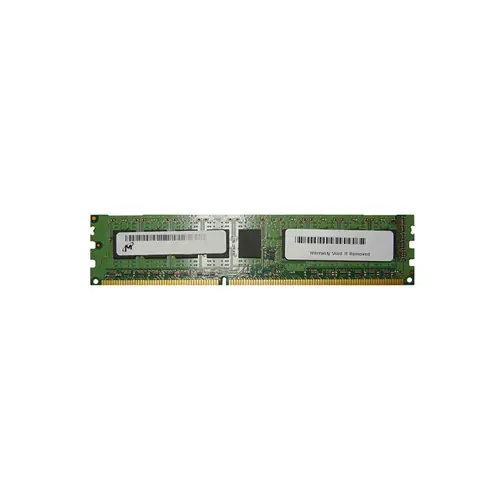
The 8GB DDR3-1600 UDIMM with ECC is a server and workstation memory module ideal for entry-level virtualization, file servers, and data-critical applications, where its unbuffered ECC design actively corrects single-bit memory errors to ensure data integrity. The dual-rank x8 configuration enhances memory interleaving for improved bandwidth utilization, while the CL11 latency at 1.5V delivers stable, power-efficient performance on single-socket platforms like Intel Xeon E3 series.
1. ECC error correction detects and corrects single-bit memory faults in real time, safeguarding transactional data integrity for mission-critical server applications.
2. 8 GB per module provides sufficient density to run multiple lightweight virtual machines or containerized workloads concurrently, optimizing consolidation ratios in small office servers.
3. Dual Rank x8 organization interleaves memory accesses across two internal ranks, boosting effective bandwidth to keep pace with multi-core CPU demands during heavy database queries.
4. 1600 MHz clock speed delivers a peak transfer rate of 12.8 GB/s, accelerating data throughput for caching and in-memory computing tasks.
5. Unbuffered signal type reduces command-to-data latency, improving responsiveness for single-socket servers where microsecond-sensitive applications like real-time analytics are hosted.
This Micron DDR3-1600 module, part number MT18JSF1G72AZ-1G6D1Z, is an 8GB Unbuffered ECC UDIMM built for entry-level servers and workstations where rock-solid data integrity matters as much as performance. Its four defining characteristics translate directly into reliability you can count on.
First, Error Correction Code (ECC) actively detects and corrects single-bit memory errors, the kind of silent data corruption caused by cosmic radiation or electrical noise. In a virtualization cluster hosting multiple VMs, one flipped bit in a hypervisor’s memory space can crash an entire host; ECC prevents that overnight outage. Second, the unbuffered architecture eliminates the extra clock cycle of registered memory, giving you lower latency for latency-sensitive tasks like in-memory databases. When Redis or Memcached serves thousands of queries per second, every nanosecond saved on access amplifies throughput. Third, the dual-rank x8 organization enables interleaved access across two internal ranks, boosting sustained bandwidth during heavy consolidation workloads where multiple VMs compete for memory. Finally, operating at the JEDEC-standard 1.5V, this module keeps thermal output within spec, preserving stability inside cramped 1U chassis where cooling is limited. For a small business file server or a home lab running ZFS, this UDIMM delivers enterprise-grade data protection without the cost of registered DIMMs, making it a prudent choice for anyone who treats uptime and accuracy as non-negotiable.
General Virtualization
Virtualized hosts demand both capacity and data integrity. This 8GB DDR3 ECC UDIMM is ideal for entry-level servers where reliability matters. Start with a 2x8GB (16GB) kit for light virtualization, but to comfortably handle multiple VMs and memory overcommitment, populate all available channels with identical modules—typically 4x8GB (32GB) or 8x8GB (64GB). The ECC feature guards against in-memory errors, a critical requirement for stable hypervisor operation.
In-Memory Database
In-memory databases like Redis or Memcached thrive on low latency and absolute data correctness. ECC unbuffered memory prevents silent data corruption in large caches. For small to mid-size datasets, deploy a balanced configuration of 4x8GB (32GB) across memory channels to maximize bandwidth. When the working set grows, scale directly to 8x8GB (64GB), ensuring all slots are filled with identical dual-rank x8 modules to maintain consistent access patterns and full ECC coverage.
High-Performance Computing (HPC)
HPC nodes require both high sustained bandwidth and can’t tolerate uncorrected errors over long simulation runs. Configure each compute node to leverage all memory channels—typically 4x8GB (32GB) per processor for quad-channel interleaving. For memory-intensive MPI jobs, double the capacity to 8x8GB (64GB) to keep large datasets in RAM. Strictly match the dual-rank, 1.5V modules across sockets to guarantee symmetric memory topology and stable 1600MHz operation, balancing performance with power efficiency in cluster environments.
Rigorously tested server memory, validated for Dell PowerEdge R210 II, T110 II, HP ProLiant ML310e Gen8.
Q: Can I mix this MT18JSF1G72AZ-1G6D1Z with other memory modules of different brands or speeds?
A: Mixing is not recommended for server environments. Different brands or speeds may cause instability and disable ECC functionality. For reliable operation, use identical modules with the same part number and batch.
Q: Is this memory compatible with my server platform?
A: This DDR3-1600 ECC Unbuffered UDIMM is designed for single-socket Intel Xeon E3/E5 or AMD Opteron platforms that accept 240-pin DDR3 ECC UDIMMs. Verify your motherboard supports 8GB dual-rank CL11 1.5V modules.
Q: What is the recommended DIMM population order for optimal performance?
A: Follow your server motherboard manual. Typically, populate identical modules per channel, starting with the slots furthest from the CPU. Maintain symmetric population across channels to maximize memory bandwidth and ECC efficiency.
Q: Does this module support overclocking or XMP profiles?
A: No, this is a standard JEDEC-compliant server memory module without XMP. It operates at fixed 1600MHz (PC3-12800) with CL11 latency. Overclocking is not supported and would compromise ECC integrity.
Q: What warranty and typical failure rate can I expect?
A: This module comes with a 1-year limited warranty. The verified Micron-built design delivers an enterprise-grade annualized failure rate (AFR) well below industry average under normal server operating conditions.