











 Secure payments
Standard refund policy
Trade Assurance
Secure payments
Standard refund policy
Trade Assurance
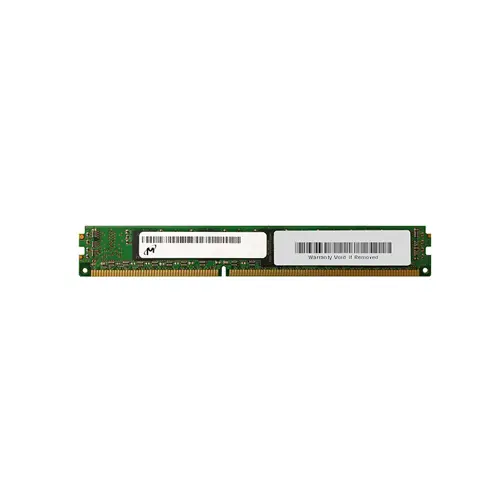
| Model | MT18KDF1G72AZ-1G6E1Z |
|---|---|
| Product Type | Memory Module |
| Compliance Standards | RoHS |
| Memory Capacity | 8 GB |
| Memory Technology | DDR3 |
| Product Voltage | 1.35V |
| RAM Speed | 1600MHz |
| RAM Standard | DDR3-1600/PC3-12800 |
| Error Identifying | ECC |
| Signal Type | Unbuffered |
| Column Access Strobe (CAS) | CL11 |
| Rank | Dual Rank x8 |
| Quantity of Pins | 240-pin |
| RAM Genre | UDIMM |
This DDR3-1600 ECC UDIMM is a server-grade memory module best suited for entry-level servers and professional workstations handling virtualization or data-critical workloads. Its dual-rank x8 organization enhances memory bandwidth through interleaving, while the integrated ECC and unbuffered signal path ensure robust data integrity and low-latency performance at a power-efficient 1.35V.
1. ECC protection continuously corrects single-bit errors, safeguarding data integrity for critical server workloads like virtualization hosts and database engines.
2. Dual-rank organization leverages rank interleaving to fully utilize the memory channel, delivering consistent throughput when multiple VMs contend for shared resources.
3. Low-voltage operation reduces overall power draw and thermal stress, lowering operational expenses in densely packed data center environments.
4. Compliance with the PC3-12800 standard supplies sufficient bandwidth for memory-intensive tasks such as in-memory caching and real-time analytics.
5. Unbuffered signaling trims access latency, giving single-socket servers a responsiveness edge in time-sensitive transactional and web-tier applications.
The Micron MT18KDF1G72AZ-1G6E1Z is a server-grade DDR3L UDIMM, purpose-built for single-socket workstations and entry-level servers where data integrity and power efficiency directly impact business continuity. Its four defining traits address real operational pain points. ECC technology safeguards against silent bit-flip errors; in a virtualization cluster, one uncorrected flip can crash multiple guest machines or corrupt an in-memory database like Redis, causing costly downtime. The 1.35V low-voltage design slashes power draw and heat output, cutting energy bills in always-on server rooms and prolonging component lifespan in dense racks. The Dual Rank x8 organization uses rank interleaving to boost sustained bandwidth, ensuring a hypervisor juggling dozens of VMs experiences smooth, contention-free memory access. Finally, the Unbuffered signal path eliminates register latency, delivering the sub-microsecond responsiveness critical for caching servers and real-time financial analytics. For SMB servers and hyper-converged appliances, this module provides the ideal balance of data protection, energy efficiency, and performance that keeps mission-critical services running reliably.
General Virtualization
For a DDR3 ECC UDIMM server platform, start by matching the number of populated channels to the CPU’s memory controller. Populate all available channels with one 8GB module each (e.g., four modules for a quad‑channel system) to maximize bandwidth without oversubscribing capacity. Leave at least one DIMM slot per channel free for future expansion, and favor identical dual‑rank x8 modules to maintain balanced interleaving and reliable ECC coverage.
In‑Memory Database
Capacity and fault tolerance are critical, so install modules in pairs or sets that utilize every channel while keeping total capacity within the UDIMM limit (typically 32–64GB). Deploy six or eight 8GB modules in a supported dual‑socket configuration to achieve 48–64GB of low‑latency memory, ensuring the dataset resides entirely in RAM. Validate that the 1.35V low‑voltage operation reduces thermal stress during sustained, latency‑sensitive workloads.
HPC
Maximize memory bandwidth by populating all available channels symmetrically; for a node with four channels per socket, install four identical 8GB modules per processor. Dual‑rank x8 DIMMs at DDR3‑1600 deliver strong throughput for memory‑bound simulations. Monitor power and cooling budgets — sticking to 1.35V UDIMMs helps keep a dense cluster within acceptable energy thresholds while providing 32–64GB per node for moderate‑scale parallel tasks.
Rigorously tested server ECC UDIMM; compatible with Dell PowerEdge T20, HP MicroServer Gen8, Lenovo ThinkServer TS140, and Supermicro X9SCL.
Q: Can I mix this MT18KDF1G72AZ-1G6E1Z with other memory modules of different brands or speeds?
A: Mixing ECC UDIMMs of different brands, speeds, or ranks risks instability and may disable ECC. For guaranteed data integrity, we strongly recommend populating your server exclusively with identical MT18KDF1G72AZ-1G6E1Z modules.
Q: Is this memory compatible with my server platform?
A: This 8GB DDR3 ECC UDIMM is compatible with select Intel Xeon E3-1200 v2/v3 and AMD AM3+ platforms supporting unbuffered ECC memory. Always confirm your server board's qualified vendor list (QVL) for validated support.
Q: What is the recommended DIMM population order for optimal performance on a server board?
A: For single module, use the farthest slot from the CPU (DIMM_A1). For dual-channel, populate identical modules in channels A and B, matching the blue slots. Always follow your system board's population guide to maintain ECC functionality.
Q: Does this module support overclocking or XMP profiles?
A: No, this is a server-grade module operating strictly at JEDEC DDR3-1600 CL11. It does not support XMP or overclocking; ECC memory prioritizes reliability and data integrity over variable frequency operation.
Q: What warranty and typical failure rate can I expect with this enterprise memory?
A: This module comes with a 1-year warranty. Enterprise memory exhibits a typical annualized failure rate (AFR) below 0.5% under standard operating conditions, backed by rigorous full-load testing before shipment.