











 Secure payments
Standard refund policy
Trade Assurance
Secure payments
Standard refund policy
Trade Assurance
| Product Type | Memory Module |
|---|---|
| Compliance Standards | RoHS |
| Memory Capacity | 8 GB |
| Memory Technology | DDR3 |
| Product Voltage | 1.5V |
| RAM Speed | 1600MHz |
| RAM Standard | DDR3-1600/PC3-12800 |
| Error Identifying | ECC |
| Signal Type | Registered |
| Column Access Strobe (CAS) | CL11 |
| Rank | Dual Rank x4 |
| Quantity of Pins | 240-pin |
| RAM Genre | RDIMM |
This 8GB DDR3-1600 RDIMM with ECC and registered signaling is engineered for legacy server platforms running memory-intensive, mission-critical workloads such as virtualization and in-memory databases, where its dual-rank x4 organization enhances signal integrity and bandwidth efficiency. Its end-to-end error correction and buffered architecture ensure consistent data integrity and stability in multi-DIMM configurations, even under sustained heavy load.
1. ECC error correction silently detects and repairs single-bit faults, shielding virtualization hosts from silent data corruption that could crash entire tenant fleets.
2. Registered buffering decouples the memory controller from the DRAM load, allowing fully populated multi-rank configurations without signal degradation in dense rack servers.
3. 8GB capacity per module gives hypervisors sufficient headroom to pack more virtual machines onto each node, directly improving consolidation ratios and lowering per-VM cost.
4. 1600 MT/s throughput keeps up with parallel I/O streams from high-speed network fabrics, preventing memory bandwidth from becoming the choke point in data-intensive analytics.
5. Dual Rank x4 layout interleaves sequential accesses across internal banks, sustaining channel utilization near peak and slashing the latency jitter that erodes consistent database response times.
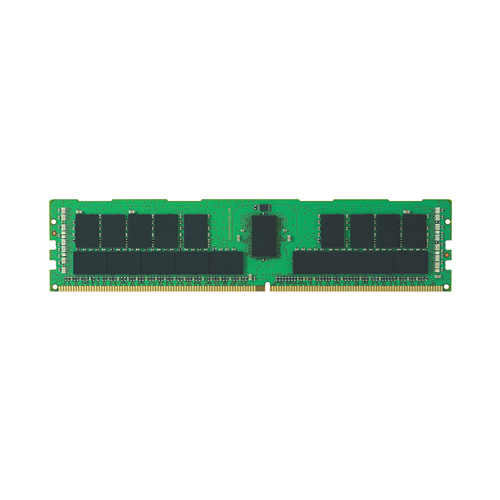
Designed for mission-critical servers, the Micron MT36JSF1G72PZ-1G6K1HE is an 8GB DDR3-1600 registered DIMM that turns technical specifications into real-world resilience. Its most vital feature, ECC, actively corrects single-bit memory errors caused by cosmic radiation or electrical noise. In a virtualization cluster hosting dozens of virtual machines, an undetected bit flip can silently corrupt a hypervisor page table, leading to cascading VM crashes and hours of troubleshooting. ECC eliminates that risk, ensuring workload continuity. The registered signal buffer stabilizes the electrical load on the memory bus, which becomes critical when populating all 24 DIMM slots in a database server. Without a register, high-density configurations suffer signal degradation that triggers intermittent boot failures or data corruption under heavy write loads. The dual-rank x4 organization interleaves internal memory banks, delivering higher sustained bandwidth for in-memory databases like Redis or SAP HANA. During peak OLTP transactions, this bank-level parallelism keeps read latency low even as requests queue, preventing the soft timeouts that frustrate end users. Finally, the 1600MHz speed matches mainstream enterprise platforms, giving you a balanced blend of throughput and 1.5V power efficiency that avoids throttling in dense rack deployments. Together, these four traits form a foundation where data integrity, system stability, and responsive performance are non-negotiable.
General Virtualization
For a balanced hypervisor host, populate at least six of these 8 GB RDIMMs across all memory channels to achieve 48 GB. This capacity comfortably supports 10–15 light to medium VMs. Always install modules in matched sets per processor memory controller to preserve symmetrical multi-channel access and maximize throughput.
In-Memory Database
Memory-resident databases demand both capacity and rock‑solid data integrity. Deploy the maximum supported RDIMM count — typically 24 modules in a dual‑socket server — for a 192 GB pool. The ECC and registered design eliminate single-bit errors and signal degradation at scale, which is critical for caching entire datasets in Redis or SAP HANA.
HPC
High‑performance computing workloads are acutely latency‑sensitive. Populate one DIMM per channel (e.g., 8 modules for a dual eight‑channel platform, totalling 64 GB) to run at the DIMM’s native 1600 MT/s without derating. This minimum‑per‑channel strategy delivers the highest bandwidth per core for tightly‑coupled MPI jobs and computational fluid dynamics solvers.
Rigorously tested, compatible with servers: Dell PowerEdge R720, HP DL380p Gen8, Lenovo x3650 M4.
Q: Can I mix this MT36JSF1G72PZ-1G6K1HE with other memory modules of different brands or speeds?
A: Mixing Registered ECC modules from different vendors or speeds is strongly discouraged. It can cause signal integrity issues, limit speed to the slowest DIMM, and compromise server stability which is critical for enterprise workloads.
Q: Is this memory compatible with my system?
A: This RDIMM is designed for servers using Intel Xeon E5-2600/E5-2400 series or AMD equivalent platforms with C600-series chipsets. Verify your board specifically requires 1.5V DDR3-1600 Registered ECC 240-pin memory.
Q: What is the recommended DIMM population order for optimal performance?
A: Populate identical DIMMs in matched sets per memory channel, following your server motherboard's slot numbering (typically 1 DIMM per channel first). This ensures balanced interleaving and maximum throughput in multi-channel architectures.
Q: Does this module support overclocking or XMP profiles?
A: No. This is a server-grade Registered ECC DIMM built for 24/7 stability at JEDEC standard DDR3-1600 with CL11 timings. It does not support XMP or memory overclocking, as data integrity takes absolute priority in server environments.
Q: What warranty and typical failure rate can I expect?
A: This module is covered by a 1-year warranty. Enterprise-class Registered ECC memory exhibits extremely low failure rates under specified operating conditions, typically delivering reliability metrics that far exceed standard desktop components.