











 Secure payments
Standard refund policy
Trade Assurance
Secure payments
Standard refund policy
Trade Assurance
| Product Type | Memory Module |
|---|---|
| Compliance Standards | RoHS |
| Memory Capacity | 8 GB |
| Memory Technology | DDR3 |
| Product Voltage | 1.5V |
| RAM Speed | 1600MHz |
| RAM Standard | DDR3-1600/PC3-12800 |
| Error Identifying | ECC |
| Signal Type | Registered |
| Column Access Strobe (CAS) | CL11 |
| Rank | Dual Rank x8 |
| Quantity of Pins | 240-pin |
| RAM Genre | RDIMM |
This 8 GB DDR3-1600 RDIMM with ECC is purpose-built for server platforms running memory-intensive workloads such as virtualization and in-memory databases, where data integrity is non-negotiable. Its dual-rank x8 configuration and registered signal buffering ensure heightened signal stability and consistent performance, while the CL11 timing delivers a reliable balance of latency and throughput under sustained heavy load.
1. Registered DIMM architecture ensures signal integrity across fully populated memory channels, delivering the reliability required for always-on enterprise infrastructure.
2. Error-correcting code protection actively detects and repairs single-bit memory faults, preserving data accuracy in transactional and financial processing.
3. Sufficient memory footprint accommodates dense virtual machine consolidation, optimizing server utilization while lowering cost per workload.
4. High-speed data rate keeps pace with concurrent multi-threaded operations, reducing bottlenecks in database and virtualized environments.
5. Dual-rank configuration with bank interleaving maximizes command throughput, improving latency consistency for memory-bound analytic applications.
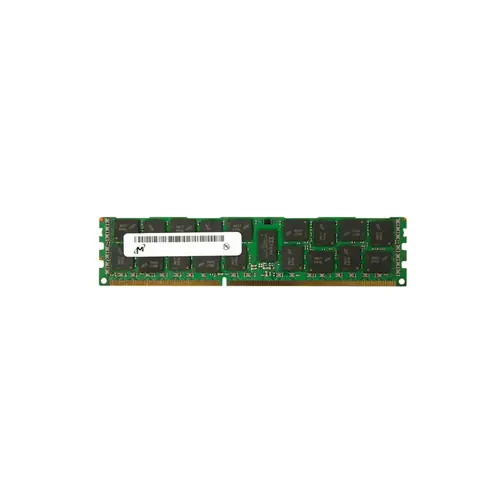
The Micron MT18JSF1G72PDZ-1G6E1 is a server-class Registered DIMM, purpose-built for enterprise environments where uptime and data integrity are absolute. Its defining characteristics are ECC error correction, registered buffering, a dual-rank x8 organization, and a 1600MHz speed grade.
In a virtualized cluster, ECC is your silent guardian. A single-bit flip from background radiation inside a hypervisor host can corrupt application data without warning; ECC detects and corrects these errors on the fly, preventing mysterious VM crashes and protecting the entire stack. The registered buffer stabilizes the signaling across densely populated channels, so you can fully load 24 DIMM slots on a dual-socket server and reliably scale to hundreds of gigabytes for heavy consolidation—no signal degradation, no costly downtime.
For an in-memory database like Redis or an OLTP engine, the dual-rank design boosts throughput through rank interleaving: the memory controller pipelines reads across ranks, hiding precharge latency and sustaining higher IOPS under concurrent user load. Coupled with 1600MT/s raw bandwidth, queries served from RAM complete noticeably faster. This isn’t just a specification list—it is the difference between a database that stumbles during peak hours and one that delivers predictable, low-latency responses, keeping your revenue-critical services running without compromise.
This memory is a server-class DDR3 Registered ECC RDIMM (8 GB, 1600 MHz, dual-rank x8, CL11, 1.5 V). Capacity planning guidance for typical server workloads follows.
General Virtualization
Populate all memory channels symmetrically with identical 8 GB RDIMMs to ensure balanced performance. In a dual‑socket platform with four channels per CPU, one DIMM per channel yields 64 GB, comfortably supporting 10–20 light to moderate virtual machines. To double capacity, add a second DIMM per channel for 128 GB total, but be aware the memory speed will likely downshift to 1333 MHz.
In-Memory Database
Maximize total capacity by filling every DIMM slot. With three dual‑rank 8 GB RDIMMs per channel on a dual‑processor server, you can reach 384 GB or more for large in‑memory datasets. The registered ECC design preserves signal integrity at high densities, which is essential for the stability of latency‑sensitive databases like SAP HANA or Redis.
High-Performance Computing
Prioritize bandwidth by installing exactly one DIMM per memory channel. An 8‑channel configuration provides 64 GB of high‑speed 1600 MT/s memory, ideal for many CFD or finite‑element simulations. If larger capacity is required, populate two DIMMs per channel to achieve 128 GB while accepting the speed reduction to 1333 MHz; the dual‑rank organization still offers good command‑rate efficiency.
Rigorously tested server memory, compatible with Dell PowerEdge R720, HP ProLiant DL380p Gen8, and similar systems.
Q: Can I mix this MT18JSF1G72PDZ-1G6E1 with other memory modules of different brands or speeds?
A: Mixing is not recommended. For RDIMMs, identical part numbers ensure consistent signal integrity and ECC functionality. Mixing speeds forces all modules to run at the lowest common speed, often causing instability.
Q: Is this memory compatible with my Intel E5-2600 v1/v2 or AMD Opteron server platform?
A: Yes, it is compatible with platforms supporting DDR3-1600 Registered ECC memory. Verify your board supports 240-pin RDIMMs and 1.5V operation; typically Intel C600 or AMD SR56x0 chipset-based servers.
Q: What is the recommended DIMM population order for optimal performance?
A: Populate identical DIMMs per channel, following your server board's manual. Typically, install in banks of triple or quadruple symmetric slots to maintain balanced memory interleaving and full ECC protection.
Q: Does this module support overclocking or XMP profiles?
A: No. This is a server-grade Registered ECC DIMM, running at JEDEC standard DDR3-1600 with CL11 timings. It does not support XMP and is not intended for overclocking to ensure data integrity.
Q: What warranty and typical failure rate can I expect?
A: This module comes with a 1-year warranty. The typical annualized failure rate for server memory is below 0.1% under specified conditions, reflecting high-quality screening and ECC reliability hardening.