











 Secure payments
Standard refund policy
Trade Assurance
Secure payments
Standard refund policy
Trade Assurance
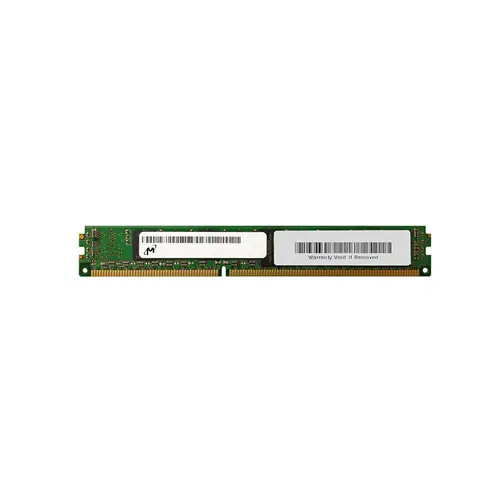
| Model | MT18KDF1G72AZ-1G6J1 |
|---|---|
| Product Type | Memory Module |
| Compliance Standards | RoHS |
| Memory Capacity | 8 GB |
| Memory Technology | DDR3 |
| Product Voltage | 1.35V |
| RAM Speed | 1600MHz |
| RAM Standard | DDR3-1600/PC3-12800 |
| Error Identifying | ECC |
| Signal Type | Unbuffered |
| Column Access Strobe (CAS) | CL11 |
| Rank | Dual Rank x8 |
| Quantity of Pins | 240-pin |
| RAM Genre | UDIMM |
This DDR3L-1600 UDIMM with ECC is tailored for entry-level servers and workstations where data integrity is critical, leveraging dual-rank x8 organization to improve memory interleaving and sustained bandwidth under multi-threaded workloads such as virtualization and light database applications. Its 1.35V low-voltage operation combined with unbuffered signal topology reduces power consumption and latency, while ECC protection ensures silent error correction for enhanced system stability.
1. Error-correcting code protection prevents single-bit data corruption, safeguarding transactional integrity in database and virtualization workloads running 24/7.
2. Unbuffered signaling keeps command-to-DRAM latency minimal, suiting microservers and edge appliances where cost-effective reliability matters more than raw capacity scaling.
3. Low 1.35V operation reduces server power draw and cooling overhead, directly lowering total cost of ownership in dense rack deployments.
4. 1600MT/s data rate delivers sufficient per-channel throughput for entry-level web servers, file sharing, and lightweight containerized applications.
5. Dual-rank organization interleaves memory accesses across two internal bank groups, elevating effective bandwidth under multi-threaded server software without requiring additional DIMMs.
The Micron MT18KDF1G72AZ-1G6J1 is an 8GB DDR3-1600 UDIMM with ECC, purpose-built for entry-level servers, micro-servers, and small business NAS systems where data integrity cannot be compromised. In these environments, an undetected bit-flip is not a theoretical risk—it directly corrupts financial records in a lightweight database or quietly destabilizes a virtualized domain controller. The module’s ECC engine corrects single-bit errors on the fly, meaning your always-on services remain accurate without silent data decay.
When you consolidate several VMs on a single socket, both thermals and memory bandwidth become critical. Operating at a low 1.35V, this module draws less power and generates less heat than standard 1.5V DDR3, which reduces cooling cost and improves long-term reliability inside a cramped 1U chassis. Its dual-rank x8 organization further interleaves memory banks, delivering measurably higher sustained throughput for applications like an in-memory Redis cache or a ZFS file system under heavy concurrent access. At 1600MHz and CL11, read latencies stay tight, accelerating transaction commits. Together, these four attributes mean you are not just adding capacity—you are hardening a small-scale infrastructure against downtime, bit corruption, and thermal drift, all within a strict power budget.
General Virtualization
This ECC UDIMM is suitable for single-socket servers or workstations hosting moderate virtualization workloads. For a typical hypervisor running 8–10 light VMs, install two 8 GB modules in dual-channel to reach 16 GB total, ensuring ECC protection for host stability. Scale to four modules (32 GB) if you need headroom for more VMs or memory overcommitment, but stay within the UDIMM limit of the platform.
In-Memory Database
For in-memory databases like Redis or Memcached, capacity and error resilience are critical. Populate all four UDIMM slots with identical 8 GB modules to achieve 32 GB of ECC-protected memory, maximizing available dataset size on a single-socket server. Match the dual-rank x8 organization per channel to maintain signal integrity and consistent latency under sustained read/write loads.
High-Performance Computing
HPC nodes built on single-socket, unbuffered ECC platforms benefit from balanced memory configurations. Use four 8 GB dual-rank UDIMMs (32 GB total) to populate one DIMM per channel across the CPU’s four memory channels, ensuring maximum memory bandwidth. The low 1.35 V operation reduces power draw per node in dense clusters, while ECC safeguards long-running simulations against silent data corruption.
Validated reliable in servers: Dell PowerEdge R220, HP MicroServer Gen8, Lenovo TS140, and more.
Q: Can I mix this MT18KDF1G72AZ-1G6J1 with other memory modules of different brands or speeds?
A: Mixing ECC UDIMMs is not recommended. Mismatched brands or speeds may cause stability issues or force all modules to the lowest common speed, compromising server reliability.
Q: Is this memory compatible with my Intel or AMD server platform?
A: This ECC UDIMM is compatible with single-socket servers using Intel Xeon E3/E5 v1/v2 or AMD Opteron 3000/4000 series CPUs and corresponding C200/C600 or SR56x0 chipset boards.
Q: What is the recommended DIMM population order for optimal performance?
A: For dual-channel servers, populate identical DIMMs in paired slots (typically the blue slots first). Always follow your motherboard’s manual to enable memory interleaving and full ECC support.
Q: Does this module support overclocking or XMP profiles?
A: No. This is a server-grade JEDEC-standard module without XMP. It is designed to run reliably at the specified 1600 MHz (PC3-12800) with CL11 timings for 24/7 operation.
Q: What warranty and typical failure rate can I expect?
A: This module includes a 1-year warranty. Its ECC design and industrial-grade testing result in an extremely low annual failure rate (typically <0.5%), ensuring minimal downtime.