











 Secure payments
Standard refund policy
Trade Assurance
Secure payments
Standard refund policy
Trade Assurance
| Model | MT18KDF1G72AZ-1G6E1ZF |
|---|---|
| Product Type | Memory Module |
| Compliance Standards | RoHS |
| Memory Capacity | 8 GB |
| Memory Technology | DDR3 |
| Product Voltage | 1.35V |
| RAM Speed | 1600MHz |
| RAM Standard | DDR3-1600/PC3-12800 |
| Error Identifying | ECC |
| Signal Type | Unbuffered |
| Column Access Strobe (CAS) | CL11 |
| Rank | Dual Rank x8 |
| Quantity of Pins | 240-pin |
| RAM Genre | UDIMM |
This 8GB DDR3L-1600 UDIMM with ECC targets single-socket servers and entry-level workstations where data integrity is critical for virtualization and small-scale memory databases. Its dual-rank x8 configuration improves bank-level parallelism for steady throughput, while the 1.35V low-voltage operation reduces power draw in always-on deployments.
1. ECC protection detects and corrects single-bit memory errors in real time, preserving data integrity during critical database transactions or long-running virtualization workloads.
2. Unbuffered UDIMM architecture minimizes signal latency and ensures broad compatibility with entry-level server motherboards, keeping single-socket system costs in check.
3. An 8 GB capacity comfortably supports multiple lightweight virtual machines or containerized web services, striking the right balance between density and budget for small-scale virtualization.
4. DDR3-1600 operation delivers steady multi-gigabyte-per-second bandwidth, helping file and print servers maintain responsive data access under concurrent user requests.
5. Low 1.35V voltage reduces energy draw and heat generation in always-on server deployments, lowering cooling overhead and improving long-term reliability in dense microserver enclosures.
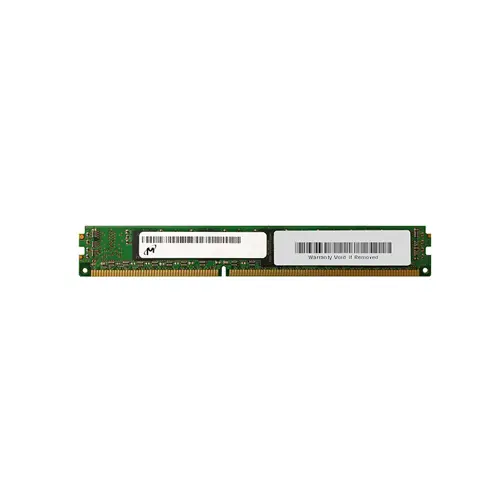
The Micron MT18KDF1G72AZ-1G6E1ZF is an Unbuffered ECC UDIMM engineered for entry-level servers and workstations where data integrity is non-negotiable. Its ECC capability is vital for correcting single-bit errors caused by background radiation. In a virtualized cluster, a flipped memory bit can silently corrupt a VM kernel, triggering cascading service failures; this module detects and corrects such errors in real time, preserving uptime for your critical workloads. Because it is unbuffered, it delivers low command-to-address latency, a critical advantage for latency-sensitive applications that cannot tolerate the additional clock cycles of registered memory. For in-memory databases like Redis, where all operational data sits in volatile RAM, an undetected bit flip can corrupt financial records or break transactional integrity—the ECC acts as an integrity shield. The dual-rank x8 organization enables memory interleaving, overlapping row activation delays to boost effective bandwidth under heavy load. The 1.35V low-voltage design cuts power draw and waste heat, reducing cooling costs and total cost of ownership in your server racks.
This module is an 8GB DDR3L-1600 ECC Unbuffered UDIMM with 1.35V low voltage and dual-rank x8 organization. ECC and server-friendly voltage make it ideal for entry-level servers, microservers, and workstations that require data integrity without the cost of registered memory. Below is the capacity planning guidance for typical server-side workloads.
General Virtualization
Start with a minimum of four identical modules (32 GB total) to comfortably host multiple light to medium VMs on a hypervisor like VMware ESXi or Proxmox. For consolidation ratios above 10 VMs per host, fill all available DIMM slots to reach 64 GB, ensuring ECC protection guards against in-memory corruption during live migrations and snapshots.
In-Memory Database
Deploy in a balanced configuration of six or eight identical sticks (48–64 GB) to keep entire datasets resident in RAM for Redis or SAP HANA test instances. Use all memory channels available on the platform to maximize bandwidth and reduce latency, which is critical for high-throughput key-value operations and real-time analytics.
High-Performance Computing
Populate all memory channels symmetrically with 8–16 DIMMs (64–128 GB) to feed compute-bound MPI and OpenMP workloads. Dual-rank DIMMs like this one provide a slight bandwidth advantage per channel, so pairing them across channels helps sustain high throughput for simulation and modeling runs without swapping to disk.
This ECC UDIMM server memory is validated for Dell PowerEdge T110 II, T20, HP ProLiant ML10 v2.
Q: Can I mix this MT18KDF1G72AZ-1G6E1ZF with other memory modules of different brands or speeds?
A: Mixing is not recommended for server environments. Different timings or ranks may degrade ECC integrity and cause instability. For guaranteed performance, always install identical modules with the same Micron part number.
Q: Is this memory compatible with my server platform, such as Intel Xeon E3 or AMD Opteron?
A: This DDR3-1600 ECC UDIMM is designed for uniprocessor servers and workstations. Verify your board supports 1.35V ECC Unbuffered DIMMs. Common compatible chipsets include Intel C200/C220 series and AMD 900-series.
Q: What is the recommended DIMM population order for optimal performance?
A: Populate identically colored slots per channel first, starting with the farthest DIMM slot from the CPU. For dual-channel platforms, install matched pairs in channel A and B slot 1. Always consult the motherboard manual.
Q: Does this module support overclocking or XMP profiles?
A: No. This is a JEDEC-compliant server memory module running at standard DDR3-1600 CL11. It does not support XMP or overclocking; it prioritizes stability and ECC error correction over frequency scaling.
Q: What warranty and typical failure rate can I expect?
A: It includes a 1-year manufacturer warranty. Micron UDIMMs exhibit an extremely low annualized failure rate, typically under 0.2%, ensuring robust long-term reliability in 24/7 server operation.