











 Secure payments
Standard refund policy
Trade Assurance
Secure payments
Standard refund policy
Trade Assurance
| Product Type | Memory Module |
|---|---|
| Compliance Standards | RoHS |
| Memory Capacity | 8 GB |
| Memory Technology | DDR3 |
| Product Voltage | 1.35V |
| RAM Speed | 1600MHz |
| RAM Standard | DDR3-1600/PC3-12800 |
| Error Identifying | ECC |
| Signal Type | Unbuffered |
| Column Access Strobe (CAS) | CL11 |
| Rank | Dual Rank x8 |
| Quantity of Pins | 240-pin |
| RAM Genre | UDIMM |
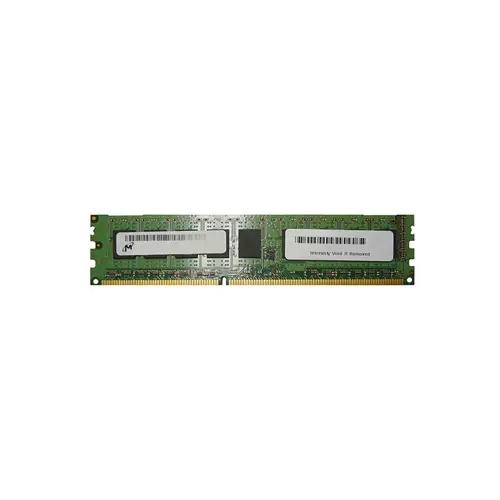
This unbuffered ECC DDR3 module with a low 1.35 V operating voltage and dual-rank x8 organization is ideally suited for entry-level servers and small business NAS systems where data integrity is paramount. The error-correcting code capability actively detects and corrects single-bit memory errors, while the dual-rank configuration improves interleaving efficiency for more consistent throughput under sustained, always-on workloads.
1. ECC protection silently corrects single-bit errors in real time, safeguarding data integrity for mission-critical server applications and minimizing downtime caused by memory faults.
2. Modest per-module capacity strikes a cost-effective balance, allowing dense memory configurations in virtualized environments without overspending on oversized DIMMs.
3. The DDR3-1600 speed tier delivers sufficient bandwidth to keep legacy enterprise workloads responsive, supporting steady database transactions and web serving under moderate concurrency.
4. Low-voltage operation trims overall power consumption and waste heat, directly lowering electricity and cooling expenses in always-on rack deployments.
5. Dual-rank organization interleaves memory accesses for higher command throughput, sustaining application performance even under heavy multi-threaded server loads.
Designed for entry-level servers and workstations, the MT18KSF1G72AZ-1G6E1ZF DDR3 UDIMM delivers four critical attributes that directly solve real-world infrastructure challenges. First, ECC error correction guards against single-bit upsets—a crucial defense in virtualization clusters, where unchecked memory errors can silently corrupt hypervisor state and crash multiple guest machines or in-memory databases like Redis. Second, the dual-rank x8 architecture enables rank interleaving, significantly increasing bandwidth when numerous VMs hammer the memory bus simultaneously, preventing performance bottlenecks. Third, its ultra-low 1.35V voltage dramatically cuts power consumption and thermal output in dense, always-on deployments, reducing cooling costs and increasing rack density. Finally, a 1600MHz clock speed paired with CL11 latencies offers the ideal balance of throughput and responsiveness for real-time analytics and transaction processing, keeping latency-sensitive applications running smoothly. With this ECC UDIMM, IT administrators ensure data integrity, scale for mixed workloads, and control operational expenses—all without stepping up to costly registered memory.
General Virtualization
For a typical single-socket virtualization host that supports ECC UDIMMs, install four 8 GB modules (32 GB total) across both memory channels. This configuration balances cost and capacity, comfortably hosting 8–10 moderate virtual machines. If higher consolidation ratios are needed, populate all available slots—up to eight modules for 64 GB—to extend headroom while maintaining ECC protection.
In-Memory Database
In-memory databases demand both capacity and data integrity. Fully populate the platform’s DIMM slots with identical 8 GB ECC UDIMMs; a board with two channels and two DIMMs per channel yields 64 GB, suitable for moderate in-memory datasets. Matching modules across channels ensures stable, predictable latency and avoids performance penalties that mixed ranks or densities can introduce.
High-Performance Computing
HPC nodes benefit from dual-channel interleaving to maximize bandwidth. Start with a balanced set of four 8 GB modules (32 GB) installed in matched pairs to enable 128‑bit memory access. For workloads that favor large working sets over peak bandwidth, scale up to the maximum supported UDIMM configuration of 64 GB, using identical dual‑rank x8 modules to preserve signal integrity and uniform access times across ranks.
This server memory has been rigorously tested and is compatible with Dell PowerEdge T20, HP MicroServer Gen8, Lenovo ThinkServer TS140.
Q: Can I mix this MT18KSF1G72AZ-1G6E1ZF with other memory modules of different brands or speeds?
A: Mixing ECC UDIMMs of different brands or speeds is not recommended. It may disable ECC capability or cause system instability. Use identical modules with matching speed, rank, and timings.
Q: Is this memory compatible with my system?
A: This 8GB DDR3L ECC UDIMM is compatible with select Intel Xeon E3 and AMD Opteron platforms that support unbuffered ECC memory. Verify support on your motherboard or server QVL list.
Q: What is the recommended DIMM population order for optimal performance?
A: On dual-channel platforms, install identical modules in the slots from the same channel, typically A1 and B1 first. Follow your server board manual for balanced memory configuration and best ECC operation.
Q: Does this module support overclocking or XMP profiles?
A: No, this is a JEDEC-compliant server ECC UDIMM running at standard DDR3-1600 speed. It does not support overclocking or XMP profiles, ensuring stability in mission-critical environments.
Q: What warranty and typical failure rate can I expect?
A: It includes a 1-year warranty. Micron server-grade UDIMMs typically achieve an annualized failure rate (AFR) well below 0.5% under normal operating conditions when properly installed.