











 Secure payments
Standard refund policy
Trade Assurance
Secure payments
Standard refund policy
Trade Assurance
| Product Type | Memory Module |
|---|---|
| Memory Capacity | 8 GB |
| Memory Technology | DDR3 |
| Product Voltage | 1.35V |
| RAM Speed | 1600MHz |
| RAM Standard | DDR3-1600/PC3-12800 |
| Error Identifying | ECC |
| Signal Type | Unbuffered |
| Column Access Strobe (CAS) | CL11 |
| Rank | Dual Rank x8 |
| Quantity of Pins | 240-pin |
| RAM Genre | UDIMM |
This 8GB DDR3-1600 ECC UDIMM is tailored for entry-level servers and single-socket workstations where data integrity is critical, such as small business file servers, virtualization hosts, or memory-intensive embedded systems. Its dual-rank x8 configuration delivers improved command and data bus utilization, while the 1.35V low‑voltage operation reduces power consumption without sacrificing the signal reliability of the unbuffered architecture and ECC protection.
1. ECC error correction silently detects and fixes single-bit errors, preserving data integrity in 24/7 server memory arrays where even a single undetected bit flip could crash a virtualized database.
2. The 1.35-volt low-power operation shrinks thermal and electrical budgets per DIMM, allowing denser rack deployments and reducing cooling overhead in always-on infrastructure.
3. An eight-gigabyte capacity per module delivers optimal density for entry-level virtualization nodes, letting you maximize VM counts without overspending on oversized registered DIMMs.
4. Dual-rank organization interleaves memory accesses across internal banks, sustaining channel bandwidth under heavy consolidation so latency-sensitive multi-tenant applications stay responsive.
5. DDR3-1600 throughput matches the needs of legacy server chipsets, ensuring stable data feeding for in-memory caching and containerized microservices without introducing a bandwidth cliff.
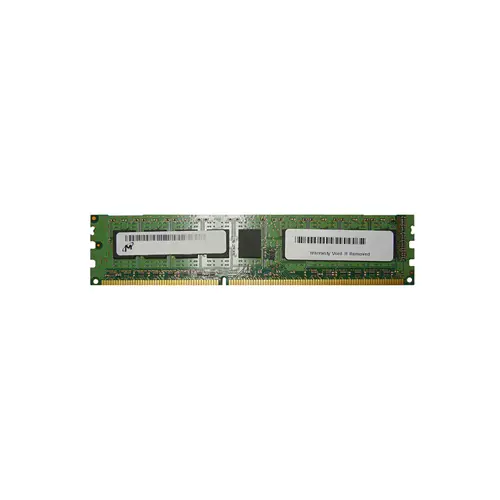
The Micron MT18KSF1G72AZ-1G6E1ZG is an 8GB DDR3-1600 Unbuffered ECC UDIMM built for servers and workstations where reliability shapes every transaction. Its four defining characteristics translate directly into safer, faster operations. First, ECC protection actively corrects single-bit errors, preventing silent data corruption that could crash virtual machines or corrupt a transactional database inside a consolidation cluster—keeping your multi-tenant environment healthy. Second, the 1.35V low-voltage design slashes power draw and waste heat, allowing microserver farms to run denser and cooler while cutting 24/7 energy bills. Third, 1600MHz speed combined with a dual-rank x8 organization enables rank interleaving, boosting effective bandwidth for in-memory databases like Redis; this delivers higher queries per second and lower tail latency under concurrent loads. Finally, the unbuffered architecture eliminates the register delay found in RDIMMs, giving latency-sensitive applications a snappier response without sacrificing mandatory ECC. Together, these attributes ensure your critical workloads remain error-free, energy-smart, and noticeably more responsive.
Based on the specifications—DDR3 1600MHz, ECC, Unbuffered, 240-pin UDIMM, and 1.35V low voltage—this is a server-grade memory module, ideal for entry-level servers and single-socket workstations that support unbuffered ECC DIMMs. Below is the capacity planning guidance for typical server workloads.
General Virtualization
For a light virtualization host running 3–5 modest VMs, a pair of these 8 GB modules (16 GB total) in dual-channel mode provides a cost‑effective start. Always populate in matched pairs to maintain memory bandwidth and ECC integrity, and leave spare DIMM slots for future growth.
In-Memory Database
In-memory databases demand both capacity and data protection. Deploy six to eight of these UDIMMs (48–64 GB) across all available channels to keep the active dataset in RAM while fully leveraging ECC to prevent silent data corruption. Dual‑rank x8 modules help balance load and improve throughput on limited channels.
High-Performance Computing (HPC)
For memory‑bandwidth‑sensitive HPC tasks, populate every memory channel with identical modules—typically four or six sticks for a quad/six‑channel platform—to maximize interleaving. Pair this 1.35V low‑voltage DDR3 with a power‑efficient CPU to reduce thermal overhead in dense cluster nodes, allowing sustained compute performance within tight power envelopes.
This rigorously tested 8GB DDR3 ECC UDIMM is compatible with Dell R210 II, R310, T110 II, HP MicroServer Gen8.
Q: Can I mix this MT18KSF1G72AZ-1G6E1ZG with other memory modules of different brands or speeds?
A: Mixing is not recommended. For reliable ECC operation, install identical modules. Mismatched speeds or brands may force the system to run at the lowest common speed, potentially causing instability or loss of error correction.
Q: Is this memory compatible with my server platform, specifically Intel Xeon E3 or entry-level AMD EPYC systems?
A: This ECC UDIMM is designed for Intel Xeon E3/E5-1xxx and select AMD platforms that support unbuffered ECC DDR3. Please verify your motherboard's qualified vendor list to ensure compatibility with 8GB dual-rank modules.
Q: What is the recommended DIMM population order for optimal performance in a server motherboard?
A: Always follow your server board's manual. Typically, populate dual-channel slots per CPU first, starting with the furthest slots. This module's dual-rank configuration benefits from balanced channel loading for maximum throughput.
Q: Does this module support overclocking or XMP profiles?
A: No. As a server-grade ECC UDIMM, this module adheres to JEDEC DDR3-1600 (PC3-12800) standards at 1.35V. ECC memory is designed for stability and data integrity, not for overclocking or XMP performance tuning.
Q: What warranty and typical failure rate can I expect for this Micron module?
A: This MT18KSF1G72AZ module includes a 1-year warranty. Enterprise-class Micron UDIMMs exhibit very low failure rates under normal server operating conditions, ensuring long-term reliability for critical workloads.