











 Secure payments
Standard refund policy
Trade Assurance
Secure payments
Standard refund policy
Trade Assurance
| Product Type | Memory Module |
|---|---|
| Memory Capacity | 8 GB |
| Memory Technology | DDR3 |
| Product Voltage | 1.35V |
| RAM Speed | 1600MHz |
| RAM Standard | DDR3-1600/PC3-12800 |
| Error Identifying | ECC |
| Signal Type | Unbuffered |
| Column Access Strobe (CAS) | CL11 |
| Rank | Dual Rank x8 |
| Quantity of Pins | 240-pin |
| RAM Genre | UDIMM |
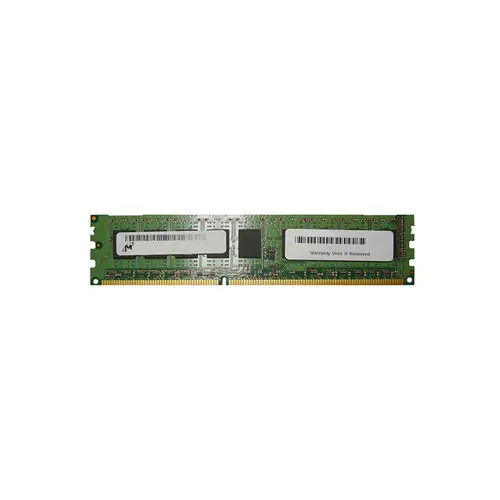
This 8GB DDR3-1600 ECC unbuffered DIMM is engineered for entry-level servers and single-socket workstations requiring data integrity, where its 1.35V low-voltage operation and error correction deliver reliable, power-efficient performance for virtualization and file-system workloads like ZFS. The dual-rank x8 organization increases interleaved bank access and available bandwidth, while CL11 latency and unbuffered signaling maintain stable, responsive operation in platforms that support unbuffered ECC memory.
1. ECC protection detects and corrects single-bit errors, preserving data integrity in always-on server tasks such as file serving and virtualization.
2. 1.35V operation lowers energy consumption and heat generation, allowing denser memory populations in space-constrained microserver chassis.
3. 8 GB capacity per module suits lightweight server roles or edge nodes running Linux containers, keeping cost per gigabyte affordable.
4. Dual Rank x8 architecture interleaves accesses across rank boundaries, sustaining memory bandwidth under concurrent multi-tenant workloads.
5. Unbuffered signal type minimizes electrical loading and access latency, giving single-socket workstations and entry servers snappier response for database queries.
The Micron MT18KSF1G72AZ-1G6P1ZF is a server-grade DDR3 UDIMM engineered for always-on reliability. Its four defining characteristics directly address critical operational headaches. ECC error correction proactively fixes single-bit memory errors that silently corrupt hypervisor states in virtualization clusters, preventing cascading guest failures and protecting business continuity. The 1.35V low-voltage specification substantially cuts power draw and heat output, lowering cooling overheads in dense server rooms while sustaining full 1600MHz throughput—a direct reduction in operating expenses. Dual-rank x8 interleaving delivers higher sustained bandwidth, essential for in-memory databases like Redis where microsecond delays degrade user experience and transaction throughput. Unlike registered modules, this unbuffered DIMM eliminates register-induced latency, offering faster command-to-data turnaround ideal for latency-sensitive workloads and guaranteeing seamless compatibility with entry-level single-socket servers and workstations. In a small business deploying virtualized file services alongside a real-time caching layer, these traits transform a simple memory upgrade into a strategic asset where data integrity, energy efficiency, and responsive performance are absolutely non-negotiable.
General Virtualization
Populate all memory channels with identical 8 GB ECC UDIMMs to guarantee reliable bandwidth and data integrity for multiple virtual machines. A four-module configuration (32 GB) installed in matching pairs across dual channels is a balanced starting point for small hypervisor hosts and general VM density.
In-Memory Database
In-memory databases demand maximum capacity and uncompromised stability. On a typical four-slot UDIMM platform, install four 8 GB modules to reach 32 GB; if the board supports eight slots, scale to eight modules for 64 GB. Always use matched dual-rank x8 DIMMs to maintain consistent ECC operation under heavy write loads.
High-Performance Computing (HPC)
HPC applications are highly sensitive to memory bandwidth. Begin with at least two 8 GB modules in a dual-channel arrangement (16 GB) to double throughput. For optimal node performance, fully populate both channels with two DIMMs each (four identical 8 GB modules, 32 GB), enabling balanced interleaving and lower latency for compute-intensive simulations.
Tested server memory, compatible with Dell PowerEdge T20, HP MicroServer Gen8, Lenovo ThinkServer TS140, and similar.
Q: Can I mix this MT18KSF1G72AZ-1G6P1ZF with other memory modules of different brands or speeds?
A: Mixing brands or speeds is not recommended for server memory. All installed modules should match in speed, rank, and timings to ensure stable ECC operation and avoid system errors.
Q: Is this memory compatible with my system?
A: Compatibility depends on your server motherboard and CPU. This ECC DDR3-1600 UDIMM requires a platform supporting unbuffered ECC memory, such as Intel Xeon E3 series or AMD AM3+ Opteron configurations. Verify your board’s QVL.
Q: What is the recommended DIMM population order for optimal performance?
A: Populate identical modules per channel following the server board’s manual—typically filling blue slots first for dual-channel operation. Balanced configurations maintain symmetrical ranks across memory channels to maximize throughput.
Q: Does this module support overclocking or XMP profiles?
A: No, this ECC server DIMM does not support overclocking or XMP profiles. It operates strictly at JEDEC standard DDR3-1600 timing sets to guarantee data integrity and 24/7 reliability in mission-critical environments.
Q: What warranty and typical failure rate can I expect?
A: This module is backed by a one-year warranty. Server-grade ECC UDIMMs typically exhibit very low annualized failure rates (AFR), well below 0.5%, when operated within specified thermal and voltage ranges.