











 Secure payments
Standard refund policy
Trade Assurance
Secure payments
Standard refund policy
Trade Assurance
| Product Type | Memory Module |
|---|---|
| Compliance Standards | RoHS |
| Memory Capacity | 8 GB |
| Memory Technology | DDR3 |
| RAM Speed | 1600 |
| RAM Standard | DDR3-1600/PC3-12800 |
| Error Identifying | Non-ECC |
| Signal Type | Unbuffered |
| Column Access Strobe (CAS) | CL11 |
| Rank | Dual Rank x8 |
| Quantity of Pins | 204-pin |
| RAM Genre | SoDIMM |
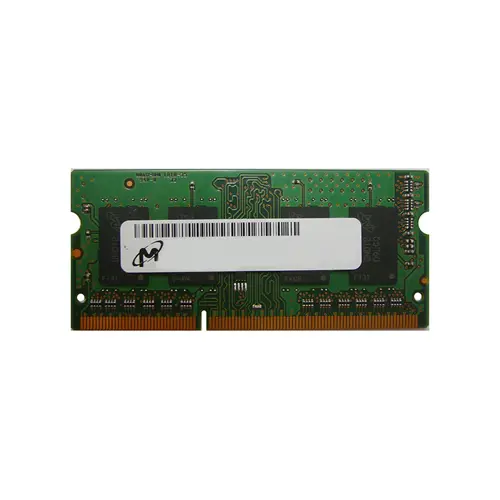
This DDR3-1600 SODIMM is a standard notebook memory module designed for upgrading mobile workstations and consumer laptops, offering seamless plug-and-play compatibility and improved multitasking performance through its dual-rank x8 organization. The unbuffered, non-ECC design with CL11 latency ensures stable and responsive operation in thermally constrained environments, making it a reliable low-power solution to extend the life of older portable systems.
1. SoDIMM form factor ensures a straightforward, tool-free upgrade path for ultrabooks and mini PCs, instantly reviving aging mobile systems without compatibility concerns.
2. Eight-gigabyte capacity comfortably handles modern web browsing, office suites, and video conferencing, preventing swap-file thrashing that would otherwise bog down lightweight laptops.
3. DDR3 technology provides an affordable drop-in boost for the vast installed base of older notebooks, letting businesses extend hardware lifecycles on a tight budget.
4. Dual Rank x8 organization increases internal bandwidth availability, which noticeably smooths integrated graphics performance during casual photo editing or HD streaming.
5. The sixteen-hundred megatransfer data rate delivers snappy application loads, so battery-conscious road warriors spend less time waiting and more time working between charges.
The Micron MT16JTF1G64HZ-1G6 is an 8 GB DDR3-1600 SODIMM designed specifically for notebooks and small-form-factor mobile systems. Its four defining characteristics directly address the real-world demands of road warriors and thin-and-light upgraders alike.
First, the unbuffered, non-ECC architecture strips away the additional registers and error-correction logic found in server memory, which dramatically reduces controller latency and power draw. For a professional working on a mobile workstation at a coffee shop, this means snappier multitasking in Excel and browser-heavy SaaS apps without draining the battery as fast as registered alternatives. Second, the 204-pin SODIMM form factor slides easily into ultrabook and mini-PC slots, making a field upgrade a one-minute job—ideal for a consultant who needs to bump a travel laptop from 4 GB to 8 GB before a client presentation. Third, the DDR3-1600 speed with a CAS latency of 11 strikes a careful balance between bandwidth and battery life, keeping Adobe Lightroom responsive during quick photo culls at an airport gate. Finally, the dual-rank x8 organization populates both logical ranks on the module, boosting interleaving efficiency so that simultaneous video streaming and document editing remain fluid. Together, these traits turn a simple memory swap into a tangible productivity gain, letting you work longer and faster wherever you plug in.
Laptop Upgrade
For older laptops limited to a single 8GB module, adding a second identical 8GB DDR3L SoDIMM enables dual‑channel mode and doubles capacity to 16GB, noticeably improving multitasking responsiveness. If the system board has only one slot, replace the existing 8GB stick with a 16GB dual‑rank module to maximize capacity without compatibility headaches. Always verify the chipset limit and BIOS revision before purchasing high‑density modules.
Mobile Workstation
Equip a mobile workstation with a pair of 16GB DDR3L SoDIMMs (32GB total) to handle memory‑intensive CAD, 3D rendering, and engineering simulations. Look for low‑voltage (1.35V) dual‑rank x8 modules to balance signal integrity with capacity, especially on Ivy Bridge or Haswell platforms that support up to 32GB. Confirm the OEM’s qualified vendor list, as some mobile workstations require unbuffered, non‑ECC memory with specific SPD profiles.
Ultrabook Power Saving
Select low‑voltage DDR3L (1.35V) SoDIMMs for Ultrabooks, as they draw less power than standard 1.5V modules, extending battery runtime during lightweight workloads. Stick with 8GB or 16GB configurations; beyond 16GB adds marginal power drain but rarely benefits typical Ultrabook tasks like web browsing and office productivity. Single‑rank modules can offer slightly lower active power than dual‑rank alternatives, making them a sensible choice for battery‑first configurations.
Rigorously tested laptop memory, compatible with Dell Latitude E6430, Lenovo ThinkPad T430, HP EliteBook 8470p.
Q: Can I mix this MT16JTF1G64HZ-1G6 with other memory modules of different brands or speeds?
A: Mixing is possible but not recommended. It may cause instability or downclocking to the lowest speed. For reliable dual-channel operation in laptops, use identical modules with matching capacity, rank, and CAS latency.
Q: Is this memory compatible with my system?
A: This 204-pin DDR3 SoDIMM fits notebooks with DDR3 slots supporting 1.5V and 1600MT/s. Verify your laptop model supports 8GB per slot, dual-rank x8 organization, and Unbuffered Non-ECC memory. Check the manufacturer's QVL for confirmation.
Q: What is the recommended DIMM population order for optimal performance?
A: Install one module per channel to enable dual-channel mode. In laptops with two slots, populate both with matching modules. If only one slot is used, place the module in the primary slot as per your service manual to avoid boot issues.
Q: Does this module support overclocking or XMP profiles?
A: No, this module adheres to JEDEC DDR3-1600 standards with fixed CL11 timings. It does not include XMP profiles and is not designed for overclocking. It offers stable performance at its rated speed for standard laptop platforms.
Q: What warranty and typical failure rate can I expect?
A: This module includes a 1-year warranty covering manufacturing defects. Typical DDR3 SoDIMM failure rates are low, under 0.2% annually. We provide lifetime technical support and a straightforward RMA process for qualifying failures during the warranty period.