











 Secure payments
Standard refund policy
Trade Assurance
Secure payments
Standard refund policy
Trade Assurance
| Product Type | Memory Module |
|---|---|
| Compliance Standards | RoHS |
| Memory Capacity | 8 GB |
| Memory Technology | DDR3 |
| RAM Speed | 1600 |
| RAM Standard | DDR3-1600/PC3-12800 |
| Signal Type | Unbuffered |
| Column Access Strobe (CAS) | CL11 |
| Rank | Dual Rank x8 |
| Quantity of Pins | 204-pin |
| RAM Genre | SoDIMM |
This unbuffered DDR3-1600 SoDIMM provides a solid 8 GB capacity upgrade for mobile workstations and older notebooks, with its dual-rank x8 configuration delivering improved memory interleaving for responsive multitasking in productivity workloads. The 204-pin low-voltage design ensures plug-and-play compatibility and energy efficiency, ideal for extending battery life in portable systems without sacrificing reliable 1600 MT/s performance.
1. Ample capacity allows users to run multiple productivity apps and dozens of browser tabs simultaneously, avoiding the slowdown caused by memory swapping and keeping the system responsive throughout a mobile workday.
2. This DDR generation’s widespread platform support guarantees effortless drop-in compatibility with a vast range of existing notebooks, turning a memory upgrade into a quick, hassle-free lift.
3. Elevated clock speed accelerates data transfers between the CPU and memory, making every interaction snappier—from near-instant application launches to seamless multimedia multitasking.
4. An unbuffered signal design eliminates power-draining register chips, trimming heat output and prolonging battery runtime for professionals who rely on their laptop away from a power outlet.
5. The standard SoDIMM pin-out aligns perfectly with typical notebook memory slots, ensuring a physically foolproof installation that even first-time upgraders can complete with confidence.
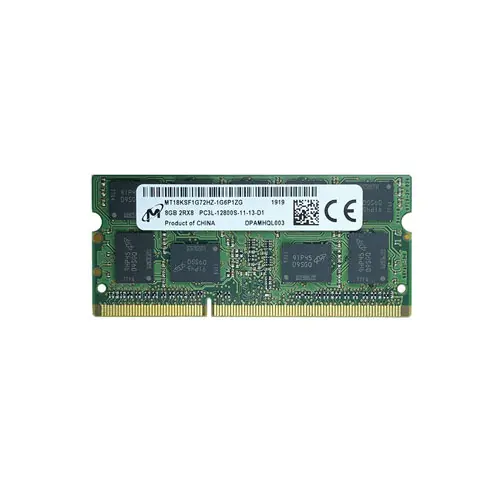
The Micron MT18KSF1G72HZ-1G6 is an 8GB DDR3-1600 Unbuffered SODIMM built specifically for notebooks and mobile workstations. In a mobile workstation juggling multiple virtual machines or large CAD assemblies, its dual-rank x8 organization keeps interleaving active, delivering the sustained bandwidth that prevents stuttering when memory channels are saturated. The unbuffered architecture talks directly to the CPU without intermediary registers, trimming latency and power waste — a tangible advantage in thin-and-light laptops where every milliwatt matters for battery endurance and heat is the enemy of quiet fans. Capacities of 8GB allow you to keep a heavy spreadsheet, a dozen browser tabs, and a conferencing app running side by side without hitting the disk swap file. And because it comes in a 204-pin SODIMM form factor, upgrading even the most cramped ultrabook takes minutes, not a service call. For consultants reviving an aging portable workstation or IT teams standardizing fleet notebooks, this module turns a struggling system into a responsive daily driver with zero compatibility headaches and the reliability business mobility demands.
Laptop Upgrade
A single 8GB DDR3-1600 SoDIMM is the most straightforward upgrade for notebooks originally equipped with 4GB. It doubles capacity, reduces disk swapping, and noticeably improves responsiveness in Windows or macOS. In dual-slot systems, pairing two identical 8GB modules creates a 16GB dual-channel configuration, delivering a cost-effective boost for moderate multitasking and light creative work.
Mobile Workstation
Professional workloads such as 3D rendering, CAD, and data analysis thrive on maximum capacity. Installing two of these 8GB dual-rank modules yields 16GB—often the upper limit for DDR3 mobile chipsets—dramatically reducing out-of-memory errors and accelerating viewport performance. Verify the chipset’s density support and ensure the BIOS is updated to recognize dual‑rank x8 organization.
Ultrabook Power Saving
In energy-sensitive ultrabooks, a single 8GB module keeps the memory bus load low and can extend battery runtime compared to populating both slots. For the best efficiency, confirm whether the platform requires low-voltage DDR3L; pairing this standard‑voltage module with a DDR3L‑only slot is unsafe. Where compatible, it provides generous headroom for productivity without excessive power overhead.
Rigorously tested DDR3 8GB SoDIMM, compatible with laptops like Dell Latitude E6430, ThinkPad T430, and more.
Q: Can I mix this MT18KSF1G72HZ-1G6 with other memory modules of different brands or speeds?
A: Mixing different brands or speeds is possible but not recommended. The module will downclock to the slowest DIMM and may cause instability. For reliable dual-channel operation, use identical modules.
Q: Is this memory compatible with my system?
A: This DDR3 SODIMM works with most laptops supporting 204-pin DDR3-1600, such as Intel 3rd/4th Gen Core or AMD A-series platforms. Verify your notebook accepts DDR3L only or 1.5 V standard-voltage modules.
Q: What is the recommended DIMM population order for optimal performance?
A: Most notebooks have two SODIMM slots. Install this 8 GB module in either slot; for dual-channel performance, populate both slots with identical 8 GB DDR3-1600 modules of matching rank and organization.
Q: Does this module support overclocking or XMP profiles?
A: No, it does not support XMP or overclocking. It operates at standard JEDEC DDR3-1600 (PC3-12800) timings of CL11. The notebook BIOS will apply the predetermined JEDEC profile automatically.
Q: What warranty and typical failure rate can I expect?
A: This Micron module carries a 1-year warranty. Typical annualized failure rate (AFR) for quality DDR3 SODIMMs is well below 0.5% under normal operating conditions, ensuring reliable long-term use.