











 Secure payments
Standard refund policy
Trade Assurance
Secure payments
Standard refund policy
Trade Assurance
| Product Type | Memory Module |
|---|---|
| Compliance Standards | RoHS |
| Memory Capacity | 8 GB |
| Memory Technology | DDR3 |
| RAM Speed | 1600 |
| RAM Standard | DDR3-1600/PC3-12800 |
| Signal Type | Unbuffered |
| Column Access Strobe (CAS) | CL11 |
| Rank | Dual Rank x8 |
| Quantity of Pins | 204-pin |
| RAM Genre | SoDIMM |
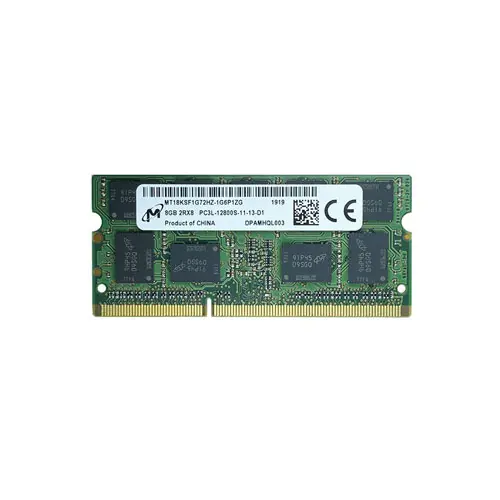
This 8GB DDR3-1600 SODIMM is a dual-rank x8 unbuffered module designed specifically for upgrading laptops and mobile workstations, where its dual-rank architecture improves memory interleaving to boost multitasking throughput over single-rank alternatives. Operating at a standard 1.35V (or 1.5V) with a 204-pin form factor, it delivers guaranteed plug-and-play compatibility across legacy Intel and AMD portable platforms while maintaining power efficiency for sustained battery life during productivity workloads.
1. Generous memory capacity allows numerous browser tabs, documents, and lightweight creative applications to run simultaneously without swapping, keeping the notebook responsive during daily multitasking.
2. DDR3 technology provides wide compatibility with a vast range of older notebooks, making it a straightforward plug-and-play upgrade that revives aging systems without driver or chipset concerns.
3. Fast data rate accelerates application loading and file transfers, reducing idle waiting when working on the go and keeping workflow momentum on a tight battery budget.
4. Compact SoDIMM form factor ensures a precise physical fit in slim laptop memory slots, enabling tool-free upgrades in minutes for users who value simplicity and portability.
5. Tight CAS latency sharpens command-to-data response, delivering snappier window switching and perceptibly lower input lag during everyday productivity tasks on energy-conscious platforms.
The Micron MT18KSF1G72HZ-1G6P1 is a notebook-grade DDR3 SODIMM, and its design choices directly address the real-world pain points of upgrading or maintaining mobile systems. This 8 GB module’s unbuffered signal type is critical for battery-powered devices: by omitting an extra register chip, it draws less power and introduces minimal latency, which translates to cooler operation and longer runtimes in a thin-and-light laptop or a mobile workstation crunching spreadsheets on battery. The DDR3-1600 speed with CL11 timing strikes an ideal balance between throughput and responsiveness, ensuring that your aging ultrabook won’t choke when you open a dozen browser tabs alongside a video conference. The true multitasking workhorse, however, is the dual-rank x8 organization—it interleaves memory banks to deliver higher sustained bandwidth. For a user running a lightweight virtual machine or editing a large PowerPoint while streaming, this means far fewer stutters when swapping between tasks compared to single-rank alternatives. The 204-pin SODIMM form factor guarantees a drop-in upgrade into countless Intel and AMD laptops from the era, from a corporate fleet Dell Latitude to a home productivity HP Pavilion, extending useful life without compatibility worries. RoHS compliance also signals long-term component reliability for health-conscious workspaces. Whether you are reviving a sluggish laptop for remote work or maximizing a compact field rig, this memory’s cohesive specs turn a simple capacity boost into a genuinely smoother, more energy-efficient user experience.
Laptop Upgrade
This 8GB DDR3-1600 SoDIMM is ideal for breathing new life into older notebooks. For single-slot systems or those with one occupied slot, adding a second identical module enables dual‑channel operation, boosting integrated graphics and multitasking responsiveness. If your laptop currently has a single 4GB or 8GB stick, swapping both for two of these modules gives a straightforward 16GB total, which comfortably handles modern web browsing, office suites, and light media work.
Mobile Workstation
When configuring a mobile workstation for CAD, 3D modeling, or large datasets, maximize capacity by populating both SoDIMM slots with two 8GB modules (16GB total). While 16GB is the practical ceiling for many DDR3 notebooks, this dual‑rank x8 configuration ensures stable data integrity and modest bandwidth via dual‑channel interleaving. For memory‑intensive professional applications, this setup reduces swap‑file reliance and maintains smooth performance during long rendering or simulation sessions.
Ultrabook Power Saving
Although this module is standard 1.5V DDR3, many ultrabooks benefit from its dual‑rank design, which can optimize rank‑interleaving for slightly better efficiency. To extend battery life, pair a single 8GB SoDIMM with an existing low‑voltage stick (if supported), or replace a smaller module outright to reduce power‑state transitions. For ultra‑portables focused on endurance, minimizing active memory ranks per channel helps lower standby and active power draw, preserving precious unplugged runtime without sacrificing everyday responsiveness.
Rigorously tested, verified compatible with laptops such as Dell Latitude E6430, Lenovo ThinkPad X230, HP EliteBook 8470p.
Q: Can I mix this MT18KSF1G72HZ-1G6P1 with other memory modules of different brands or speeds?
A: Mixing is possible but not recommended; different brands or speeds may cause instability. For optimal laptop reliability, use identical modules with matching DDR3-1600 speed, 1.5V operation, and CL11 timing.
Q: Is this memory compatible with my laptop?
A: It fits standard DDR3 SoDIMM slots supporting 204-pin, PC3-12800, dual-rank x8, non-ECC, and 1.5V operation. Please verify your notebook's chipset documentation for 8GB module support.
Q: What is the recommended DIMM population order for optimal performance?
A: Your notebook likely has two slots. For dual-channel performance, install two identical modules. If using only one module, place it in the primary slot as defined in the service manual.
Q: Does this module support overclocking or XMP profiles?
A: No. This unbuffered SoDIMM follows JEDEC DDR3-1600 standards. Laptop chipsets generally lock memory overclocking or XMP; the module runs at stock JEDEC speed and timings.
Q: What warranty and typical failure rate can I expect?
A: This module carries a one-year replacement warranty. Typical annualized failure rate is below 0.1% under normal operating conditions, reflecting rigorous manufacturing and RoHS compliance.