











 Secure payments
Standard refund policy
Trade Assurance
Secure payments
Standard refund policy
Trade Assurance
| Product Type | Memory Module |
|---|---|
| Compliance Standards | RoHS |
| Memory Capacity | 8 GB |
| Memory Technology | DDR3 |
| Product Voltage | 1.5V |
| RAM Speed | 1600MHz |
| RAM Standard | DDR3-1600/PC3-12800 |
| Error Identifying | ECC |
| Signal Type | Registered |
| Column Access Strobe (CAS) | CL11 |
| Rank | Dual Rank x4 |
| Quantity of Pins | 240-pin |
| RAM Genre | RDIMM |
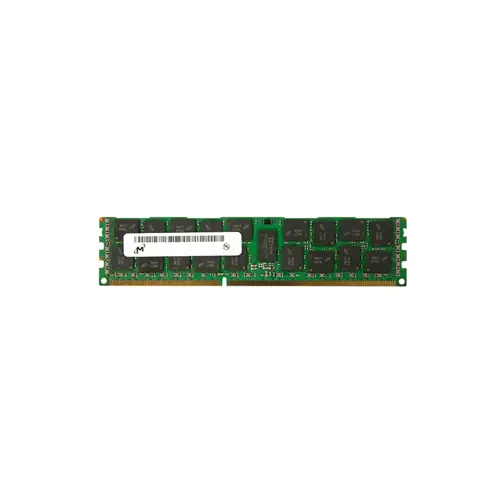
This Micron 8GB DDR3-1600 RDIMM is engineered for server platforms requiring high data integrity and stability, making it ideal for virtualization, in-memory databases, and mission-critical enterprise workloads. Its registered signal type with ECC and dual-rank x4 organization ensures reliable operation under heavy memory loads, effectively correcting single-bit errors while maximizing memory bandwidth in multi-DIMM configurations.
1. A generous memory footprint accommodates numerous containers and virtual machines, enabling higher consolidation ratios without sacrificing responsiveness.
2. The elevated data rate supplies the throughput needed to keep multiple processor cores fed, vital for parallel analytics workloads.
3. ECC memory actively detects and corrects data errors, eliminating a major source of system crashes in 24/7 server environments.
4. Registered signal buffering stabilizes electrical loads across fully populated memory channels, allowing large-capacity configurations with unmatched reliability.
5. Dual-rank design with x4-wide DRAMs maximizes bank-level parallelism, keeping memory bandwidth utilization high during persistent virtualized workloads.
Designed specifically for server environments, the Micron MT36JSF1G72PZ-1G6M1F 8GB DDR3-1600 Registered DIMM addresses the non-negotiable demands of enterprise data centers. Its ECC capability is your frontline defense against soft errors and bit flips. In a virtualization cluster where a single undetected memory error can corrupt dozens of guest operating systems or databases, ECC silently corrects single-bit errors and detects multi-bit faults, directly preserving transaction integrity and preventing costly downtime.
The Registered signal architecture, with its onboard buffer, allows your server to support far greater RAM capacity without instability. For a database administrator running an in-memory database like SAP HANA or a heavily virtualized VMware host, this means you can pack all DIMM slots confidently, dedicating 8GB modules to each virtual machine knowing the memory bus remains electrically stable under load.
Furthermore, the Dual Rank x4 organization is critical for performance. It enables memory interleaving, which lowers read latency and increases effective bandwidth as the memory controller can access one rank while the other completes a refresh or precharge. In real terms, during peak OLTP workloads, this translates to faster query responses and smoother application performance, ensuring your servicing SLAs are met consistently without random latency spikes.
This is an 8GB DDR3-1600 Registered ECC RDIMM, a server-class memory module. Capacity planning depends on workload demands, channel population, and rank behavior.
General Virtualization
Populate all memory channels symmetrically across NUMA domains. For a dual-socket host with four channels per CPU, install one DIMM per channel (eight modules, 64GB) to secure maximum bandwidth. Scale to two DIMMs per channel (16 modules, 128GB) while maintaining 1600MHz if the platform supports two dual-rank RDIMMs at that speed.
In-Memory Database
Maximize capacity while balancing latency. Fully loading three DIMMs per channel can exceed 192GB, but dual-rank x4 modules typically force a clock drop to 1333MHz at three DPC. For latency-sensitive datasets, populate only two DIMMs per channel to sustain 1600MHz. Always account for mirroring or sparing overhead, which can halve usable memory.
High-Performance Computing
HPC nodes prioritize balanced bandwidth. Install one identical 8GB RDIMM per channel (e.g., eight modules for a four-channel CPU) to deliver 64GB with consistent low latency. This configuration avoids speed penalties and supplies 4–8GB per core for many floating-point workloads, keeping compute-bound jobs deterministic across nodes.
Rigorously tested server memory. Compatible with Dell R720, HP DL380p Gen8, Lenovo x3650 M4.
Q: Can I mix this MT36JSF1G72PZ-1G6M1F with other memory modules of different brands or speeds?
A: Mixing RDIMMs with different brands, speeds, or timings is not recommended. It may cause system instability or failure to POST. Use identical modules for validated server stability.
Q: Is this memory compatible with my system?
A: This DDR3-1600 Registered ECC module requires a server platform supporting 240-pin RDIMMs, like Intel Xeon E5-2600 series or AMD Opteron 6300 series processors. Verify motherboard QVL for compatibility.
Q: What is the recommended DIMM population order for optimal performance?
A: Refer to your server board manual. Typically, populate identical RDIMMs first in slots per channel (e.g., DIMM_A1, B1) to enable balanced memory interleaving and maximum throughput.
Q: Does this module support overclocking or XMP profiles?
A: No. This is a server-grade Registered ECC DIMM running at JEDEC standard DDR3-1600 with CL11. Overclocking and XMP profiles are not supported to ensure data integrity and 24/7 reliability.
Q: What warranty and typical failure rate can I expect?
A: This module includes a 1-year warranty. Enterprise RDIMMs have very low annualized failure rates (AFR), typically under 0.3%, due to rigorous screening and error-correcting design, ensuring critical workload uptime.