











 Secure payments
Standard refund policy
Trade Assurance
Secure payments
Standard refund policy
Trade Assurance
| Product Type | Memory Module |
|---|---|
| Compliance Standards | RoHS |
| Memory Capacity | 8 GB |
| Memory Technology | DDR3 |
| Product Voltage | 1.5V |
| RAM Speed | 1600MHz |
| RAM Standard | DDR3-1600/PC3-12800 |
| Error Identifying | ECC |
| Signal Type | Registered |
| Column Access Strobe (CAS) | CL11 |
| Rank | Dual Rank x4 |
| Quantity of Pins | 240-pin |
| RAM Genre | VLP RDIMM |
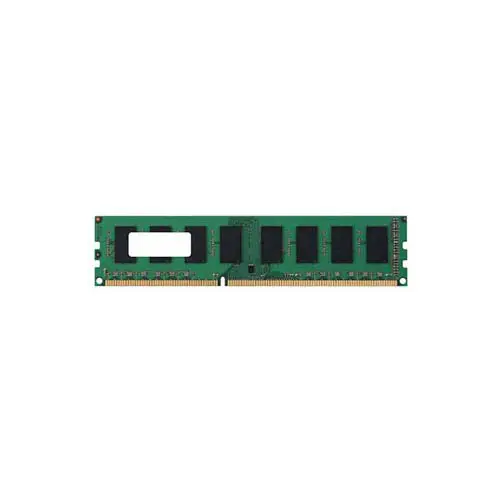
This Micron 8GB DDR3-1600 VLP RDIMM with ECC and registered signaling is engineered for enterprise server platforms, where it ensures data integrity in virtualized environments and memory-intensive workloads like in-memory databases. Its dual-rank x4 configuration and low-profile design enable dense packing for improved memory interleaving, while the CL11 latency and 1.5V operation deliver reliable, power-efficient performance in 24/7 data center deployments.
1. Registered signal type buffers the command and address lines, allowing the server to support high-capacity memory configurations without compromising signal integrity under heavy multi-socket workloads.
2. ECC error correction provides real-time single-bit error detection and correction, safeguarding transactional data integrity in virtualization clusters and database servers.
3. VLP form factor enables dense memory population in space-constrained chassis like 1U rack servers, improving airflow and allowing more DIMMs per node for higher consolidation ratios.
4. Dual Rank x4 organization leverages bank interleaving to sustain memory bandwidth during concurrent access from multiple virtual machines, reducing latency spikes under load.
5. 1600 MT/s data rate balances throughput and power efficiency, delivering consistent application performance for mid-range enterprise workloads without excessive thermal overhead.
The MT36JDYS1G72PZ-1G6M1 is a server-class VLP RDIMM designed to solve the critical infrastructure challenges that keep your data center running. Its ECC capability actively detects and corrects single-bit errors, which is non-negotiable for an in-memory financial database. A stray bit-flip in a transaction ledger is not just an anomaly; it means silent data corruption that erodes trust, and ECC ensures every calculation remains auditable and accurate. For dense virtualization clusters, the registered buffer technology decouples the memory bus from the CPU’s electrical limits, allowing you to populate all 24 DIMM slots of a rack server without signal degradation. This directly translates into higher virtual machine density per node, maximizing your hypervisor investment. The dual-rank x4 architecture leverages rank interleaving to amplify effective bandwidth; while one rank is recharging, the memory controller seamlessly reads from the other, slashing latency for a high-throughput Redis cache serving millions of concurrent queries. Finally, the Very Low Profile form factor is mission-critical in 1U and blade enclosures, preserving open airflow lanes to prevent thermal throttling on adjacent processors. In a 24/7 operation, that physical design directly protects your uptime SLA and hardware longevity, making this module a pillar of enterprise resilience.
General Virtualization
Deploy six to eight of these 8 GB VLP RDIMMs across a dual‑socket platform to achieve 48–64 GB of balanced capacity. This density comfortably supports 15–25 lightweight virtual machines, while the registered ECC design maintains data integrity under sustained multi‑tenant workloads.
In-Memory Database
Maximize capacity by populating all available DIMM slots, aiming for at least 128 GB (16 modules) on a capable server board. The low CAS latency (CL11) and dual‑rank organization help reduce access stalls, ensuring fast key‑value lookups for in‑memory datasets like Redis or Memcached clusters.
High‑Performance Computing
Configure fully‑populated memory channels (typically 12–24 modules per node) to deliver both high capacity and maximum interleaved bandwidth. The very‑low‑profile form factor improves airflow in dense compute sleds, and registered ECC corrects single‑bit errors that can silently corrupt long‑running HPC simulation results.
Rigorously compatibility-tested with Dell PowerEdge R720, HP ProLiant DL380p Gen8, Lenovo ThinkServer RD430, and similar DDR3 servers.
Q: Can I mix this MT36JDYS1G72PZ-1G6M1 with other memory modules of different brands or speeds?
A: Mixing RDIMMs is not recommended for server environments. Timings, ranks, and chip densities must match precisely to ensure signal integrity and avoid system instability. Always use identical modules for best results.
Q: Is this memory compatible with my Intel Xeon E5 based server?
A: This DDR3-1600 Registered ECC module is compatible with Intel Xeon E5-2600 v1/v2 series and similar AMD Opteron platforms supporting 1.5V RDIMMs. Please verify your motherboard’s memory QVL list for specific support.
Q: What is the recommended DIMM population order for optimal performance?
A: Follow your server board’s manual for balanced memory channels. Typically, populate first the blue slots per channel pair to maximize interleaving. For dual-rank x4 RDIMMs, install identical kits in groups of three or four DIMMs per CPU.
Q: Does this module support overclocking or XMP profiles?
A: No. This is a server-grade Registered ECC module designed for stability at JEDEC standard DDR3-1600 CL11. Overclocking or XMP profiles are not supported and would compromise data integrity typical in enterprise environments.
Q: What warranty and typical failure rate can I expect?
A: This Micron module includes a 1-year warranty. Typical annualized failure rate for RDIMMs is extremely low (under 0.2%), thanks to rigorous screening and ECC technology. We provide prompt replacement in the rare event of failure.