











 Secure payments
Standard refund policy
Trade Assurance
Secure payments
Standard refund policy
Trade Assurance
| Product Type | Memory Module |
|---|---|
| Compliance Standards | RoHS |
| Memory Capacity | 8 GB |
| Memory Technology | DDR3 |
| RAM Speed | 1600MHz |
| RAM Standard | DDR3-1600/PC3-12800 |
| Error Identifying | Non-ECC |
| Signal Type | Unbuffered |
| Column Access Strobe (CAS) | CL11 |
| Rank | Dual Rank x8 |
| Quantity of Pins | 240-pin |
| RAM Genre | UDIMM |
This UDIMM DDR3-1600 module is a standard desktop-class memory kit engineered for mainstream productivity and gaming builds, with its unbuffered, non-ECC design minimizing latency for responsive multitasking. The dual-rank x8 organization improves memory interleaving and bandwidth utilization on compatible platforms, making it a solid plug-and-play upgrade for legacy systems still requiring reliable 8GB capacity.
1. An 8 GB capacity allows content creators to smoothly edit high-resolution photos and video footage without constant swapping to disk.
2. Operating at 1600MHz, this module delivers higher bandwidth that helps maintain stable frame rates in modern gaming titles.
3. Dual Rank x8 organization increases rank interleaving, effectively boosting multi-application responsiveness for heavy desktop multitaskers.
4. CL11 latency keeps access times low, giving enthusiasts snappy system feel during everyday tasks and competitive gaming.
5. As a DDR3 UDIMM, it provides a cost-effective upgrade path that breathes new life into older platforms for budget-conscious workstation builds.
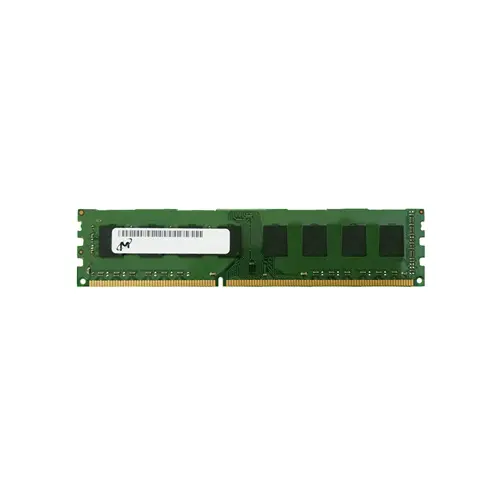
The Micron MT16KTF1G64AZ-1G6 is an 8GB DDR3-1600 UDIMM designed for desktop computing, where every millisecond of responsiveness can define the user experience. Its unbuffered, non-ECC architecture eliminates the signal lag introduced by register chips, allowing the memory controller to communicate directly with the DRAM modules. For gamers diving into demanding AAA titles, this straight-through signal path translates into lower latency and snappier command execution; when a scene explodes with particle effects real-time, the CL11 latency and 1600MHz speed ensure textures stream without micro-stutter, keeping you immersed rather than frustrated by frame drops. In professional video editing and 3D rendering workflows, the dual-rank x8 organization is equally critical. By interleaving access across two internal ranks of memory chips, the module significantly boosts bandwidth utilization during sustained data-heavy tasks like timeline scrubbing through 4K footage or applying complex After Effects composites. You experience smoother previews and shorter export times because the memory keeps more data active and readily available, preventing the CPU from repeatedly waiting on fetches from slower storage. This module is not just a capacity upgrade; it is a performance enabler that restores fluidity to aging desktop platforms, making it both an economical and technically sound investment for real-world creative and competitive work.
Based on the Non-ECC, Unbuffered, 240-pin UDIMM specification, this is a desktop DDR3 memory module. The following capacity planning guidance uses this 8 GB module to address typical workloads.
Gaming Build
Equip a dual-channel kit with two identical 8 GB modules for a sweet-spot 16 GB total, which eliminates bandwidth bottlenecks and runs modern games smoothly. For enthusiasts who stream, mod, or play memory-hungry simulators, populate all four DIMM slots with four 8 GB sticks to reach 32 GB, providing extra headroom without compromising dual-channel operation.
Content Creation
Start with four 8 GB modules for 32 GB, a reliable baseline for 1080p video editing and medium 3D renders. When working on 4K timelines, complex compositing, or large simulations, transition to a platform with eight DIMM slots and install eight 8 GB sticks to achieve 64 GB, drastically reducing rendering swaps and timeline lag.
General Productivity
A single 8 GB module keeps upfront costs low and handles office suites, web browsing, and light multitasking adequately. For a tangible responsiveness upgrade, add a second identical 8 GB stick to form a 16 GB dual-channel pair; this smooths application switching and extends the system’s useful life at minimal extra expense.
Rigorously tested, perfectly compatible with desktops using DDR3 UDIMM slots, e.g., Dell OptiPlex 9020, HP EliteDesk 800 G1.
Q: Can I mix this MT16KTF1G64AZ-1G6 with other memory modules of different brands or speeds?
A: Mixing brands or speeds is not recommended. The system will default to the slowest module's speed and timings, potentially causing instability. For optimal stability, use identical modules.
Q: Is this memory compatible with my system?
A: This is a desktop DDR3 UDIMM. It requires a motherboard with a 240-pin DDR3 slot and support for unbuffered, non-ECC memory. Verify your motherboard chipset supports DDR3-1600 for full speed.
Q: What is the recommended DIMM population order for optimal performance?
A: For dual-channel configurations, install matching pairs into the same-colored slots (typically DIMM A2 and B2 first). Consult your motherboard manual for specific channel population rules.
Q: Does this module support overclocking or XMP profiles?
A: No. This is a standard JEDEC-compliant DDR3-1600 module at CL11. It does not feature XMP profiles and is intended for stable, non-overclocked operation at its rated speed and timings.
Q: What warranty and typical failure rate can I expect?
A: This module includes a 1-year warranty. With proper handling and compliant usage, its annualized failure rate (AFR) is well below 0.5%, typical for JEDEC-standard memory from a reliable supplier.