











 Secure payments
Standard refund policy
Trade Assurance
Secure payments
Standard refund policy
Trade Assurance
| Product Type | Memory Module |
|---|---|
| Compliance Standards | RoHS |
| Memory Capacity | 8 GB |
| Memory Technology | DDR3 |
| Product Voltage | 1.5V |
| RAM Speed | 1600MHz |
| RAM Standard | DDR3-1600/PC3-12800 |
| Error Identifying | ECC |
| Signal Type | Unbuffered |
| Column Access Strobe (CAS) | CL11 |
| Rank | Dual Rank x8 |
| Quantity of Pins | 240-pin |
| RAM Genre | UDIMM |
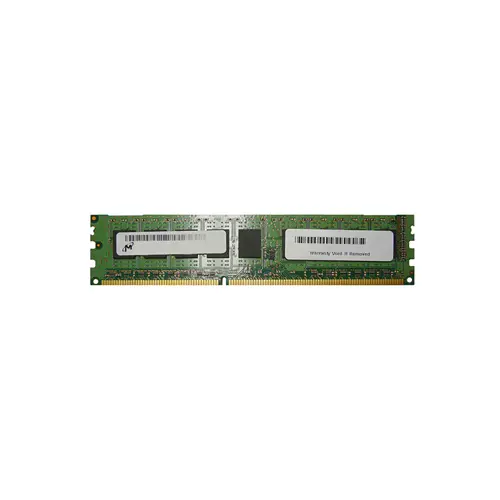
This DDR3-1600 ECC UDIMM is tailored for entry-level servers and single-socket workstations where data integrity is critical, making it ideal for light virtualization, file servers, and archival storage workloads. Its dual-rank x8 organization and unbuffered ECC architecture deliver enhanced signal stability and real-time error correction, ensuring reliable operation in 24/7 environments without the added latency of registered memory.
1. ECC error correction silently detects and fixes single-bit memory faults, safeguarding long-running server tasks where data integrity directly impacts business continuity.
2. The module’s density comfortably provisions core infrastructure services like domain controllers or lightweight hypervisors, balancing memory allocation with power and cost efficiency.
3. Its data transfer rate supplies enough memory bandwidth to avoid queue buildup under concurrent client requests, keeping response times consistent for small-scale enterprise workloads.
4. Dual-rank x8 organization enables rank interleaving, helping the memory controller overlap commands and boost throughput during mixed read/write scenarios without expanding channel count.
5. Unbuffered UDIMM design removes the register stage, trimming access latency for cost-conscious server builds that prioritize speed over maximum DIMM scalability.
The Micron MT18JSF1G72AZ-1G6D1 is an 8 GB DDR3-1600 UDIMM engineered specifically for entry-level servers and workstations, where budget constraints cannot compromise data integrity. Its four defining characteristics translate directly into reliability and performance for your critical workloads.
First, integrated ECC continually detects and corrects single-bit memory errors caused by background radiation. In a virtualisation cluster hosting multiple VMs, a silent bit-flip inside a guest operating system can corrupt databases or crash an entire node without warning; ECC eliminates this risk, preserving uptime and transactional consistency. Second, the unbuffered design avoids the additional clock cycle lag of registered modules, delivering lower latency and broad compatibility with cost-effective server motherboards. Third, the dual-rank x8 organisation interleaves access across two internal ranks of DRAM chips, boosting sustained bandwidth under concurrent loads. When you run an in-memory database like Redis alongside several containerised applications, this rank interleaving prevents I/O bottlenecks and keeps query response times predictably fast. Finally, true DDR3-1600 speed at 1.5 V ensures a balanced power envelope, while the standard 240-pin UDIMM form factor simplifies field upgrades. For IT managers, that means deploying more resilient virtualised services and accelerating memory-intensive analytics without investing in more expensive registered platforms.
General Virtualization
For density-focused workloads like virtualization, populate all available channels with 8 GB ECC UDIMMs to maximize capacity while maintaining data integrity. A typical dual-socket server with six channels per CPU would target 12 modules (96 GB total) to comfortably host dozens of light-to-moderate VMs. Avoid mixing unbuffered modules of different ranks or timings, as this can cause stability issues under sustained hypervisor load.
In-Memory Database
In-memory databases thrive on low latency and error-free operation, making ECC mandatory. Deploy the maximum number of these dual-rank x8 modules to leverage rank interleaving and increase effective bandwidth. For a single-socket server with four slots, a 4×8 GB (32 GB) configuration provides a balanced pool for datasets that fit entirely in RAM, ensuring consistent 1.5 V power delivery and CAS 11 predictability.
High-Performance Computing
HPC clusters often use energy-efficient nodes, where 1.5 V UDIMMs reduce thermal output versus higher-voltage alternatives. Install matched pairs across memory channels to sustain 1600 MT/s throughput during parallel MPI jobs. A typical twin-channel compute node equipped with four 8 GB modules (32 GB total) handles complex modeling workloads while ECC guards against cosmic-ray-induced bit flips in long-running simulations.
This memory has been rigorously tested and is compatible with Dell PowerEdge T110 II, T20, R220, and HP MicroServer Gen8.
Q: Can I mix this MT18JSF1G72AZ-1G6D1 with other memory modules of different brands or speeds?
A: Mixing ECC UDIMMs of different brands or speeds is not recommended. It risks stability and boot failures. Use identical modules for guaranteed reliability.
Q: Is this memory compatible with my system?
A: This 8GB DDR3-1600 ECC UDIMM fits servers/workstations with 240-pin sockets supporting unbuffered ECC. Check your motherboard’s QVL for Intel Xeon E3 or AMD platforms.
Q: What is the recommended DIMM population order for optimal performance?
A: Follow your server board’s manual. For dual-channel, populate the primary slots (e.g., slot A1 and B1) first, then add matching sticks to maximize performance and ECC function.
Q: Does this module support overclocking or XMP profiles?
A: No, this JEDEC-compliant server memory does not support overclocking or XMP. It is designed for stable, error-free operation at 1600MHz with CL11.
Q: What warranty and typical failure rate can I expect?
A: Backed by a 1-year warranty. Manufactured to strict standards, the failure rate is extremely low under specified environments, ensuring long-term server reliability.