











 Secure payments
Standard refund policy
Trade Assurance
Secure payments
Standard refund policy
Trade Assurance
| Product Type | Memory Module |
|---|---|
| Compliance Standards | RoHS |
| Memory Capacity | 8 GB |
| Memory Technology | DDR3 |
| Product Voltage | 1.5V |
| RAM Speed | 1600MHz |
| RAM Standard | DDR3-1600/PC3-12800 |
| Error Identifying | ECC |
| Signal Type | Registered |
| Column Access Strobe (CAS) | CL11 |
| Rank | Dual Rank x4 |
| Quantity of Pins | 240-pin |
| RAM Genre | RDIMM |
This registered ECC DDR3 module, configured as dual-rank x4 with CL11 latency, delivers critical data integrity and signal stability for virtualization and in-memory database workloads. Its 8GB RDIMM form factor is optimized for legacy enterprise servers requiring dependable memory validation in multi-DIMM configurations.
1. Registered signal buffering allows the memory controller to drive multiple modules per channel without signal degradation, ensuring reliable operation in densely populated server racks running mission-critical workloads.
2. ECC error correction actively detects and fixes single-bit memory faults in real time, directly preventing silent data corruption that could compromise financial transactions or database integrity.
3. RDIMM architecture combined with DDR3-1600 speed delivers consistent bandwidth under concurrent access patterns, sustaining throughput for virtualized environments where multiple VMs contend for memory resources.
4. Dual Rank x4 organization interleaves accesses across two internal rank groups, boosting effective memory bandwidth and reducing latency collisions during heavy multi-tenant cloud hosting.
5. 8 GB capacity per module strikes a practical balance for virtualization density, allowing enough headroom for moderate VM counts while keeping power budgets and cooling requirements manageable in scale-out server deployments.
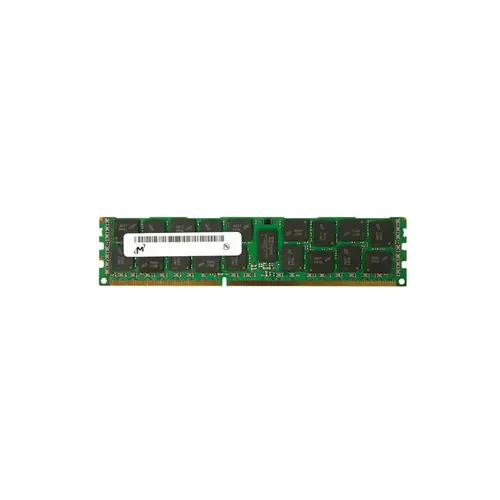
When you are responsible for a virtualized cluster hosting dozens of mission-critical VMs or running an in-memory database where every calculation must be exact, memory failure is not an option. The Micron MT36JSF1G72PZ-1G6K1 is an 8GB DDR3-1600 RDIMM built specifically to eliminate those risks. Its ECC technology actively detects and corrects single-bit errors, preventing silent data corruption that could crash a financial transaction or alter a medical record without warning. The registered signal buffer stabilizes the entire memory channel as you scale up capacity, so a fully populated server with 192GB or more remains rock-solid under constant load instead of suffering signal degradation that causes random reboots. Behind the scenes, the dual-rank x4 organization increases effective bandwidth through rank interleaving, allowing the memory controller to issue concurrent read and write commands and significantly reducing latency for virtual machines fighting for I/O. Running at 1600MHz with a CAS latency of 11, this module balances high throughput with predictable timing, making it the dependable backbone for database caching, virtualization hosts, and any enterprise workload where uptime and accuracy directly impact revenue. For IT administrators who measure success in hours of uninterrupted operation, this kind of reliability is not a feature list; it is peace of mind.
General Virtualization
Use six to eight of these 8 GB Registered ECC modules to build a 48–64 GB pool, which comfortably hosts a moderate number of VMs on a dual‑socket server. Populate one DIMM per channel (e.g., three modules per CPU in a triple‑channel DDR3 platform) to maintain balanced memory access and 1600 MT/s speed; scaling to 12 modules (96 GB) covers heavier consolidation needs without sacrificing reliability.
In‑Memory Database
Maximize capacity by filling all available DIMM slots — a 24‑slot dual‑processor server yields 192 GB with these 8 GB RDIMMs, allowing larger datasets to reside entirely in RAM. Distribute modules evenly across CPU sockets and memory channels to preserve NUMA locality and consistent low‑latency ECC protection, and enable memory mirroring or sparing if the platform supports it for extra resilience.
High Performance Computing
Install one 8 GB module per memory channel (typically eight modules for a dual‑socket node with four channels per CPU) to achieve peak bandwidth at DDR3‑1600, which benefits bandwidth‑sensitive HPC codes. If more capacity is required, populate a second DIMM per channel (16 modules, 128 GB) while accepting a minor frequency drop; always keep all channels equally loaded and use identical dual‑rank x4 RDIMMs to avoid timing skew.
This server memory is rigorously tested and compatible with systems like Dell PowerEdge R720, HP DL380p Gen8.
Q: Can I mix this MT36JSF1G72PZ-1G6K1 with other memory modules of different brands or speeds?
A: Mixing Registered ECC modules of different brands or speeds is not recommended and may cause stability issues. For reliable server operation, always use identical part numbers with matching rank, latency, and revision.
Q: Is this memory compatible with my Intel Xeon E5-2600 v2 server platform?
A: Yes, this DDR3-1600 Registered ECC RDIMM is designed for Intel Xeon E5-2600 v1/v2 series and similar AMD G34/C32 platforms. Please verify your server board’s supported DIMM types and maximum capacity.
Q: What is the recommended DIMM population order for optimal performance?
A: Populate slots per your server’s manual—typically white slots first for the first channel per CPU, then black. Balance identical DIMMs across memory channels to maintain ECC and interleaving benefits.
Q: Does this module support overclocking or XMP profiles?
A: No. Server Registered ECC memory operates strictly at JEDEC standard DDR3-1600 (PC3-12800) with fixed timings. Overclocking and XMP profiles are not supported for enterprise reliability.
Q: What warranty and typical failure rate can I expect?
A: This module includes a 1-year warranty. Typical AFR is below 0.5% in controlled server environments, assuming proper cooling and ECC monitoring are in place.