











 Secure payments
Standard refund policy
Trade Assurance
Secure payments
Standard refund policy
Trade Assurance
| Product Type | Memory Module |
|---|---|
| Compliance Standards | RoHS |
| Memory Capacity | 8 GB |
| Memory Technology | DDR3 |
| Product Voltage | 1.5V |
| RAM Speed | 1600MHz |
| RAM Standard | DDR3-1600/PC3-12800 |
| Error Identifying | ECC |
| Signal Type | Unbuffered |
| Column Access Strobe (CAS) | CL11 |
| Rank | Dual Rank x8 |
| Quantity of Pins | 240-pin |
| RAM Genre | UDIMM |
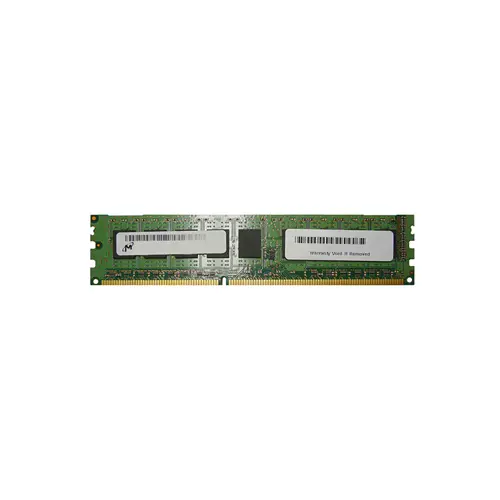
This Micron 8GB DDR3-1600 UDIMM with ECC is purpose-built for entry-level single-socket servers and professional workstations where data integrity is critical. Its unbuffered design with dual-rank x8 organization delivers lower latency and broad platform compatibility, while ECC protection actively corrects single-bit errors to prevent silent data corruption in memory-intensive tasks like financial modeling or content verification.
1. ECC protection silently corrects single-bit memory errors in real time, preserving data integrity for mission-critical workloads running on entry-level servers or small business NAS systems.
2. Unbuffered architecture eliminates the register latency found in RDIMMs, delivering slightly faster data access for latency-sensitive applications on single-socket server platforms.
3. Dual Rank x8 organization populates each memory channel with two addressable ranks, enabling rank interleaving that boosts throughput during concurrent database queries and light virtualization.
4. The 1600MT/s data rate supplies enough memory bandwidth to keep a modern hypervisor and several lightweight guest VMs responsive without becoming a bottleneck.
5. An 8GB capacity module strikes a practical balance for microserver deployments, allowing a pair of DIMMs to support up to 16GB of usable space for web hosting, caching, or office collaboration services.
Your infrastructure depends on absolute data integrity, and the Micron MT18JSF1G72AZ-1G6E1ZE 8GB DDR3-1600 UDIMM server memory is built to deliver it. Its ECC engine is your frontline defense against silent bit flips that can corrupt virtual machine images or in-memory database tables, preventing unexplained crashes in a 24/7 virtualization host. The unbuffered design skips the register delay, cutting latency for transactional databases like Redis, where speed is revenue. Configured as dual-rank x8, this module enables memory interleaving, so a hypervisor juggling multiple VMs or a busy cache server sees consistently higher bandwidth instead of stalling under parallel loads. Running at PC3-12800 with a standard 1.5V and CL11 latency, it provides a predictable foundation that avoids the headaches of overclocked instability. For an entry-level server consolidating file services and virtualized applications, these four traits work together to eliminate data corruption, sustain performance and extend platform uptime—letting you focus on your business, not on memory errors.
Server Memory Identified
This module is a DDR3-1600 ECC Unbuffered UDIMM (8GB, 1.5V, CL11, dual-rank x8, 240-pin). ECC and UDIMM form factor target entry-level servers, micro-servers, and workstations where data integrity is essential but registered memory isn’t required.
General Virtualization
Equip hosts with a balanced DIMM-per-channel configuration to maximize memory bandwidth. For a typical single-socket virtualization host, populate four identical 8GB UDIMMs (32GB total) across all channels to support a modest number of VMs while maintaining ECC protection. Always keep a cold spare module on hand to minimize downtime from memory faults.
In-Memory Database
Capacity and latency are paramount. Deploy the maximum supported UDIMM slots—often four or eight—with these 8GB modules to reach 32GB or 64GB. Set the memory speed to the highest stable setting (1600MHz) and ensure identical ranks across channels; mixing dual-rank modules with different configurations can degrade performance and increase latency.
High-Performance Computing
HPC workloads benefit from a symmetric, fully populated memory layout. Install one module per channel (e.g., four modules for a quad-channel platform) to saturate memory bandwidth. Monitor thermal conditions closely, as dual-rank UDIMMs at 1.5V can generate significant heat under sustained compute loads. For node resilience, consider running with one spare rank by slightly under-populating the last channel.
Rigorously tested ECC UDIMM, compatible with servers like Dell PowerEdge R720, HP ProLiant DL380p Gen8, and Lenovo ThinkServer TS440.
Q: Can I mix this MT18JSF1G72AZ-1G6E1ZE module with other memory brands or speeds?
A: Mixing is not recommended for server environments. Even identical specs from different brands may cause subtle timing mismatches, risking system instability. For reliable ECC operation, always use matched modules with the same Micron part number.
Q: Is this memory compatible with my server platform?
A: This ECC UDIMM is designed for single-socket Intel Xeon E3-series or select AMD AM3+ servers. Verify your board supports 240-pin DDR3-1600 ECC Unbuffered memory. It will not work in registered (RDIMM) slots.
Q: What is the recommended DIMM population order for optimal performance?
A: Populate identical DIMMs per channel, starting with the slots farthest from the CPU. For dual-rank modules like this one, one DIMM per channel typically yields maximum memory bandwidth without rank-switching penalties.
Q: Does this module support overclocking or XMP profiles?
A: No. As a server-grade ECC UDIMM, it strictly adheres to JEDEC DDR3-1600 standards. Overclocking or XMP is disabled to maintain data integrity and error correction reliability, which are critical in server workloads.
Q: What warranty and typical failure rate can I expect?
A: This Micron module includes a one-year warranty. Enterprise-class ECC memory typically exhibits an annualized failure rate (AFR) well under 0.5%, backed by rigorous factory testing lasting over 24 hours per module.