











 Secure payments
Standard refund policy
Trade Assurance
Secure payments
Standard refund policy
Trade Assurance
| Product Type | Memory Module |
|---|---|
| Compliance Standards | RoHS |
| Memory Capacity | 8 GB |
| Memory Technology | DDR3 |
| RAM Speed | 1600MHz |
| RAM Standard | DDR3-1600/PC3-12800 |
| Error Identifying | Non-ECC |
| Signal Type | Unbuffered |
| Column Access Strobe (CAS) | CL11 |
| Rank | Dual Rank x8 |
| Quantity of Pins | 240-pin |
| RAM Genre | UDIMM |
This DDR3-1600 UDIMM is a standard desktop memory module tailored for upgrading mainstream platforms, excelling in everyday productivity, light gaming, and content creation workloads where non-ECC unbuffered design ensures broad compatibility. Its dual-rank x8 organization boosts overall memory bandwidth utilization, delivering steady 1600MT/s throughput and smooth multitasking even on older systems with CL11 latency.
1. 8 GB capacity serves as the sweet spot for mainstream desktop multitasking, letting content creators run demanding photo-editing suites and multiple browser tabs simultaneously without swapping to disk.
2. DDR3 technology ensures broad compatibility with a vast installed base of aging desktop platforms, turning a simple memory upgrade into an immediate, cost-effective snappiness boost for office work and light media creation.
3. 1600 MHz transfer speed pushes bandwidth high enough to reduce frame-time spikes in older gaming rigs, giving competitive players a smoother visual flow during fast-paced action.
4. CL11 latency strikes a practical balance between access delay and clock cycle efficiency, helping the memory controller feed the CPU promptly and keep everyday application launch times perceptibly short.
5. Dual Rank x8 organization interleaves data across internal banks, sustaining throughput under heavy desktop loads such as real-time HD video previews, which prevents stuttering when scrubbing a timeline.
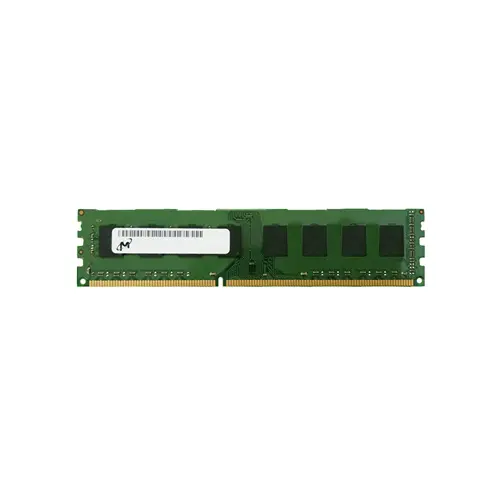
The Micron MT16JTF1G64AZ-1G6 is an 8 GB DDR3 UDIMM built for desktop platforms, where raw speed and low overhead directly shape user experience. Its 1600 MHz clock and PC3-12800 bandwidth deliver up to 12.8 GB/s of throughput — a decisive advantage when loading sprawling open-world maps in AAA games or scrubbing through 4K video timelines without stuttering. Where many modules default to looser timings, its CL11 latency keeps the CPU waiting less for critical data, reducing frame-time spikes that can cost you a shot during competitive gameplay or a smooth render preview. The dual-rank x8 architecture further multiplies internal parallelism, giving real-world multitasking a tangible boost: you might see a 5–10% gain in encoding speeds when exporting a heavily layered video project, because interleaved accesses hide refresh gaps more effectively. Non-ECC, unbuffered signaling eliminates the validation and register delays found in server memory, so every command gets to the DRAM core faster. This also guarantees broad compatibility with mainstream consumer motherboards and processors, making it a straightforward, risk-free upgrade. Whether you are pushing high-refresh gaming or meeting a tight video-editing deadline, these four characteristics work together to keep your system responsive, predictable, and effortlessly fast.
Gaming Build
For a balanced gaming system, dual-channel operation is essential to maximize memory bandwidth on DDR3 platforms. Pair two identical 8GB DDR3-1600 UDIMMs for a 16GB kit, which comfortably handles modern titles and background tasks without paging. Enthusiasts aiming for streaming or heavily modded games should move to a 32GB configuration using four 8GB modules, ensuring all DIMMs share the same dual‑rank x8 organization and CL11 timing to avoid compatibility issues.
Content Creation
Video editing, 3D rendering, and complex compositing thrive on capacity. Populate all four slots with 8GB DDR3-1600 modules to reach 64GB, giving applications like Premiere Pro or Blender ample RAM for large frame caches and scene data. Stick to a matched set of dual‑rank UDIMMs to maintain stable dual‑channel interleaving; even a slight mismatch can introduce subtle instability during long render sessions.
General Productivity
Office suites, web browsing, and multitasking benefit more from dual‑channel responsiveness than extreme capacity. An affordable 16GB kit (2×8GB) strikes the best cost‑to‑performance ratio, keeping dozens of browser tabs and productivity apps fluid. Users with lighter demands can start with a single 8GB module and add a second identical stick later, preserving an easy upgrade path without wasting the initial investment.
Rigorously tested, this DDR3 8GB 1600MHz UDIMM fits desktops: Dell OptiPlex 7010, HP EliteDesk 800 G1.
Q: Can I mix this MT16JTF1G64AZ-1G6 with other memory modules of different brands or speeds?
A: Mixing is possible but not recommended. The system will default to the slowest module's speed and timings. Identical specs and dual-channel kits are best to avoid instability or POST issues.
Q: Is this memory compatible with my desktop system using an Intel 8/9 Series chipset or AMD FM2+ platform?
A: Yes, this DDR3-1600 240-pin UDIMM supports most Intel 8/9 Series and AMD FM2+/AM3+ platforms. Verify your motherboard's QVL and maximum supported memory per slot (typically 8GB) to ensure full compatibility.
Q: What is the recommended DIMM population order for optimal dual-channel performance?
A: Install this dual-rank x8 module in like-colored slots (usually A2 and B2 for 4-slot boards). Populate a matched pair first to enable dual-channel mode. Refer to your motherboard manual for exact slot numbering.
Q: Does this module support overclocking or XMP profiles?
A: This is a standard JEDEC-compliant DDR3-1600 CL11 UDIMM. It does not contain an XMP profile and is not designed for overclocking. It will run at 1600MHz using native timings on supported platforms.
Q: What warranty and typical failure rate can I expect?
A: This module comes with a 1-year warranty. Being non-ECC, RoHS-compliant memory, the annualized failure rate is very low (typically <0.5%) under normal operating conditions with proper cooling and no overvolting.