











 Secure payments
Standard refund policy
Trade Assurance
Secure payments
Standard refund policy
Trade Assurance
| Product Type | Memory Module |
|---|---|
| Compliance Standards | RoHS |
| Memory Capacity | 8 GB |
| Memory Technology | DDR3 |
| Product Voltage | 1.35V |
| RAM Speed | 1600MHz |
| RAM Standard | DDR3-1600/PC3-12800 |
| Error Identifying | ECC |
| Signal Type | Registered |
| Column Access Strobe (CAS) | CL11 |
| Rank | Dual Rank x4 |
| Quantity of Pins | 240-pin |
| RAM Genre | RDIMM |
This DDR3-1600 registered ECC RDIMM, with its dual-rank x4 configuration and CL11 latency, ensures stable, error-corrected data integrity ideal for virtualization and in-memory database workloads. Operating at a low 1.35V, it balances power efficiency with signal reliability through its registered buffer, making it well-suited for dense server deployments where uptime and data accuracy are critical.
1. ECC error correction ensures data integrity in financial transaction processing, eliminating silent memory corruption that could lead to costly transactional errors.
2. Registered signal buffering stabilizes large memory arrays under full population, a prerequisite for zero-downtime virtual machine failover operations.
3. Dual Rank x4 organization saturates memory channels with interleaved access, directly increasing virtual machine consolidation ratios without performance degradation.
4. 8 GB capacity per module offers the ideal density for hyper-converged infrastructure nodes, balancing memory overhead for hypervisor and multiple tenant workloads.
5. 1600 MHz speed delivers ample throughput for in-memory caching layers, responsive even under heavy concurrent requests to business intelligence dashboards.
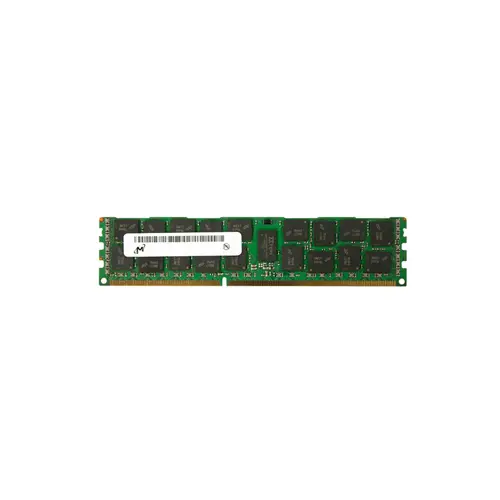
Designed specifically for enterprise servers and workstations, the Micron MT36KSF1G72PZ-1G6K1 is an 8GB DDR3-1600 Registered DIMM whose four defining characteristics directly address the real-world demands of data center reliability, virtualization density, and in-memory computing.
First, ECC error correction silently detects and corrects single-bit memory errors caused by background radiation, a critical safeguard for financial transaction databases and long-running virtualization hosts where a single uncorrected bit flip can corrupt a hypervisor’s state and crash dozens of virtual machines. Second, the Registered signal architecture buffers the command and address lines, maintaining rock-solid signal integrity when all memory channels are fully populated—a pain point for IT architects scaling up VMware ESXi clusters or bare-metal Kubernetes nodes that routinely drive 384 GB and beyond with absolute stability. Third, the 1.35 V low-voltage operation significantly lowers thermals and power draw per DIMM across a packed rack, directly reducing cooling OPEX in multi-node environments. Finally, the dual-rank x4 organization increases bank-level parallelism, dramatically boosting throughput for latency-sensitive in-memory databases like Redis and SAP HANA under heavy concurrent queries. This means faster data retrieval, higher VM consolidation ratios, and uncompromised uptime—turning memory from a commodity part into a strategic reliability asset.
General Virtualization
For a typical virtualization host, populate all memory channels symmetrically to maximize bandwidth and leave room for growth. Start with six or eight 8 GB RDIMMs (48–64 GB) in balanced configurations to support moderate VM density without overcommitting host resources. Registered DIMMs at 1.35V also reduce power consumption per GB compared to older 1.5V modules, which matters in always-on environments.
In-Memory Database
In-memory databases demand low latency and high reliability, making ECC RDIMMs a hard requirement. Deploy at least 64–128 GB by filling all channels with eight to sixteen of these 8 GB modules in x4 dual-rank organization, which delivers better signal integrity and modest performance gains through rank interleaving. Keep CAS latency (CL11) in mind when mixing modules, and aim for identical part numbers to avoid timing mismatches that can undermine data integrity.
High-Performance Computing (HPC)
Memory bandwidth often limits HPC throughput, so populate all memory channels per CPU socket with identical 8 GB RDIMMs—typically twelve or sixteen modules for dual-socket systems to reach 96–128 GB. The 1600 MT/s speed and registered architecture provide stable operation under sustained load, while dual-rank x4 devices can offer a slight bandwidth edge in stream-heavy workloads. Scale to the maximum supported DIMM count per node to feed many cores and keep inter-socket communication balanced.
Rigorously tested server RDIMM, compatible with Dell PowerEdge R720, HP DL380p Gen8, Cisco UCS C220 M3.
Q: Can I mix this MT36KSF1G72PZ-1G6K1 with other memory modules of different brands or speeds?
A: Mixing RDIMMs of different brands or speeds is not recommended. It may cause POST failures, system instability, or force all DIMMs to the lowest common frequency and relaxed timings.
Q: Is this memory compatible with my system?
A: It is compatible with servers using Intel Xeon E5-2600 v1/v2 or AMD Opteron 6300 series platforms that support DDR3-1600 ECC Registered DIMMs. Verify your board's QVL for confirmation.
Q: What is the recommended DIMM population order for optimal performance?
A: Follow your server manual. Typically, populate identical DIMMs per channel starting with the farthest slot from the CPU. Balance memory across both sockets for uniform memory access.
Q: Does this module support overclocking or XMP profiles?
A: No. This is an enterprise-grade Registered ECC module adhering strictly to JEDEC DDR3-1600 standards. It does not support XMP or overclocking to ensure maximum data integrity.
Q: What warranty and typical failure rate can I expect?
A: This Micron module carries a 1-year warranty. Typical annualized failure rate (AFR) for such enterprise RDIMMs is well below 0.5% under specified operating conditions, ensuring high reliability.