











 Secure payments
Standard refund policy
Trade Assurance
Secure payments
Standard refund policy
Trade Assurance
| Product Type | Memory Module |
|---|---|
| Compliance Standards | RoHS |
| Memory Capacity | 8 GB |
| Memory Technology | DDR3 |
| Product Voltage | 1.5V |
| RAM Speed | 1866MHz |
| RAM Standard | DDR3-1866/PC3-14900 |
| Error Identifying | ECC |
| Signal Type | Registered |
| Column Access Strobe (CAS) | CL13 |
| Rank | Single Rank x4 |
| Quantity of Pins | 240-pin |
| RAM Genre | RDIMM |
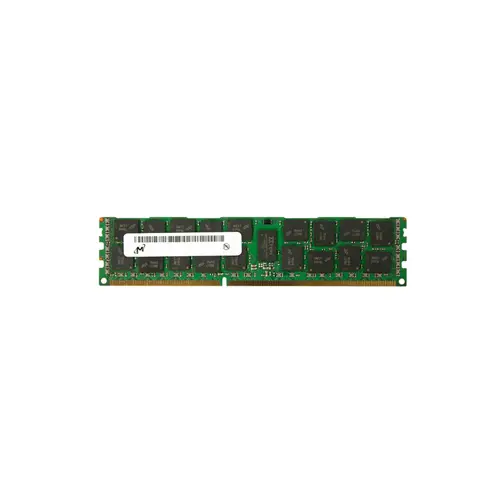
This Micron 8GB DDR3-1866 RDIMM is engineered for entry-level server and small-business virtualization platforms, where its registered architecture and ECC error correction ensure signal stability and data integrity under continuous operation. With single-rank x4 organization and CL13 latency, it provides balanced throughput ideal for memory-resident databases or light multi-tenant workloads without overloading older dual-socket memory controllers.
1. An 8 GB module provides sufficient memory headroom for moderate virtualization workloads, letting several light VMs or containers coexist without triggering performance-sapping disk swapping.
2. DDR3 technology delivers a proven, cost-efficient backbone for legacy server infrastructure, ensuring stable compatibility and reliable uptime across aging yet essential enterprise platforms.
3. The 1866 MHz clock rate elevates memory bandwidth, accelerating in-memory databases and data-intensive analytics by shrinking read/write latency under sustained request loads.
4. ECC protection corrects single-bit errors on the fly, safeguarding financial transactions and critical records from silent data corruption that could compromise business operations.
5. The registered buffer reduces the electrical load on the memory controller, allowing dense server populations to maintain sharp signal integrity and stable operation across fully loaded memory channels.
When you are responsible for a virtualized server cluster hosting dozens of mission‑critical workloads, memory errors are not an inconvenience—they are a threat to business continuity. The Micron MT18JSF1G72PZ-1G9E1KF 8GB DDR3‑1866 RDIMM is purpose‑built for exactly this environment, and four of its engineering characteristics translate directly into operational resilience.
The registered signal buffer stabilizes the command and address lines when multiple DIMMs populate a server, preventing signal degradation that can cause silent crashes in dense virtualization hosts. Its ECC circuitry detects and corrects single‑bit flips—frequent enough in large memory arrays due to cosmic radiation—preserving transactional integrity for an in‑memory database like Redis or SAP HANA, where a corrupted bit could cascade into financial discrepancies. Running at 1866MHz with a PC3‑14900 bandwidth ceiling, this module feeds modern Xeon processors fast enough to keep pace with simultaneous VM requests and indexing operations, cutting the latency you feel during peak OLAP queries. The single‑rank x4 organization reduces electrical loading on the memory channel, allowing full‑speed operation even when all slots are occupied in a 2U rack server. For IT administrators who measure uptime in decimals, these features mean no overnight page‑outs, no unexplained data rot, and a confident path to scaling virtual infrastructure without replacing existing DDR3 platforms.
General Virtualization
For hypervisor hosts running multiple VMs, populate channels evenly with identical 8GB RDIMMs. Aim for balanced configurations like 6×8GB or 8×8GB across memory channels to maximize bandwidth while leaving headroom for scale. Using single-rank x4 modules keeps latency low, and registered ECC ensures stability under mixed workloads.
In-Memory Database
In-memory workloads like Redis or SAP HANA demand large, reliable capacity. Combine numerous 8GB RDIMMs (e.g., 16×8GB) to reach 128GB or more, fully populating all channels while maintaining ECC protection. The 1866MHz speed and single-rank design help sustain high throughput even under heavy transactional pressure.
High-Performance Computing
HPC clusters require consistent, error-free operation over long runs. Registered ECC DDR3-1866 DIMMs fit cost-optimized cluster nodes well. Deploy them in uniform populations per node (often 8×8GB or 16×8GB) to achieve both high memory bandwidth and capacity. The 1.5V operation also controls the thermal profile in dense rack environments.
Rigorously tested DDR3 RDIMM, compatible with Dell PowerEdge R720, HP DL380p Gen8, Lenovo x3650 M4.
Q: Can I mix this MT18JSF1G72PZ-1G9E1KF with other memory modules of different brands or speeds?
A: Mixing RDIMMs of different brands, speeds, or ranks is not recommended. For server stability and ECC integrity, all installed modules should match this unit's exact specifications—DDR3-1866, Registered, Single Rank x4, 1.5V.
Q: Is this memory compatible with my system?
A: This DDR3-1866 Registered ECC module targets Intel E5-series and select AMD Opteron platforms. Verify your server board supports 240-pin RDIMM, 1.5V, and a single-rank x4 memory organization; consult the qualified vendor list (QVL) for precise confirmation.
Q: What is the recommended DIMM population order for optimal performance?
A: Populate identical modules per channel, starting with the DIMM farthest from the CPU. For a single processor, fill blue slots first, then black, as detailed in your server board's manual to maintain balanced interleaving and full bandwidth.
Q: Does this module support overclocking or XMP profiles?
A: No. This server-grade Registered ECC DIMM adheres to JEDEC DDR3-1866/PC3-14900 standards at CL13. It does not support XMP or manual overclocking, as reliability and data integrity are prioritized over performance tuning.
Q: What warranty and typical failure rate can I expect?
A: This module comes with a 1-year warranty. When operated within specified voltage and thermal limits, enterprise-class RDIMMs like this one exhibit a very low annualized failure rate (AFR), typically under 0.2% in controlled data center environments.