











 Secure payments
Standard refund policy
Trade Assurance
Secure payments
Standard refund policy
Trade Assurance
| Product Type | Memory Module |
|---|---|
| Compliance Standards | RoHS |
| Memory Capacity | 8 GB |
| Memory Technology | DDR3 |
| Product Voltage | 1.35V |
| RAM Speed | 1866MHz |
| RAM Standard | DDR3-1333/PC3-10600 |
| Error Identifying | ECC |
| Signal Type | Registered |
| Column Access Strobe (CAS) | CL9 |
| Rank | Dual Rank |
| Quantity of Pins | 240-pin |
| RAM Genre | DIMM |
This DDR3L-1866 Registered ECC DIMM is engineered for server platforms, making it ideal for virtualization workloads and in-memory databases where data integrity and uptime are critical. Its dual-rank design enhances interleaving performance at a low 1.35V operating voltage, while ECC and registered signal buffering ensure reliable, error-corrected operation even under high-density memory configurations.
1. ECC detects and corrects single-bit memory errors in real time, preventing silent data corruption in long-running database and virtualization workloads.
2. Registered signal buffering stabilizes high-density memory configurations by reducing electrical load on the memory controller, essential for scaling up to large-capacity server farms.
3. Dual Rank interleaves two independent sets of DRAM pages on the same DIMM, boosting effective bandwidth and lowering latency during heavy multi-tenant application throughput.
4. 1.35V low-voltage operation cuts overall server power draw and thermal output, directly lowering cooling costs in densely packed rack environments.
5. 1866MHz clock speed delivers higher memory throughput per channel, accelerating in-memory analytics and reducing response times under concurrent user requests.
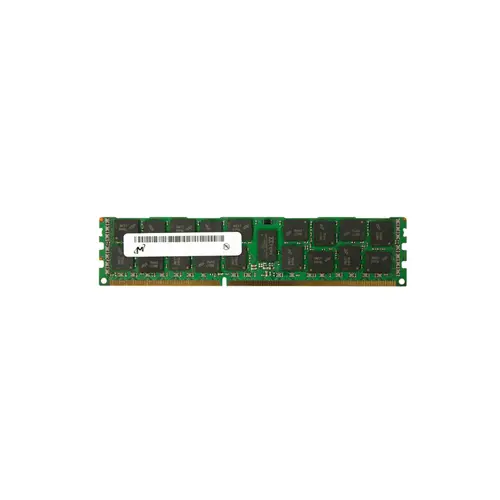
When you are running a mission-critical virtualization cluster or an in-memory database, a memory error is not just a glitch—it is a transaction rollback, a corrupted dataset, or hours of downtime. The Micron MT18KSF1G72PDZ-1G4E1 is engineered precisely for these environments. As a registered DDR3 DIMM with ECC, its 8 GB dual-rank design directly addresses your real-world reliability and performance needs. The ECC capability silently corrects single-bit flips caused by cosmic radiation or electrical noise before they cascade into application faults, which is non-negotiable for financial ledgers or database index integrity. The registered buffer stabilizes the electrical load on the memory bus, so your server can populate all 24 DIMM slots without training failures or signal degradation—vital when scaling a VMware farm to hundreds of virtual machines. Meanwhile, the dual-rank organization interleaves memory banks to deliver superior sustained bandwidth under heavy queue depths, cutting latency on Redis queries. Operating at 1.35V low-voltage standard, it also lowers your aggregate thermal profile in dense 1U chassis, reducing cooling costs while maintaining the 1866 MT/s speed that keeps your SAP HANA instance responsive. This module is not just a spec sheet; it is your insurance for consistent uptime and predictable performance.
General Virtualization
For a general virtualization host, populate at least four 8 GB registered DIMMs per CPU to enable multi-channel memory interleaving and reach a 32 GB baseline. Scale to six or eight identical modules per processor (48–64 GB) to comfortably host a dozen lightweight VMs. Always install modules in matched sets across memory channels to balance load and avoid NUMA bottlenecks.
In-Memory Database
In-memory databases demand capacity and fault tolerance. Fully populate all memory channels with these 8 GB ECC RDIMMs—on a dual-socket server with 12 slots per CPU that yields 96 GB per node minimum. Use identical, dual-rank DIMMs in every channel to maximize capacity while maintaining error correction coverage; for larger datasets, replace 8 GB sticks with higher-density modules but keep the same registered ECC architecture.
High-Performance Computing (HPC)
HPC workloads are bandwidth-sensitive. Equip each CPU with one 8 GB dual-rank DIMM per channel (e.g., 6 or 8 modules per socket) to saturate the memory bus and achieve peak throughput. Dual-rank registered modules deliver superior bandwidth over single-rank alternatives at the same capacity. When scaling out a cluster, maintain identical DIMM configurations across nodes to guarantee predictable MPI performance and minimize job-completion time.
Rigorously tested server DDR3 RDIMM – compatible with Dell R720, HP DL380p Gen8, Lenovo RD630.
Q: Can I mix this MT18KSF1G72PDZ-1G4E1 with other memory modules of different brands or speeds?
A: Mixing brands or speeds can cause instability, especially with Registered ECC modules. We strongly recommend using identical part numbers to maintain signal integrity and avoid system errors.
Q: Is this memory compatible with my Intel Xeon E5 or AMD Opteron 6300 series server platform?
A: Yes, it is compatible with platforms supporting DDR3L 1.35V Registered DIMMs. It operates at DDR3-1333 (PC3-10600) and can also run at 1866MHz if the memory controller allows, suiting many Intel and AMD servers.
Q: What is the recommended DIMM population order for optimal performance with this dual-rank module?
A: Follow your server manual's population order, typically filling identical DIMMs per channel starting with the first slot. For dual-rank RDIMMs, populate one DIMM per channel first, then add the second for balanced memory bandwidth.
Q: Does this module support overclocking or XMP profiles?
A: No. This is a JEDEC-compliant server module. It does not support overclocking or XMP profiles, as enterprise memory prioritizes reliability and stability over adjustable performance settings.
Q: What warranty and typical failure rate can I expect with this server memory?
A: It includes a 1-year warranty. As an enterprise-grade module with ECC and Registered design, the typical annual failure rate is very low, generally below 0.5% under standard operating conditions.