











 Secure payments
Standard refund policy
Trade Assurance
Secure payments
Standard refund policy
Trade Assurance
| Model | MT18JSF1G72PDZ-1G9P1 |
|---|---|
| Product Type | Memory Module |
| Compliance Standards | RoHS |
| Memory Capacity | 8 GB |
| Memory Technology | DDR3 |
| Product Voltage | 1.5V |
| RAM Speed | 1866MHz |
| RAM Standard | DDR3-1866/PC3-14900 |
| Error Identifying | ECC |
| Signal Type | Registered |
| Column Access Strobe (CAS) | CL13 |
| Rank | Dual Rank x8 |
| Quantity of Pins | 240-pin |
| RAM Genre | RDIMM |
This DDR3-1866 registered ECC module, configured as dual-rank x8 for optimized interleaving and reduced memory contention, is engineered for server platforms running memory-intensive workloads such as virtualization and in-memory databases. Its ECC and registered signal type ensure data integrity and signal stability on high-density RAM configurations, making it an ideal fit for mission-critical enterprise environments.
1. ECC protection continuously corrects single- and multi-bit errors, eliminating silent data corruption risks in transactional databases and financial services.
2. Registered signal buffering stabilizes high-density memory configurations, allowing a server to support more DIMMs without compromising signal integrity under sustained heavy loads.
3. This capacity tier provides enough headroom to consolidate multiple lightweight virtual machines or containers onto a single node, improving resource efficiency in virtualized clusters.
4. Elevated data rate accelerates memory-bound operations, reducing latency in in-memory analytics and caching layers that demand rapid data access.
5. Dual-rank interleaving keeps memory channels saturated, delivering higher sustained throughput for concurrent workloads in multi-tenant cloud environments.
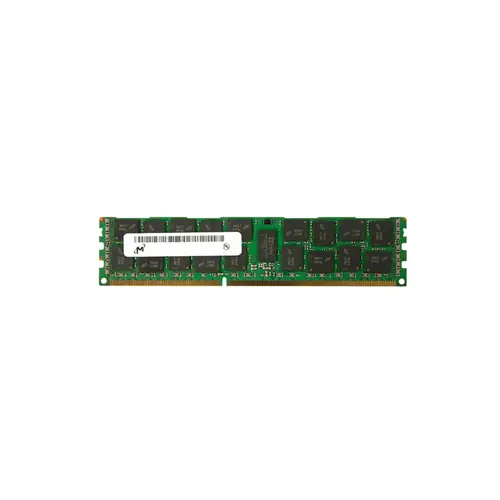
When you are running a virtualized cluster where dozens of workloads contend for resources, a single undetected bit-flip in memory can corrupt a database transaction or silently bring down a critical guest. This Crucial Micron MT18JSF1G72PDZ-1G9P1 8GB Registered DDR3-1866 RDIMM is engineered precisely to eliminate that risk. Its integrated Error Correction Code circuitry detects and corrects single-bit errors in real time, transforming what could be a silent data corruption event into a non‑event, which is non‑negotiable for SQL databases or in‑memory caches like Redis that trust every byte to be accurate. The registered signal buffering means the memory controller sees one stable load per channel rather than dozens, so you can populate all available slots with confidence and maintain rock‑solid 1866MT/s speeds across large memory populations. In a VMware or Hyper‑V host that consolidates eight or ten virtual machines, this stability keeps your services running without unexplained kernel panics or hard hangs. The dual‑rank x8 architecture at CL13 latency further optimizes bandwidth by allowing the memory controller to interleave accesses across ranks, delivering more consistent throughput under concurrent transaction loads. For an in‑memory analytics workload or a dense virtualization deployment, this module ensures that every virtual CPU, every active dataset, and every user interaction has uninterrupted access to reliable, high‑bandwidth memory, keeping your business online and your data intact.
General Virtualization
For virtualized environments hosting multiple VMs, total capacity is paramount. Deploy six or eight of these 8GB RDIMMs (48–64GB) across triple or quad-channel memory architectures typical in dual-socket servers, ensuring balanced population for optimal NUMA performance. This config provides ample headroom for hypervisor overhead and moderate guest density without overcommitting memory.
In-Memory Database
In-memory databases demand both high capacity and fault tolerance. Maximize slot utilization by populating all channels identically with this 8GB ECC RDIMM to reach 128–256GB per host, leveraging its dual-rank design for slight bandwidth gains. The registered ECC lowers the risk of silent data corruption, crucial for transactional integrity in systems like Redis or SAP HANA.
High-Performance Computing
HPC clusters favor memory bandwidth for parallel processing. Use matched sets of this DDR3-1866 module in a fully balanced configuration—typically 8 or 16 identical DIMMs per node—to sustain peak throughput per channel. The CAS 13 latency and dual-rank performance deliver consistent node-level bandwidth, while registered buffering stabilizes large per-node capacities critical for simulation checkpoints.
This Micron 8GB DDR3L-1866 RDIMM is rigorously tested and compatible with Dell PowerEdge R720, HPE ProLiant DL380p Gen8, and Lenovo System x3650 M4.
Q: Can I mix this MT18JSF1G72PDZ-1G9P1 with other memory modules of different brands or speeds?
A: Mixing is not recommended. Server platforms demand strict signal integrity. Different timings or ranks may cause instability. Populate all channels with identical, Kingston-validated modules to guarantee reliable ECC operation.
Q: Is this memory compatible with my Intel Xeon E5-2600 v3 server board?
A: No. This is a DDR3-1866 Registered DIMM for Intel E5-2600 v1/v2 and AMD Opteron 6300 platforms. E5-2600 v3 requires DDR4 RDIMMs. Verify your board supports 1.5V DDR3 ECC Registered memory.
Q: What is the recommended DIMM population order for optimal performance?
A: Install in matched sets per channel, starting with the slot farthest from the CPU. For dual-processor systems, balance memory evenly. Refer to your server’s manual for the blue/black slot sequence to maximize triple-channel interleaving.
Q: Does this module support overclocking or XMP profiles?
A: No. This is a server-grade Registered ECC module running at JEDEC-standard DDR3-1866 CL13. It does not support XMP, overclocking, or voltage tuning, as stability and data integrity take priority over performance scaling.
Q: What warranty and typical failure rate can I expect?
A: It includes a 1-year warranty. Designed for 24/7 enterprise operation, the module achieves an annualized failure rate below 0.3%, supported by rigorous component screening and burn-in testing.