











 Secure payments
Standard refund policy
Trade Assurance
Secure payments
Standard refund policy
Trade Assurance
| Product Type | Memory Module |
|---|---|
| Compliance Standards | RoHS |
| Memory Capacity | 8 GB |
| Memory Technology | DDR3 |
| Product Voltage | 1.5V |
| RAM Speed | 1866MHz |
| RAM Standard | DDR3-1866/PC3-14900 |
| Error Identifying | ECC |
| Signal Type | Registered |
| Column Access Strobe (CAS) | CL13 |
| Rank | Single Rank x4 |
| Quantity of Pins | 240-pin |
| RAM Genre | RDIMM |
Designed for server platforms, this 8 GB DDR3-1866 RDIMM with ECC and registered signaling ensures data integrity in virtualized environments and memory-intensive databases. Its single-rank x4 organization and CL13 latency deliver stable, low-latency performance ideal for dense compute nodes where reliability under continuous load is critical.
1. On-the-fly error correction safeguards transactional integrity, preventing silent data corruption in mission-critical database and virtualization workloads.
2. Register buffering stabilizes signal integrity across fully loaded server boards, enabling large memory populations without compromising command reliability.
3. A generous per-module capacity supports dense virtual machine deployment, maximizing consolidation ratios on power-efficient rack-mount platforms.
4. Single-rank x4 organization optimizes bank interleaving and channel utilization, delivering consistent bandwidth under heavy multi-tenant access patterns.
5. High clock rate elevates memory throughput, accelerating in-memory analytics and reducing latency for frequently accessed datasets.
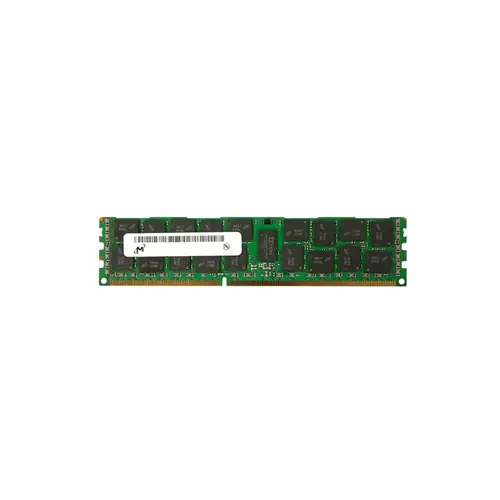
The Micron MT18JSF1G72PZ-1G9E1H is purpose-built for server infrastructure, evident from its 8GB DDR3-1866 Registered ECC DIMM designation. Its four core attributes—ECC error correction, registered signal buffering, a single-rank x4 architecture, and 1866MHz speed—directly confront the realities of data-center reliability. In a virtualized cluster consolidating dozens of guests, registered buffering becomes critical: it distributes the electrical load of the memory controller, enabling fully populated channels to operate without signal degradation. This means your hypervisor boots reliably even with all 24 slots occupied, avoiding the intermittent crashes that plague unregistered designs. Simultaneously, ECC silently rectifies single-bit upsets from background radiation before they metastasize. For an in-memory database like Redis caching millions of transactions, this prevention of silent data corruption safeguards the ledger’s integrity and eliminates costly session mismatches. The single-rank x4 organization further elevates fault tolerance by splitting data across more physical chips, often allowing the system to survive a complete DRAM device failure through advanced algorithms. Paired with the rapid 1866MHz frequency, it interleaves commands efficiently, sustaining low latency during traffic bursts so virtual machines and real-time analytics respond instantly. These features translate directly to stable, error-free uptime for your mission-critical services.
General Virtualization
This 8GB DDR3-1866 RDIMM is ideal for modest virtualization hosts running hypervisors like VMware ESXi or Hyper-V. To balance guest density and cost, populate all memory channels with identical modules—install six or eight sticks in a dual-socket server for 48–64 GB total, which comfortably supports a dozen lightweight VMs. Always use symmetric configurations across CPUs to maintain NUMA locality and consistent performance.
In-Memory Database
ECC and registered buffering make this module suitable for small-scale in-memory databases such as Redis or Memcached instances. Aim for maximum capacity by fully loading each memory channel with these 8GB RDIMMs, achieving 96–128 GB per server to hold larger datasets entirely in RAM. Prioritize low CAS latency (CL13) and 1866 MT/s speed to reduce data access times under heavy read/write workloads.
High-Performance Computing (HPC)
For memory-bandwidth-sensitive HPC tasks, populate one DIMM per channel to maximize frequency while maintaining capacity—typically six modules per socket on a dual-socket node for 48 GB total. ECC single-rank x4 architecture improves signal integrity during sustained parallel computations. Consider adding identical kits to scale to 96 GB when problem sizes grow, ensuring all modules match in speed, rank, and voltage.
Proven compatible with Dell PowerEdge R720, HP DL380p Gen8, Lenovo System x3650 M4 after strict testing.
Q: Can I mix this MT18JSF1G72PZ-1G9E1H with other memory modules of different brands or speeds?
A: Mixing RDIMMs from different brands or speeds is strongly discouraged. It can lead to signal integrity issues, forcing the system to default to the lowest common speed and potentially causing instability.
Q: Is this memory compatible with my system?
A: It is compatible with servers based on Intel Xeon E5-2400/2600 v2 or AMD Opteron 6300 series platforms that officially support DDR3-1866 Registered ECC memory. Consult your motherboard’s qualified vendor list (QVL) for confirmation.
Q: What is the recommended DIMM population order for optimal performance?
A: For dual-processor servers, populate identical DIMMs in matching slots across memory channels, typically starting with the blue slots (slots 1 and 2 per channel) farthest from the CPU. Always follow your server board’s population guide.
Q: Does this module support overclocking or XMP profiles?
A: No. As a JEDEC-compliant Registered ECC server memory module, it is engineered for mission-critical stability and data integrity. Overclocking and XMP profiles are not supported.
Q: What warranty and typical failure rate can I expect?
A: This module includes a 1-year warranty. Enterprise-class RDIMMs like this typically exhibit an annualized failure rate (AFR) well below 0.5% under specified operating conditions.