











 Secure payments
Standard refund policy
Trade Assurance
Secure payments
Standard refund policy
Trade Assurance
| Product Type | Memory Module |
|---|---|
| Compliance Standards | RoHS |
| Memory Capacity | 8 GB |
| Memory Technology | DDR3 |
| Product Voltage | 1.5V |
| RAM Speed | 1866MHz |
| RAM Standard | DDR3-1866/PC3-14900 |
| Error Identifying | ECC |
| Signal Type | Registered |
| Column Access Strobe (CAS) | CL13 |
| Rank | Single Rank x4 |
| Quantity of Pins | 240-pin |
| RAM Genre | RDIMM |
This 8GB DDR3-1866 Registered ECC module is purpose-built for legacy server and virtualization platforms where data integrity and stability under sustained loads—such as in-memory databases or multi-tenant hypervisors—are critical. Its single-rank x4 organization combined with CL13 latency and registered buffering reduces electrical loading on the memory bus, enabling reliable multi-DIMM operation and stronger signal integrity in dense server deployments.
1. A density of 8GB per module provides sufficient headroom to run multiple virtual machines and memory-hungry enterprise applications on a single host without immediate scale-out.
2. ECC protection silently corrects single-bit errors in real time, guarding long-running server workloads against data corruption and preventing costly unplanned downtime.
3. The registered signal type buffers command and address lines, preserving signal integrity so the platform can stably populate all memory channels at full capacity.
4. Single Rank x4 organization reduces electrical loading per channel, enabling higher DIMM-per-channel counts and maximizing total memory footprint in dense virtualization clusters.
5. The 1866MHz clock speed raises peak memory bandwidth, accelerating database queries and in-memory analytics where large data sets must flow to the processor with minimal latency.
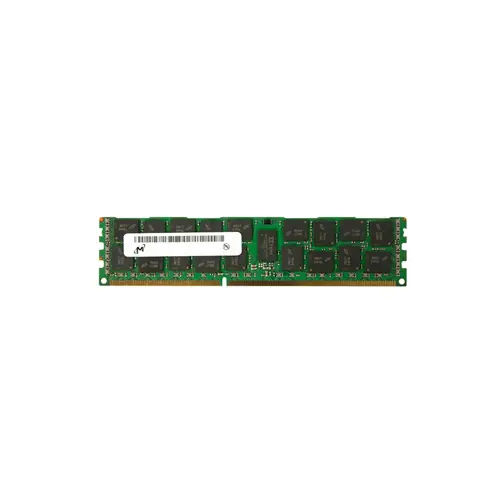
For mission-critical servers, the Micron MT18JSF1G72PZ-1G9E1HE 8GB DDR3-1866 RDIMM converts four essential specifications into real-world resilience. Its ECC technology continuously corrects single-bit errors caused by background radiation or electrical noise; in a dense virtualization cluster hosting dozens of VMs, an undetected bit flip can silently corrupt financial databases or crash a hypervisor, making ECC non-negotiable for data integrity. The registered buffer isolates the memory controller from heavy electrical loads, enabling stable population of all available DIMM slots without signal degradation. This becomes critical when running large in-memory databases such as SAP HANA or Redis, where you demand both maximum capacity and consistent 1866 MHz bandwidth to keep query response times low. Operating at a full 1866 MT/s with a CAS latency of 13 and a single-rank x4 configuration, the module delivers predictable interleaving and low-latency data access, eliminating the performance jitter that undermines transactional workloads. Every millisecond saved in that environment directly protects service-level agreements. Together, these attributes ensure your infrastructure stays reliable when absolute data accuracy and uptime are non-negotiable.
Server Memory Identification: The module is a DDR3-1866 8GB Registered ECC RDIMM (single-rank x4, 1.5V), designed exclusively for server platforms. Below is capacity planning for typical workloads.
General Virtualization
Populate all memory channels symmetrically with identical 8GB RDIMMs. In a dual-socket server with eight channels, installing two DIMMs per channel delivers 128GB and enables balanced interleaving for consistent VM performance. For higher consolidation ratios, add a third DIMM per channel to reach 192GB. Always match ranks to prevent clock-speed degradation.
In-Memory Database
Maximize capacity by filling every slot with the same 8GB module—a 24-slot system provides 192GB. The single-rank x4 organization sustains 1866MT/s reliably even at full population. ECC and registered buffering guarantee the data integrity essential for Redis, SAP HANA, and in-memory OLTP workloads.
High-Performance Computing
Balance bandwidth and capacity with a uniform DIMM layout. For peak frequency, populate one 8GB RDIMM per channel; for larger working sets, install two per channel while keeping all channels identically populated. This symmetric configuration maximizes sustained throughput under NUMA-aware MPI scheduling. ECC is mandatory to prevent silent data corruption during long-running simulations.
Rigorously tested; compatible with Dell PowerEdge R720, HPE ProLiant DL380p Gen8, and Lenovo System x3650 M4.
Q: Can I mix this MT18JSF1G72PZ-1G9E1HE with other memory modules of different brands or speeds?
A: Mixing this RDIMM with modules of different brands or speeds is not recommended. For guaranteed signal integrity, ECC function, and system stability, all channels must be populated with identical, qualified modules.
Q: Is this memory compatible with my server platform?
A: This DDR3 ECC Registered module fits servers with Intel Xeon E5-2400/2600 v1/v2 or AMD Opteron 6300 platforms, using 240-pin RDIMM slots and 1.5V support. Verify compatibility with your server's memory QVL.
Q: What is the recommended DIMM population order for optimal performance?
A: Follow your server’s population guide: install identical DIMMs in the first slot of each channel. For this single-rank x4 module, populate symmetrically to achieve full 1866MHz speed and optimal interleaving.
Q: Does this module support overclocking or XMP profiles?
A: No. This server RDIMM operates at JEDEC-standard DDR3-1866 and does not support overclocking or XMP. It prioritizes data integrity and stability over tuning, which is crucial for enterprise environments.
Q: What warranty and typical failure rate can I expect?
A: This module includes a 1-year warranty. Enterprise DDR3 RDIMMs exhibit an average annual failure rate under 0.2% in normal operating conditions, ensuring dependable reliability for 24/7 server workloads.