











 Secure payments
Standard refund policy
Trade Assurance
Secure payments
Standard refund policy
Trade Assurance
| Product Type | Memory Module |
|---|---|
| Compliance Standards | RoHS |
| Memory Capacity | 8 GB |
| Memory Technology | DDR3 |
| Product Voltage | 1.5V |
| RAM Speed | 1866MHz |
| RAM Standard | DDR3-1866/PC3-14900 |
| Error Identifying | ECC |
| Signal Type | Registered |
| Column Access Strobe (CAS) | CL13 |
| Rank | Single Rank x4 |
| Quantity of Pins | 240-pin |
| RAM Genre | RDIMM |
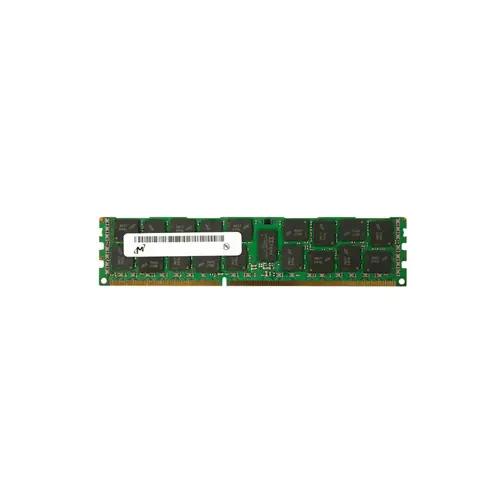
This 8GB DDR3-1866 RDIMM with ECC and registered signal buffering is engineered for legacy server platforms requiring data integrity in virtualized environments and memory-intensive database workloads. Its single-rank x4 configuration and CL13 latency provide stable electrical loading with improved signal reliability, making it well-suited for scaling capacity in dual-socket systems without compromising memory bandwidth.
1. Single-bit error correction safeguards transactional data integrity, preventing silent data corruption in always-on database servers.
2. Registered signal buffering stabilizes high-capacity memory arrays, essential for maintaining uptime in dense virtualization clusters.
3. This module density balances cost and capacity, optimally serving moderate workloads like web front-ends or small-scale hypervisor nodes.
4. High-frequency operation boosts memory bandwidth, accelerating in-memory analytics and reducing latency for concurrent request processing.
5. Single-rank architecture using x4 DRAM chips minimizes electrical load, allowing fully populated servers to sustain peak memory throughput without signal degradation.
The Micron MT18JSF1G72PZ-1G9E1HF is an 8GB DDR3-1866 RDIMM engineered specifically for servers and workstations where reliability is not just expected, it is mandatory. Its ECC technology silently detects and corrects single-bit memory errors, preventing the silent data corruption that can crash a hypervisor hosting dozens of virtual machines or introduce inaccuracies into financial transactions—an absolute necessity when uptime equals revenue.
The Registered signal buffer means you can populate all memory channels to maximum capacity without instability. In a dense virtualization cluster, this translates directly to hosting more VMs per physical host without sacrificing speed or risking boot failures that come from electrical loading on unbuffered DIMMs.
Meanwhile, the part’s Single Rank x4 organization and 1866MHz clock speed deliver balanced bandwidth. For an in-memory database like Redis or a transactional SQL engine, the fast CAS latency of CL13 keeps query response times low, while the rank architecture optimizes command scheduling, ensuring that heavy concurrent reads during peak traffic do not bottleneck. This module turns theoretical specifications into tangible operational confidence, from keeping your hyperconverged infrastructure resilient to ensuring your database replicas remain consistently accurate.
General Virtualization
Deploy a balanced set of identical 8 GB registered DIMMs across all memory channels to ensure symmetric multi-channel operation, which boosts concurrent VM performance. Starting with four modules (32 GB total) per socket provides a solid footprint for moderate consolidation; scale to eight or more modules per host when hosting memory-overcommitted workloads or larger virtualization clusters.
In-Memory Database
Populate all available DIMM slots with these 8 GB RDIMMs to maximize total capacity while preserving the 1866 MT/s speed across channels. Because in-memory databases demand the active dataset to reside in RAM, a fully-loaded 16-slot server with 128 GB or more eliminates slow storage I/O. Keep rank count per channel within platform limits—single-rank modules help maintain clock rates even with two DIMMs per channel on supported platforms.
HPC
Install at least one DIMM per memory channel to achieve peak bandwidth, which is critical for simulation and modelling codes that stream large vectors. A typical dual-socket node with four channels per socket should start with eight modules (64 GB) for excellent throughput and low latency; for capacity-sensitive HPC jobs, expand to two DIMMs per channel while accepting a slight clock drop. Always match module part numbers across sockets to avoid asymmetric NUMA penalties.
Rigorously tested for servers, compatible with Dell R720, HP DL380p Gen8, Lenovo RD430 and similar platforms.
Q: Can I mix this MT18JSF1G72PZ-1G9E1HF with other memory modules of different brands or speeds?
A: Mixing RDIMMs of different brands or speeds is not recommended. The memory controller will downclock all modules to the slowest common speed, potentially causing stability issues and invalidating platform validation.
Q: Is this memory compatible with my Intel Xeon E5-2600 v2 system?
A: Yes, this DDR3-1866 Registered ECC RDIMM is compatible with Intel Xeon E5-2600 v2 platforms using a C602 chipset. Ensure your server board supports 1.5V operating voltage and 8GB Single Rank x4 modules.
Q: What is the recommended DIMM population order for optimal performance with this module?
A: Populate identical DIMMs per memory channel starting from slot 0. For dual-processor servers, balance memory identically across both sockets and channels. Refer to your server's technical manual for exact slot numbering to maximize interleaving.
Q: Does this module support overclocking or XMP profiles?
A: No, server-class Registered ECC memory adheres strictly to JEDEC specifications for reliability. It does not support overclocking or XMP profiles, as these can undermine data integrity in mission-critical environments.
Q: What warranty and typical failure rate can I expect?
A: This module carries a 1-year warranty. Enterprise-grade Registered ECC DIMMs typically exhibit an annualized failure rate below 0.5% under proper thermal and voltage conditions, ensuring high operational reliability.