











 Secure payments
Standard refund policy
Trade Assurance
Secure payments
Standard refund policy
Trade Assurance
| Product Type | Memory Module |
|---|---|
| Compliance Standards | RoHS |
| Memory Capacity | 8 GB |
| Memory Technology | DDR3 |
| Product Voltage | 1.5V |
| RAM Speed | 1866MHz |
| RAM Standard | DDR3-1866/PC3-14900 |
| Error Identifying | ECC |
| Signal Type | Registered |
| Column Access Strobe (CAS) | CL13 |
| Rank | Single Rank x4 |
| Quantity of Pins | 240-pin |
| RAM Genre | RDIMM |
This 8GB DDR3-1866 RDIMM with ECC and registered signaling targets server platforms, where its single-rank x4 organization minimizes electrical loading to allow higher memory density at speed while reducing latency, making it well-suited for memory-intensive workloads like virtualization and in-memory databases that demand data integrity. The combination of ECC error correction and registered clock buffering ensures stable operation under sustained load, preserving critical data accuracy in multi-DIMM configurations.
1. 8 GB capacity per module supplies the memory headroom essential for consolidating multiple enterprise VMs on a single host without forcing early hardware refresh.
2. 1866 MHz transfer speed elevates memory bandwidth, keeping latency-sensitive server tasks like OLTP and in-memory caching highly responsive under peak loads.
3. ECC protection actively corrects single-bit errors and detects multi-bit faults, preserving transactional integrity in financial databases and compliance-dependent environments.
4. Registered signal buffering decouples the DRAM from the memory controller, allowing stable fully populated channels across 24/7 rack servers that demand maximum RAM scalability.
5. Single Rank x4 organization with x4-wide DRAM devices enables Single Device Data Correction, virtually eliminating downtime from chip-level failures in virtualized infrastructure.
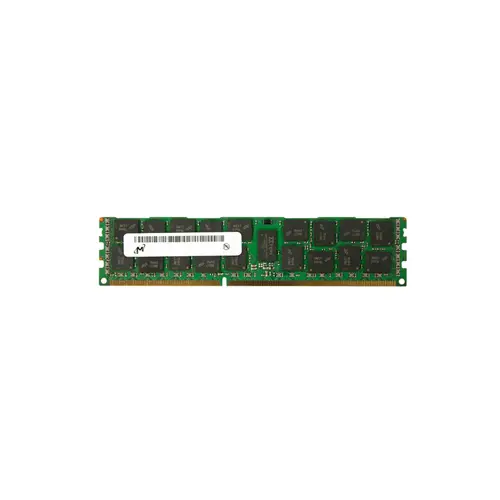
This Micron 8GB registered ECC DDR3 module confronts the realities of always-on server infrastructure where data integrity and signal stability are non-negotiable. ECC actively corrects single-bit memory errors, which is indispensable in a virtualized cluster. Without it, a cosmic particle could silently flip a bit inside a hypervisor page table, corrupting live migration processes and triggering cascading tenant outages that undermine SLA commitments. The registered signal buffering then ensures those virtualized hosts can populate all DIMM channels without electrical loading issues, delivering the high capacity density required for memory overcommit scenarios. When paired with an in-memory database like Redis or memcached, the 1866MHz frequency and CL13 latency become critical: they slash response times for sub-millisecond key lookups under heavy user loads, directly safeguarding customer-facing application performance. Its Single Rank x4 organization further sharpens that speed advantage by reducing access latency over dual-rank setups, while offering improved signal integrity in multi-socket systems. Together, these traits transform routine memory into a reliable foundation for data-critical workloads.
General Virtualization
For general virtualization hosts, populate at least one RDIMM per memory channel to maximize bandwidth. A balanced configuration using eight identical 8 GB modules (64 GB total) across two processors provides sufficient capacity for moderate VM densities, while scaling to sixteen modules (128 GB) enables deeper consolidation. Always install matched sets to preserve symmetric multi-channel operation and ECC integrity.
In-Memory Database
In-memory databases demand large, contiguous memory pools with strong error protection. Populate all available DIMM slots on each memory riser with these 8 GB registered ECC modules to reach 128 GB or more per server node. Uniform single-rank x4 DIMMs keep electrical loading low, allowing higher operating frequencies and lower latency under heavy transactional loads.
High-Performance Computing
HPC workloads benefit from both capacity and consistent memory bandwidth. Configure an identical RDIMM per channel across all memory controllers—commonly eight or twelve modules per node—to deliver 64–96 GB of balanced, high-speed DDR3-1866 memory. This arrangement avoids bandwidth bottlenecks in parallel simulations and computational fluid dynamics, while ECC guards against silent data corruption during extended job runs.
Strictly tested server memory, compatible with Dell PowerEdge R720, R620, HP DL380p Gen8, and IBM x3650 M4.
Q: Can I mix this MT18JSF1G72PZ-1G9E1K with other memory modules of different brands or speeds?
A: Mixing different brands or speeds with registered ECC RDIMM can cause instability. For reliable performance, populate channels with identical Micron modules rated at DDR3-1866 CL13.
Q: Is this memory compatible with my Intel or AMD server platform?
A: It is compatible with dual-processor Intel Xeon E5-2600 v2 and select AMD Opteron 6300 series platforms that require 240-pin DDR3-1866 registered ECC RDIMMs at 1.5V.
Q: What is the recommended DIMM population order for optimal performance?
A: Populate identical RDIMMs per channel starting with the blue slots (DIMM1). For dual-processor boards, balance capacity evenly across both CPU memory banks to maximize interleaving.
Q: Does this module support overclocking or XMP profiles?
A: No. As an enterprise ECC registered DIMM, it strictly adheres to JEDEC DDR3-1866 standards. XMP and overclocking are not supported to ensure signal integrity and data protection.
Q: What warranty and typical failure rate can I expect?
A: This Micron module has a 1-year warranty. With an AFR below 0.5%, enterprise RDIMMs demonstrate high reliability compared to consumer memory under 24/7 workloads.